Last updated: May 2026
Every tool promises the best results. Most comparisons are either outdated, sponsored, or skip the context that actually matters, which is your use case.
This guide cuts through it. We tested every major AI image generator in 2026, pulled data from real benchmarks, and ranked them honestly: for ecommerce and product photography, for general creative work, and for teams that need commercial-safe output at scale.
Quick answer: There is no single best AI image generator for everyone. The right tool depends on what you are making, how often, and what you can spend. If you run an ecommerce brand and need product images that stay accurate and convert, Shhots AI is the tool built for that job. If you want artistic or campaign imagery, Midjourney v7 sets the quality ceiling. We break down the clear winners by use case below.
What Is an AI Image Generator?
An AI image generator is a tool that turns text descriptions, called prompts, into images using machine learning. You describe what you want, and the model generates a visual output in seconds.
The underlying technology varies. Most popular tools use diffusion models, which start from random noise and iteratively refine it into a coherent image guided by your text. Some newer models, like GPT Image 2, use autoregressive approaches that process images more like language.
In 2026, these tools have moved well past novelty. Marketing teams use them for campaign assets. DTC brands use them for product photography. Game studios use them for concept art. And solo creators use them for content they previously could not afford to produce.
The output gap between the best and worst models has widened significantly this year, which makes choosing correctly more important than ever.
How We Evaluated These Tools
We tested each tool across four prompt categories:
- Photorealism: can it pass for a real photograph?
- Prompt fidelity: does the output match what you asked for?
- Commercial usability: is the output ready for ads, product pages, and social content?
- Ease of use: how fast can a non-designer produce usable results?
We also factored in pricing, free tier availability, licensing terms, and workflow integration.
Best for Ecommerce and Product Photography: Shhots AI
Best for: DTC founders, Shopify merchants, anyone who needs product images that look like their actual product
General-purpose AI image generators, including Midjourney and GPT Image 2, are built for creative exploration. They produce beautiful images, but they struggle with the specific demands of ecommerce:
- Product accuracy. The output needs to look like your product, not a generic version of it.
- Catalog consistency. Fifty product images need to feel cohesive, not stylistically random.
- Turnaround speed. Teams running Shopify stores need dozens of images, not one at a time.
- Commercial clearance. Every image needs to be ready for ads, listings, and social.
This is the gap Shhots AI was built to fill.
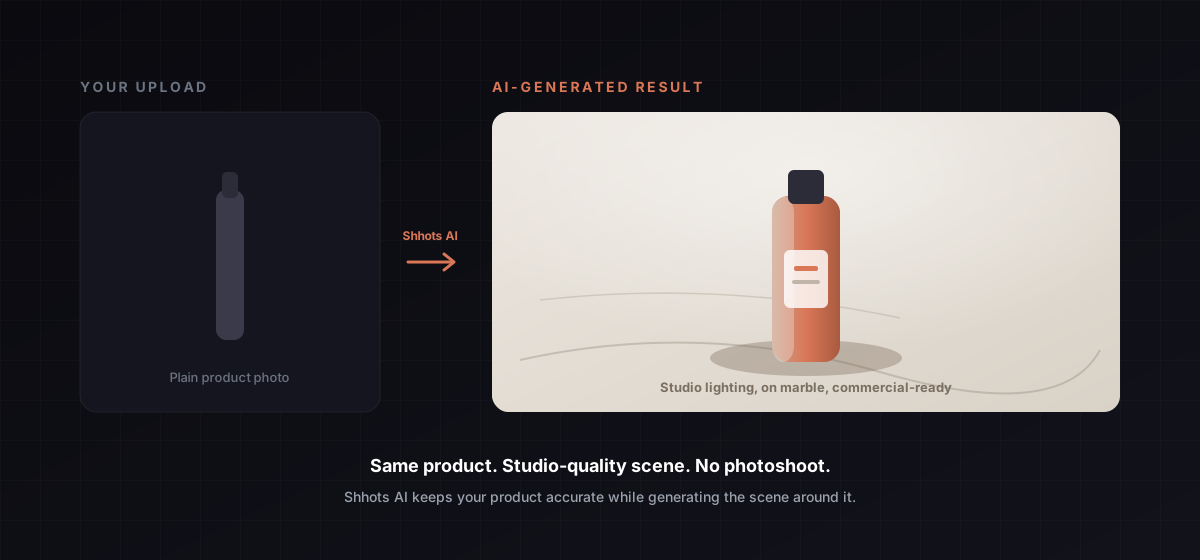
Shhots AI is purpose-built for DTC brands and Shopify merchants who need professional product photography, and product videos, without the cost or lead time of a traditional photoshoot. Upload your product image, describe the scene, and get commercial-quality output in seconds.
Where Midjourney generates an interpretation of your prompt, Shhots AI keeps your product accurate across every output. That is what makes it viable for real product pages and paid ad campaigns, not just inspiration boards.
What makes Shhots AI different:
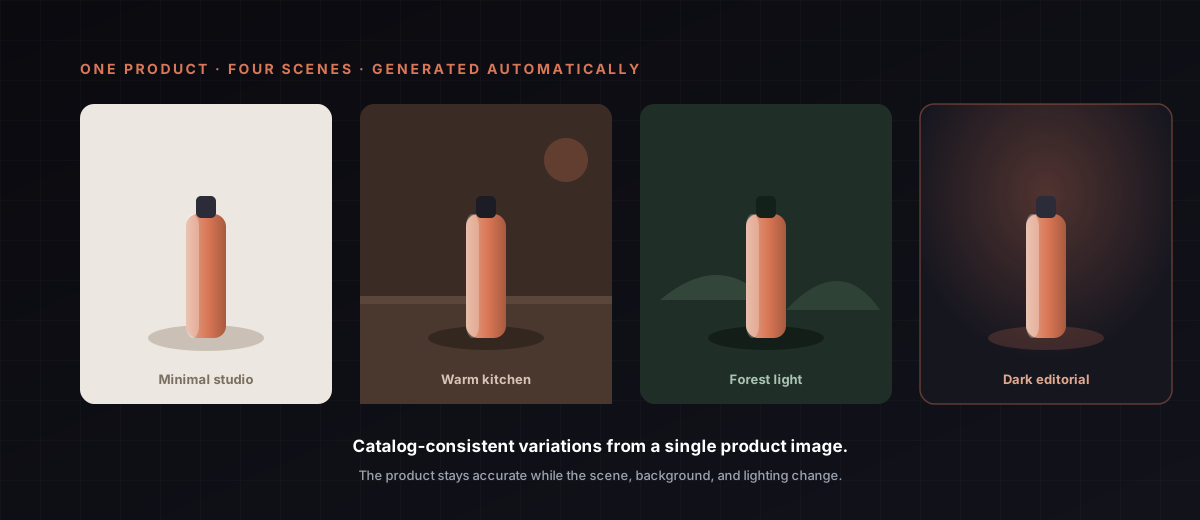
- Product-consistent output across scenes and variations
- Built-in AI video generation (turn a product image into motion)
- Designed for non-designers, with no prompt engineering required
- Pricing built for DTC economics, not enterprise budgets
If you are a Shopify brand spending money on photography or running ads that need fresh visuals every week, try Shhots AI free.
See also: AI product photoshoots case study for a D2C brand and AI image to video generators for ecommerce.
Best Overall for Creative Work: Midjourney v7
Best for: Designers, artists, brand campaign work, editorial content
Midjourney remains the quality benchmark for artistic and commercial image generation. Version 7, released in early 2026, added significant photorealism improvements, better text rendering, and stronger prompt adherence without losing the distinctive aesthetic intelligence that made it popular.
What sets Midjourney apart is how it interprets mood and composition. Ask for “a product on a marble surface with dramatic side lighting” and it does not just execute the instruction. It makes creative decisions that elevate the image.
What it is best at:
- Cinematic, atmospheric imagery
- Brand campaign concepts and hero shots
- Stylized creative work where aesthetic quality matters most
What it is not great for:
- Text embedded in images (GPT Image 2 is better here)
- Consistent product photography at scale (the output drifts)
- Free access, since there is no free tier as of 2026
Pricing: Starts at $10 per month (Basic, roughly 200 fast generations). The $30 per month Standard plan is the practical sweet spot for regular use.
Note on free access: Midjourney removed its free trial permanently in late 2024. If you need free AI image generation, see the free options section below.
External link: Midjourney pricing details.
Best for Prompt Accuracy: GPT Image 2 (DALL-E successor)
Best for: Beginners, marketers needing text-in-image, conversational iteration
OpenAI’s GPT Image 2 is the strongest upgrade to this lineup in 2026. Where DALL-E 3 was already the best model for prompt fidelity and text rendering, GPT Image 2 closes the quality gap with Midjourney on photorealism while keeping that accuracy advantage.
The biggest practical benefit is the conversational workflow via ChatGPT. You can describe what you want, see the result, and refine it through natural back-and-forth, with no need to learn complex prompt syntax.
The downside: GPT Image 2 generates one image at a time and is slower than diffusion-based models. For high-volume workflows, that matters.
What it is best at:
- Images that include readable text (stats, callouts, social graphics)
- Beginner-friendly usage with no learning curve
- Accurate representation of complex multi-element prompts
Pricing: Included with ChatGPT Plus at $20 per month. API access is priced per image.
External link: OpenAI image generation.
Best Free AI Image Generator in 2026
“What is the best free AI image generator?” is one of the most searched questions in this category, and the honest answer has changed in 2026.
Ideogram, best overall free option
Ideogram offers a genuinely usable free tier: up to 10 free slow-mode images per day, with commercial usage rights included. It is particularly strong for images with text overlays, and quality on photorealistic prompts has improved significantly in recent updates.
For creators who need occasional free image generation without watermarks, Ideogram is the most practical starting point.
Adobe Firefly, best free option for commercial use
Adobe Firefly’s free tier includes 25 generative credits per month, which is enough for basic experimentation. The reason it appears on the free list is not volume, it is safety. Firefly is trained exclusively on licensed content, so everything you generate is clear for commercial use, even on the free plan.
Google Gemini (Imagen 3), best free photorealistic option
Google’s Imagen 3 model, available through the Gemini interface with a free Google account, delivers strong photorealistic outputs. For creators who need realistic imagery without spending anything, this is the most capable free option in 2026.
Stable Diffusion, free to run yourself
Stable Diffusion is open-source and free to self-host if you have a capable GPU (16GB or more of VRAM recommended). The quality on SDXL and newer Flux-based models is competitive with paid tools. If you have the hardware and do not mind setup time, this is the best value in the category.
Summary of free options:
| Tool | Free Tier | Commercial Rights | Best For |
|---|---|---|---|
| Ideogram | 10 images per day | Yes | Text-in-image, general use |
| Adobe Firefly | 25 credits per month | Yes | Commercial-safe generation |
| Google Gemini | Free with account | Check ToS | Photorealistic images |
| Stable Diffusion | Free (self-host) | Yes | Unlimited volume on own GPU |
| GPT Image 2 | Limited (ChatGPT free) | Check usage | Prompt-accurate images |
Best for Developers: Flux 1.1 Pro
Best for: API-driven workflows, custom pipelines, developer teams building image generation into products
Flux 1.1 Pro from Black Forest Labs is the strongest open-weights model for developers in 2026. It delivers image quality competitive with Midjourney at a fraction of the API cost, as low as roughly $0.003 to $0.05 per image depending on the provider, and it handles fine-tuning for custom styles better than any other accessible model.
If you are building image generation into a product or need volume output without a subscription cap, Flux is the architecture to start with.
Pricing: Via API (fal.ai, Replicate, or direct), pay per image.
External link: Flux model documentation.
Best Open-Source Option: Stable Diffusion
Stable Diffusion remains the default choice for anyone who wants full control, complete privacy, and zero per-image cost. Running locally, it generates images at the marginal cost of electricity once you have the hardware.
The SDXL base and the newer Flux-based models bring quality into range of the paid competitors. The tradeoff is setup time. Running Stable Diffusion well requires a capable GPU, some technical comfort, and patience with model weights and fine-tuning.
For high-volume, experimental, or privacy-sensitive workflows where you can handle the setup, no tool offers better economics.
Pricing: Free (open source). GPU hardware and cloud compute costs apply.
External link: Stable Diffusion on GitHub.
Best for Commercial Safety: Adobe Firefly
Best for: Corporate design teams, regulated industries, agencies needing bulletproof IP clearance
Adobe Firefly is trained exclusively on licensed content and Adobe Stock, which makes it the only major AI image generator where the commercial rights story is straightforward. Every output comes with Content Credentials, documenting what AI was used in production.
The tradeoff is creative range. The licensed training dataset limits Firefly’s ability to produce highly stylized, avant-garde, or culturally specific work. Quality is strong but not at Midjourney’s level for artistic output.
For teams at companies where a legal challenge to AI-generated imagery would be costly, such as financial services, healthcare, and global ad agencies, Firefly is the defensible choice.
Pricing: Free tier (25 credits per month). Included with Creative Cloud subscriptions. Standalone Firefly plan at $9.99 per month.
External link: Adobe Firefly.
Quick Comparison Table
| Tool | Best For | Free Tier | Quality | Starting Price |
|---|---|---|---|---|
| Shhots AI | Ecommerce, product photos | Yes | ★★★★★ | See pricing |
| Midjourney v7 | Artistic and campaign work | No | ★★★★★ | $10/mo |
| GPT Image 2 | Prompt accuracy, text-in-image | Limited | ★★★★☆ | $20/mo (ChatGPT Plus) |
| Adobe Firefly | Commercial safety | 25 credits/mo | ★★★★☆ | Free / $9.99/mo |
| Ideogram | Free use plus text | 10 imgs/day | ★★★★☆ | Free |
| Stable Diffusion | Developers, high volume | Yes (self-host) | ★★★★☆ | Free |
| Flux 1.1 Pro | Developers, API pipelines | No | ★★★★★ | ~$0.003/image |
| Google Gemini (Imagen 3) | Photorealism, free access | Yes | ★★★★☆ | Free |
What Is the Most Realistic AI Image Generator?
Photorealism has improved across every major model in 2026, but the tools that consistently produce images indistinguishable from real photography are:
GPT Image 2 (OpenAI). Handles commercial photography prompts with exceptional accuracy. “Luxury skincare bottle on beige marble with soft studio lighting” produces images that look close to professional commercial photography, not AI art.
Google Imagen 3 (via Gemini). Strongest detail rendering and sharpness in the free tier. Particularly strong on natural scenes and product lifestyle imagery.
Midjourney v7. Best overall cinematic and atmospheric realism. The gap to real photography is smallest here for scene-based imagery, though it can still produce visual flourishes that read as AI-generated on close inspection.
Flux 1.1 Pro. Best photorealism among API-accessible open models.
For product photography specifically, where the image must look like a real photo of a real product, general-purpose models still struggle with product accuracy. That is where purpose-built tools like Shhots AI perform significantly better.
How to Choose the Right AI Image Generator
You run a Shopify brand and need product photography: Shhots AI. General-purpose tools were not built for catalog-consistent, commercially usable product imagery. Shhots AI is.
You are a designer or creative professional: Start with Midjourney. The quality ceiling is highest and the aesthetic intelligence is unmatched. Budget for the Standard plan at $30 per month.
You are a marketer needing social content with text: Use GPT Image 2 via ChatGPT Plus. The conversational workflow and text rendering accuracy are unmatched.
You need commercial-safe output for a large company: Adobe Firefly only. The IP story is clean, and everything else introduces risk.
You are building image generation into a product: Flux 1.1 Pro via API. Best quality-to-cost ratio, strong fine-tuning support.
You need free image generation: Ideogram for general use, Google Gemini for photorealism. Both have usable free tiers with commercial rights.
You want full control and do not mind setup: Stable Diffusion. Free, powerful, and runs locally once configured.
FAQs
What is the best AI image generator in 2026?
There is no single best tool, because the right choice depends on your use case. For ecommerce product photography, purpose-built tools like Shhots AI significantly outperform general-purpose generators on product accuracy and catalog consistency. Midjourney v7 produces the highest quality artistic imagery, and GPT Image 2 handles complex prompts most accurately.
What is the best free AI image generator?
Ideogram offers the most practical free tier: 10 images per day with commercial usage rights and no watermarks. Google Gemini (Imagen 3) is the strongest for free photorealistic generation. Adobe Firefly’s free tier (25 credits per month) is best if commercial clearance is your priority.
What is the most realistic AI image generator?
GPT Image 2 and Google Imagen 3 currently produce the most photorealistic outputs from general-purpose models. For product photography, Shhots AI generates commercial-quality product images that maintain product accuracy across scenes, which general models struggle with.
Is there a free AI image generator with no watermark?
Yes. Ideogram’s free tier produces watermark-free images with commercial rights. Google Gemini’s free access also generates watermark-free output. Adobe Firefly’s free tier is watermark-free as well.
Can I use AI-generated images commercially?
It depends on the tool and plan. Midjourney paid plans grant commercial rights. Adobe Firefly is specifically designed for commercial use and includes Content Credentials. GPT Image 2 via ChatGPT Plus allows commercial use under OpenAI’s terms. Always check the specific terms for the tool and plan you are using. Shhots AI generates commercially usable product images by default.
What is a good AI image generator for beginners?
GPT Image 2 via ChatGPT is the most beginner-friendly, because the conversational interface requires no prompt engineering knowledge. Ideogram is also highly accessible and has a generous free tier.
How much does an AI image generator cost?
Free options include Ideogram (10 per day), Google Gemini, Adobe Firefly (25 credits per month), and Stable Diffusion (self-hosted). Paid tools start at $10 per month (Midjourney Basic), $20 per month (ChatGPT Plus with GPT Image 2), and $9.99 per month (Adobe Firefly standalone). For ecommerce product photography, Shhots AI offers pricing that works for DTC economics.
What is the difference between AI image generators and AI product photography tools?
General AI image generators (Midjourney, GPT Image 2, and others) create images from text prompts, which is powerful for creative work, but they generate a version of your product concept rather than your actual product. AI product photography tools like Shhots AI take your existing product image and place it into generated scenes, backgrounds, and lighting setups, preserving the product’s look while creating infinite visual variations. For ecommerce brands, this distinction matters enormously.
The Bottom Line
The AI image generation landscape in 2026 has a clear structure. For ecommerce brands and DTC founders, the category worth your attention is purpose-built product photography AI that keeps your product accurate, your output commercially usable, and your production costs low enough to justify daily use. That is exactly what Shhots AI was built for.
For general creative work, Midjourney and GPT Image 2 set the quality standard. Firefly owns commercial safety. Stable Diffusion and Flux serve developers and high-volume pipelines. Free options have improved enough that casual creators no longer need to pay.
Generate your first AI product photo free.
Related reads: