Disclosure: Shhots AI is our product.
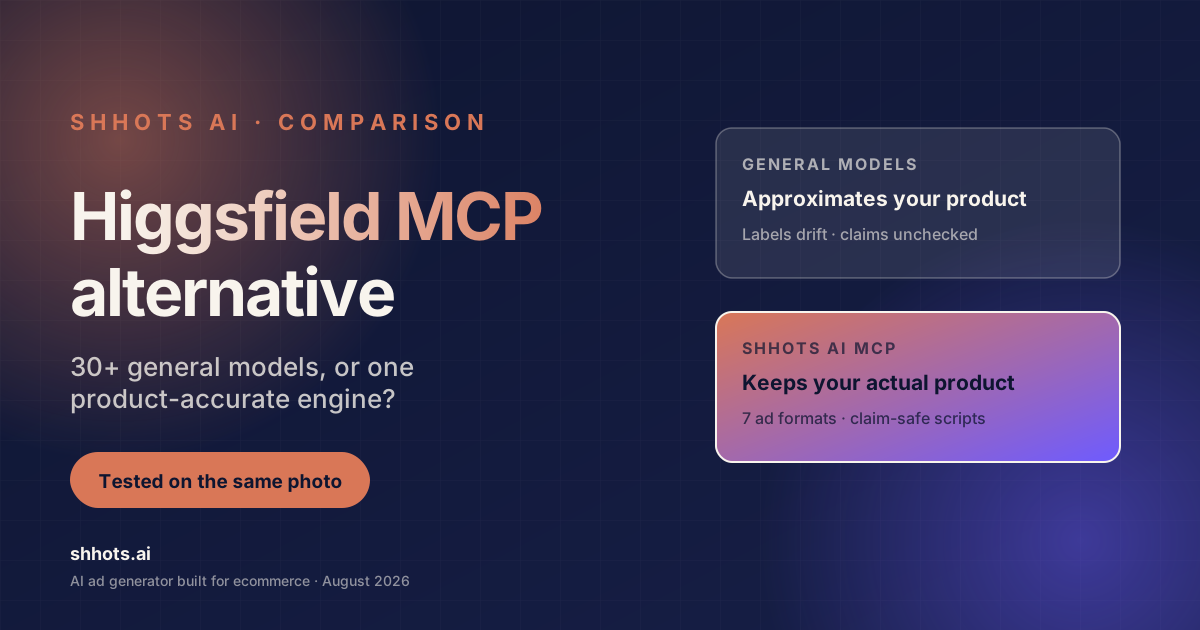
The best Higgsfield MCP alternative for product ads is Shhots AI MCP, and the reason comes down to one question: does the product in your ad need to be your actual product? Higgsfield’s MCP gives Claude access to 30-plus general image and video models. Shhots gives Claude one specialized capability, compositing AI actors and scenes around a real physical product, preserved accurately from a single photo. This comparison covers where each wins, what they cost, and how to decide in under a minute.
Both tools connect to Claude the same way, through an MCP connector with OAuth sign-in. Higgsfield generates video up to 15 seconds; Shhots goes to 30. The difference is what they were built for.
Table of Contents
- The short answer
- What Higgsfield MCP does well
- Where product ads break
- Shhots AI MCP as the Higgsfield MCP alternative
- What product-accurate output looks like
- Feature comparison table
- Pricing comparison
- Run the test yourself
- Which one should you pick?
- FAQ
The short answer
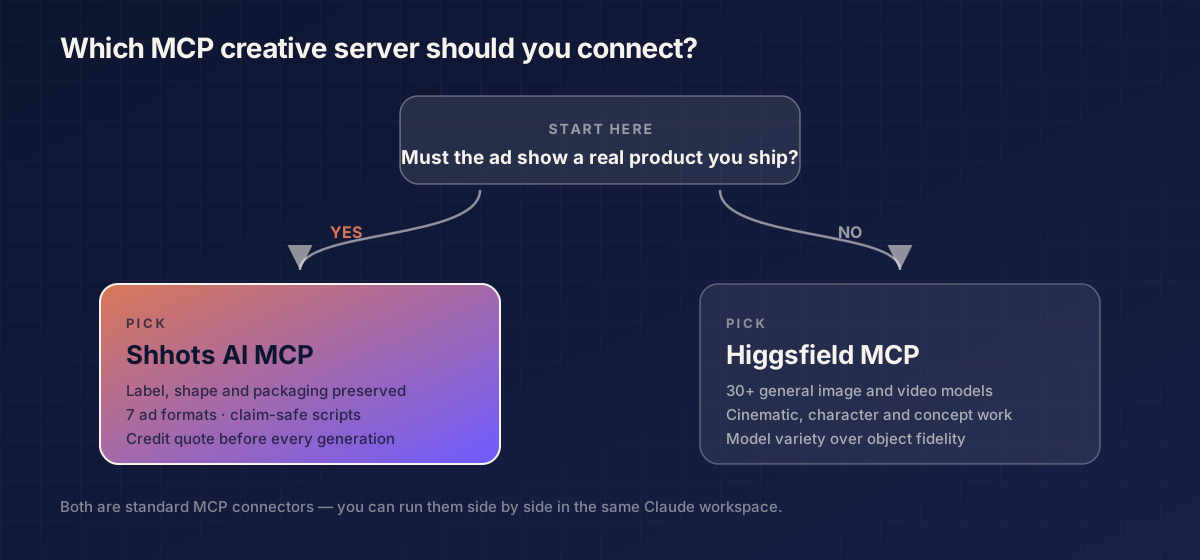
Pick by job:
- Cinematic footage, character work, concept art, music-video visuals, general creative exploration: Higgsfield MCP. Model breadth is the product, and it is genuinely impressive.
- Ads for a physical product you sell, where the label, shape, and packaging must match reality: Shhots AI MCP. Product accuracy is the product.
If you run a Shopify or DTC brand and the asset’s job is to sell an item customers will hold in their hands, the choice resolves quickly.
What Higgsfield MCP does well
Credit where it is due. Higgsfield launched its official MCP server in April 2026 at mcp.higgsfield.ai and executed well. Through one OAuth connector, Claude gains access to more than 30 image and video models, Veo, Kling, Sora, Seedance, MiniMax Hailuo, Flux, and Higgsfield’s own Soul and Cinema Studio among them, exposed through a handful of general tools. Output runs up to 4K for images and 15 seconds for video, and the agent picks a model per task. Setup is one click, no API key.
For a creator producing cinematic clips, stylized visuals, or character-consistent storytelling, that breadth is the correct architecture. Thirty models means thirty aesthetics on tap.
Where product ads break
General video and image models share one weakness that matters enormously for commerce: they generate an approximation of your product rather than your product.
Feed a text-to-video model a photo of your serum bottle and the output will contain a serum bottle. The label text may be garbled, the cap may change colour, the proportions may drift between frames. For concept work, nobody cares. For an ad, this is a problem three times over:
- Trust. Customers notice when the product in the ad differs from the product photos on your store. Mismatch reads as a scam.
- Compliance. Ad platforms and consumer protection rules expect the advertised product to be the sold product. Distorted packaging invites rejected ads and disputes.
- Iteration cost. Regenerating until the label survives intact burns credits and hours. Many teams give up and mask the product in post, which defeats the point of AI generation.
The same gap applies to claims. A general model will happily write “clinically proven” into a script because it sounds like ad copy. Nothing in the pipeline checks whether your product can legally say that.
Shhots AI MCP as the Higgsfield MCP alternative
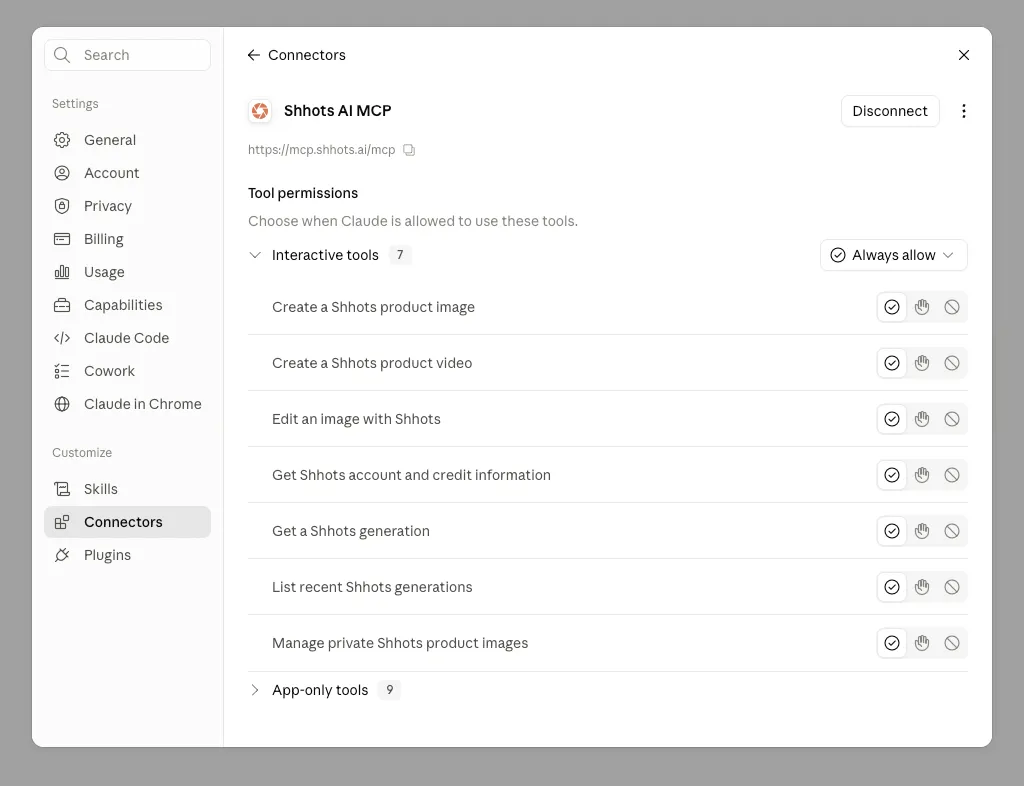
Shhots AI approached the problem from the commerce side. The platform generates UGC ads, cinematic product films, AI photoshoots, and image ads by placing AI actors and environments around a real product, analyzed once from a photo and preserved through every generation. The Shhots MCP server brings that capability into Claude, ChatGPT, Gemini, Perplexity, and Cursor.
Four differences define it as a Higgsfield MCP alternative:
Product fidelity is the core engine. Your bottle, box, or device is composited, held, unboxed, and lit while staying itself. One photo is enough.
Claim safety is enforced in the tool schema. The video and image tools reject invented benefits, certifications, ingredients, pricing, and performance claims. Scripts build only on visible or user-supplied facts. This guardrail lives at the API level, so it holds no matter how the request is phrased.
Ad formats, not model names. You choose from 7 commerce formats, UGC, cinematic, animated, product speaking, storefront, lifestyle, and unboxing ASMR, in 5, 10, 15, or 30 seconds. The taxonomy matches how media buyers actually brief creative, so you never pick a model.
A persistent product session. Upload once and every follow-up asset reuses the active product automatically. “Give me the same script as unboxing ASMR” is a full instruction. The Claude AI video generator guide walks through a complete session.
What product-accurate output looks like
Two ads generated through the Shhots MCP server in Claude, each from one product photo. Both products carry printed labels. The hardest thing for a general video model to keep intact across a cut.
The test to apply is not “does this look good”, plenty of general models clear that bar. It is “would a customer who received this product recognize it from the ad”.
Feature comparison table
| Shhots AI MCP | Higgsfield MCP | |
|---|---|---|
| Built for | Product ads for real physical items | General image and video creation |
| Product accuracy | Real product composited from one photo | Model-dependent, may drift |
| Claim safety guardrail | Enforced in the tool schema | Not a design goal |
| Video formats | 7 ad formats, 5/10/15/30 seconds | 30+ models, up to 15 seconds |
| Image styles | Studio, lifestyle, editorial, bold, 5 ratios | Model-dependent, up to 4K |
| Conversational editing | Yes, edits the previous result directly | Varies by model |
| Product library | Persistent active product per connection | Creation history |
| Works in | Claude, ChatGPT, Gemini, Perplexity, Cursor | Claude and other MCP clients |
| Cost transparency | Credit quote shown before every generation | Plan and model dependent |
| MCP access from | Pro plan, $49/month (6,000 credits) | Plan-dependent, promotions vary |
Pricing comparison
Shhots pricing is flat and quoted per generation: Starter at $19 per month for 2,000 credits, Pro at $49 for 6,000, Scale at $99 for 12,000, and a $499 Done-For-You service. The MCP server is included on Pro and Scale.
| Output | Credits | Roughly, on the $49 Pro plan |
|---|---|---|
| Product image | 11 | ~$0.09 |
| UGC ad, 10s | 551 | ~$4.50 |
| UGC ad, 15s | 826 | ~$6.75 |
| Product ad, 15s | 852 | ~$7.00 |
The quote appears in chat before you spend and credits are only deducted when you confirm, so a session never surprises you. Full breakdown on the pricing page.
Higgsfield prices by plan tier with model-dependent costs, and has run unlimited-generation promotions for MCP users. For pure volume experimentation across many models, those promotions can be strong value. For predictable per-ad economics on a product catalog, flat credits are easier to budget against a CAC target.
Run the test yourself
The honest test is empirical, and it takes one afternoon. Take a single product photo, run the same brief through both connectors, and compare the outputs against the physical item on your desk.
Check three things:
- The label. Is the text still your text, or has it become label-shaped noise?
- The silhouette across frames. Does the cap, lid, or neck stay the same object when the creator picks it up?
- The script. Does it contain any claim you never made?
Those three checks predict whether an asset can actually ship as an ad. Everything else is taste.
Which one should you pick?
Pick Higgsfield MCP if you are a creator or studio producing cinematic content, stylized visuals, or character-driven work where model variety matters more than object fidelity.
Pick Shhots AI MCP if you sell a physical product and the asset’s job is conversion. Ecommerce founders, DTC brands, and agencies producing ad creative at volume get product accuracy, claim safety, and per-ad cost clarity that general model aggregators are not designed to provide.
Run both if your work spans brand films and product ads. They connect side by side in the same Claude workspace, and Claude routes each request to the tool you name.
For the wider comparison beyond MCP, see the full Higgsfield AI alternatives guide. For the rest of the toolchain around this decision, see the 2026 AI ad stack.
FAQ
What is the best Higgsfield MCP alternative for product ads?
Shhots AI MCP. It composites AI actors and scenes around your real product from a single photo, enforces claim-safe scripts at the tool level, and offers 7 ad-specific video formats inside Claude, ChatGPT, Gemini, Perplexity, and Cursor.
Can I use Shhots and Higgsfield MCP at the same time?
Yes. Both are standard MCP connectors and can be connected to the same Claude account simultaneously. Name the tool you want in your request and Claude routes it accordingly.
Does Shhots have as many models as Higgsfield?
No, and it does not aim to. Higgsfield aggregates 30-plus general models and lets the agent pick one. Shhots combines frontier models inside a product-accuracy pipeline and exposes them as 7 ad formats and 4 image styles rather than a model list, so you brief an outcome instead of choosing a model.
Is Shhots cheaper than Higgsfield?
It depends on usage. Shhots MCP access starts at $49 per month on the Pro plan with a fixed credit price per asset and the quote shown before each generation, which makes per-ad economics predictable. Higgsfield prices by plan tier with model-dependent costs and periodic unlimited promotions, which can be cheaper for high-volume experimentation.
Why does product accuracy matter for AI ads?
Ad platforms and consumer protection rules expect the advertised product to match the sold product, and customers distrust ads where the packaging looks off. Accurate compositing keeps ads compliant and credible, and it removes the regeneration cycles teams otherwise burn trying to get a label to survive.
Does the Shhots MCP server work outside Claude?
Yes. The same server connects to ChatGPT, Gemini, Perplexity, and Cursor, and to Claude Code. Setup is the same OAuth flow in each client’s connector settings.