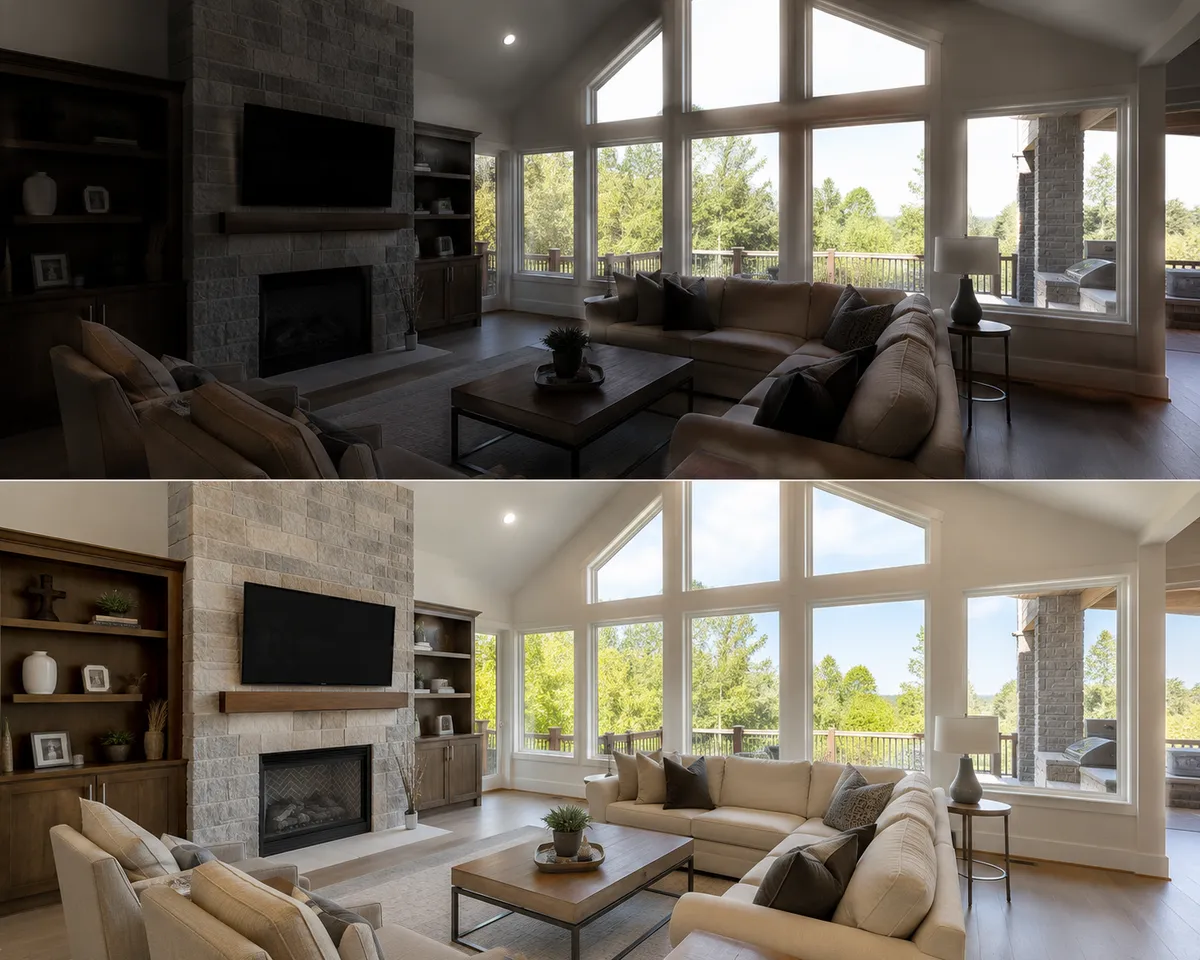
Disclosure: Shhots AI is our product. The single-exposure AI HDR workflow described here is our own product; the bracketing and flambient sections describe standard photographic practice, not something we sell.
HDR real estate photography solves one physical problem: a room’s windows are many times brighter than its corners, and a camera sensor cannot hold both in a single ordinary exposure. Either the windows blow out to white or the room falls into shadow.
For twenty years the fix was bracketing, which means shooting the same frame at several exposures and blending them. In 2026 there is a second fix: AI that recovers the highlight and shadow detail from one exposure. This guide covers how both work, what each costs in time and money, and the honest cases where a photographer should still bracket.
If you just want the one-pass version on your own listing photos, that is the HDR preset on AI real estate photo editing, at about $0.45 a photo.
Why do listing photos need HDR at all?
Stand in a living room at noon and look at the window. Your eyes handle the scene fine, because they adjust locally. A camera exposes the whole frame at once.
The result is the two failure photos every agent has seen:
- Exposed for the room: the interior looks right and the windows are white rectangles. The buyer cannot see the yard, the view, or whether the neighbour’s wall is two feet away.
- Exposed for the window: the view is beautiful and the room is a cave.
A buyer scrolling a portal reads both as “bad photo” and moves on. MLS photo rules do not require HDR, but the listings that win the click are almost all exposure-balanced, which is why the technique became standard in listing photography.
How does bracketed HDR work?
Bracketing is the traditional answer, and it happens in two places: on site and at the desk.
On site. The camera goes on a tripod, because the frames have to align. The photographer shoots the same composition 3 to 5 times at different shutter speeds: one exposure for the shadows, one for the mid-tones, one or two for the windows. Most cameras automate the sequence.
At the desk. The exposures are merged in Lightroom, Photomatix, or similar, then corrected for color and verticals. This is the part that eats the evening. An edit cycle for a full shoot commonly runs 1 to 3 hours, which is why so many photographers outsource it to editing services at $1.10 to $2.25 an image with a 12 to 48 hour turnaround.
Done well, bracketed HDR is excellent. Done badly, it produces the grey halos and radioactive interiors that gave “HDR” a bad name on early phone cameras.
What is flambient photography?
Flambient is the refinement most high-end listing photographers use now: a blend of flash and ambient frames rather than pure exposure stacking. The photographer shoots an ambient frame for the natural light and window color, then flash frames to light the room cleanly, and blends them by hand in Photoshop.
It produces the cleanest color of any method, and it costs the most skill and the most editing time per image. For luxury listings where the photography budget is real, it earns its keep. For the 40 ordinary listings a photographer shoots in a month, the hand-blend time is the bottleneck.
How does single-exposure AI HDR work?
The AI approach starts from the other end. Instead of capturing more light data on site, it reconstructs the balanced frame from one exposure: highlight detail is recovered where the sensor clipped, shadows are lifted without noise, and the frame is rebalanced so the window view and the room read together.
On Shhots AI this is one preset. Upload the shoot, the photos sort themselves by room, run HDR / Exposure Balance on the frames that need it, and each generation comes back in under a minute for 55 credits, which is about $0.45 on the $49 a month Pro plan. The same credits cover sky replacement, window pull, decluttering, virtual staging, and the listing video.
The practical consequence is who can produce the result. Bracketing requires a tripod, a camera that brackets, and blending skill. A single-exposure pass works on a handheld frame from a phone, which is how most agent-shot photos arrive.
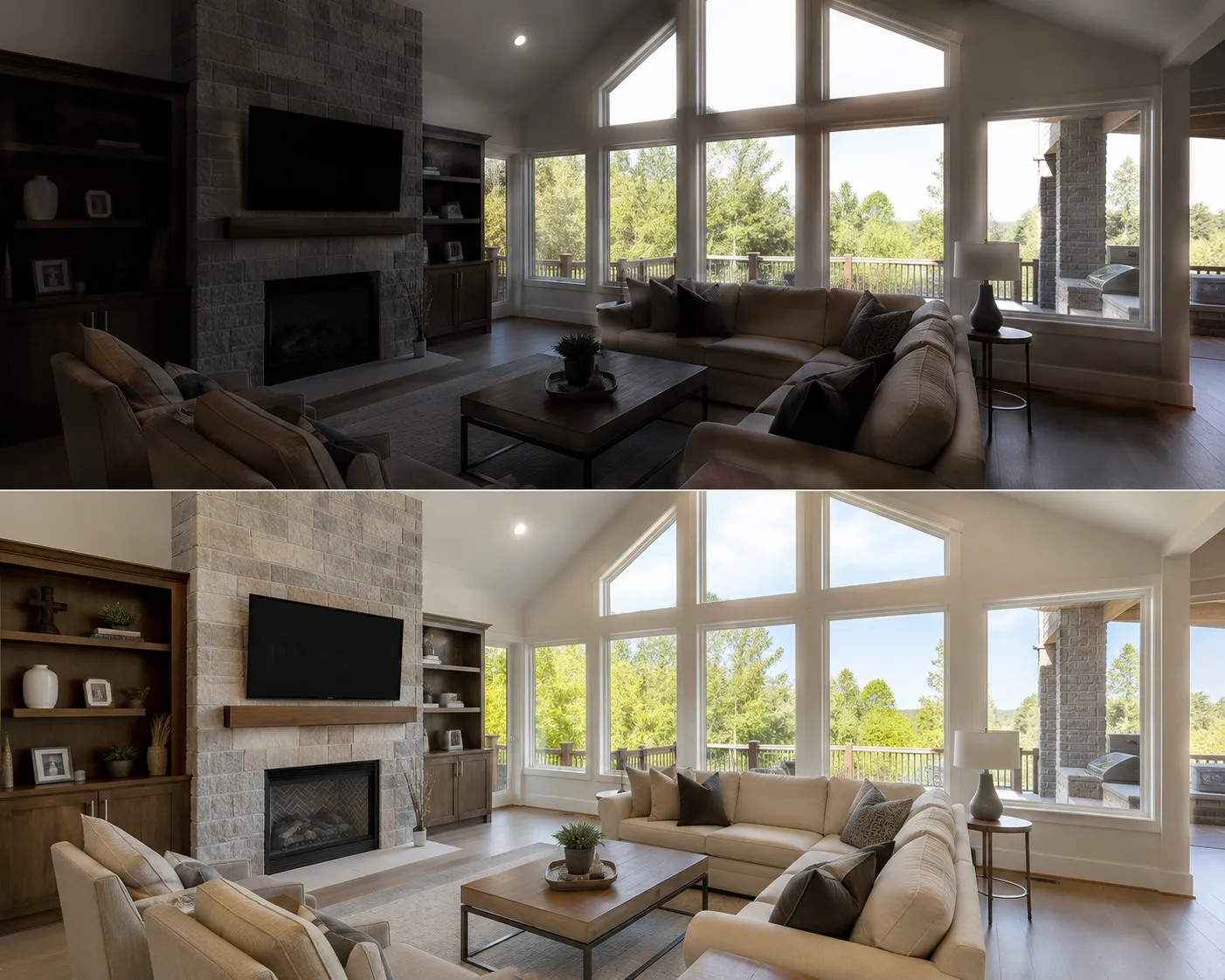
Bracketing vs flambient vs AI HDR, compared
| Bracketed HDR | Flambient | Single-exposure AI | |
|---|---|---|---|
| Gear on site | Tripod + bracketing camera | Tripod + camera + flash | Any camera or phone |
| Frames per composition | 3 to 5 | 3 to 8 | 1 |
| Who edits | You, or a service | You, in Photoshop | The model |
| Edit time per shoot | 1 to 3 hours, or 12 to 48 h outsourced | Longest of the three | Under a minute per photo |
| Cost per image | $1.10 to $2.25 outsourced | Your evening | About $0.45 |
| Color fidelity | Good | Best | Good |
| Handheld phone shots | No | No | Yes |
Prices as of September 2026: outsourced ranges are published editing-service rates; the AI figure is 55 credits at the Pro rate.
When should a photographer still bracket?
Three honest cases.
The shot is irreplaceable. A twilight exterior with the city behind it, a penthouse view that is the listing’s entire argument. Captured light data beats reconstructed light data, and when one frame carries the marketing, capture everything.
The client is paying for flambient color. Some brokerages hire a specific photographer because of how their interiors look. That look is a hand-blend, and an AI pass is not trying to reproduce it.
The output goes very large. For a wall-sized print, more captured data helps. For portal galleries, social cuts, and brochures, it does not show, and the 4K upscale preset covers print sizes for signage.
Everything else, which is most listing photography most weeks, is exposure balancing at volume, and that is now a preset rather than an evening.
HDR real estate photo editing services: what they charge vs AI HDR
If you bracket on site and outsource the blend, the HDR line on the invoice looks like this. Prices per image in USD, read from each vendor’s live pricing page on September 23, 2026 unless noted.
| Service | HDR price per image | Notes | Turnaround |
|---|---|---|---|
| PhotoUp | 1.25 credits, $1.38 to $1.88 | Credits cost $1.10 to $1.50 depending on pack size; flambient blends are 1.5 credits | 24 hours standard |
| BoxBrownie | $2.00 image enhancement | HDR blending is not priced separately on its pricing page | Under 48 hours, per vendor |
| Styldod | From $1.50 | August 2026 figure | 24 to 48 hours, rush at +$6 or +$12 |
| AutoHDR | From $0.37 | AI merge of the brackets you shot | 20 to 30 minutes |
| Autoenhance.ai | $29 a month for 100 images, $0.29 each after | AI, accepts bracket uploads, current limited offer | Instant |
| Shhots AI | About $0.45 | Single exposure, no brackets needed; the same credits cover staging and video | Under a minute |
The human services still expect brackets. The AI services split: AutoHDR and Autoenhance.ai merge the brackets you shot, and Shhots AI reconstructs the balance from one frame. That difference decides who can use each one. A photographer with a tripod can use all six. An agent with a phone can use the last one.
How agents get HDR results without a photographer
The workflow that actually happens on a Tuesday:
- Walk the listing with a phone, shooting each room straight on with the whole ceiling line in frame.
- Upload the shoot to a property in Real Estate Studio. The photos group themselves by room type.
- Run HDR / Exposure Balance on interiors with windows, Auto Enhance on the rest, Sky Replacement on flat exteriors.
- Compare each result against the original in the side-by-side view before anything goes to the MLS.
Twenty photos costs about $9 and roughly twenty minutes. That does not make phone photography match a professional shoot; framing, lens quality, and composition still show. It makes the exposure problem stop being the reason a listing looks amateur.
Photographers use the same flow in reverse: shoot properly, skip the bracketing sequence, and let the bulk workflow handle the edit cycle across every listing in the pipeline, so same-day delivery stops depending on a midnight Lightroom session.
HDR real estate photography FAQ
What does HDR mean in real estate photography?
HDR stands for high dynamic range. In listing photography it means producing one photo that holds both the bright window view and the darker interior, either by blending several exposures or by recovering the detail from a single exposure with AI.
How many photos do you need for bracketed HDR?
Three to five exposures of the same composition is standard: one exposed for shadows, one for mid-tones, and one or two for the highlights in the windows. The camera must not move between frames, which is why bracketing is shot from a tripod.
Can AI really do HDR from one photo?
Yes, within limits. The AI reconstructs highlight and shadow detail rather than capturing it, and on typical interior frames the balanced result is the same edit an outsourced service returns in 24 hours. Where the original clipped hard on an irreplaceable view, captured bracketing still holds more real information.
Do HDR listing photos need a disclosure label on the MLS?
Exposure balancing is ordinary photo correction, and no board asks you to label it. Materially altered photos, such as virtual staging or in some boards a replaced sky, do need a label. The state and MLS disclosure guide covers what specific boards require.
What does HDR real estate photo editing cost?
Outsourced HDR editing services charge $1.38 to $2.00 per image with 24 to 48 hour turnaround: PhotoUp bills HDR at 1.25 credits, $1.38 to $1.88 depending on pack size, and BoxBrownie charges $2 for image enhancement. AI services that merge your brackets run $0.29 to $0.37 per image. On Shhots AI the HDR preset costs 55 credits per image, about $0.45 on the $49 a month Pro plan, from a single exposure, and returns in under a minute. Prices as of September 2026.
Is HDR the same as window pull?
They are related edits with different targets. HDR balances the whole frame’s exposure. Window pull specifically recovers the view through the glass so the window reads as a picture instead of a white panel. On Shhots AI both are named presets in the same Correction menu.
Related reading
- AI real estate photo editing, the full correction preset list and per-image pricing
- Real estate photo editing outsourcing, the 2026 cost math on editing services
- Virtual staging before and after, how to grade a generated result before it ships
- AI for real estate agents, where photo correction sits among the four listing jobs
Where to start
Take the worst window photo in your current listing, the one where the glass is a white rectangle, and run it through the HDR preset. One frame, 55 credits, under a minute. If the view comes back and the room still looks like the room, you have replaced the bracketing workflow for that listing.
Start on Pro at $49 a month or see every correction preset on AI real estate photo editing.