Disclosure: Shhots AI is our product.
Real estate reels work in 2026 when they get watched all the way through. Instagram says the most important thing it predicts about a reel is how likely you are to watch it to the end, so completion rate is the number to design around. In practice that means 15 to 30 seconds, three posts a week, and an opening line that gives the viewer a reason to stay instead of introducing you.
This guide covers ten formats that hold retention, the hook patterns behind them, what each one costs to produce, and the Fair Housing rules that quietly apply to neighbourhood content.
What actually decides whether a reel gets shown
Instagram’s own explanation of its ranking is more specific than the advice that circulates about it, and the difference matters.
The predictions Instagram says it weighs most heavily are how likely you are to watch a reel all the way through, whether you like it, whether you would call it entertaining, and whether you visit the audio page. The signals feeding those predictions are, roughly in order, your own recent activity, your history with the account that posted, and information about the reel and its author.
Two things follow from that, and both cut against common advice.
Duration is a lever, not a target. A 10-second reel watched to the end beats a 60-second reel abandoned a third of the way in, because completion is what Instagram is predicting. Fifteen to thirty seconds is where a hook plus one useful idea fits without the ending falling off a cliff. There is no published magic length, and anyone quoting one is guessing.
Introducing yourself costs you the reel. “Hi, I’m Dana and I’m a realtor in Austin” spends the opening on information nobody was looking for, and the opening is where you either earn the rest of the watch or lose it. The name goes in the caption and the profile.
The widely repeated “three-second rule” is practitioner convention rather than anything Instagram publishes. It is a reasonable working assumption because it follows from optimising for completion, but treat it as a rule of thumb rather than a threshold someone has measured.
One thing Instagram has stated plainly: it prioritises original content over reposts in the Reels tab and feed. Reposting another agent’s tour or a viral clip with your logo on it is working against the ranking, not with it.
The hook patterns that hold
| Pattern | Opening line | Works because |
|---|---|---|
| Specific number | ”This kitchen added $40,000 to the sale price.” | A number is a claim the viewer wants resolved |
| Open loop | ”The reason this listing sat for 90 days is in the second photo.” | Payoff is withheld, so leaving costs something |
| Direct contradiction | ”Stop pricing at $499,000.” | Disagreement with a common belief holds attention |
| Price anchor | ”$700,000 in Denver, right now.” | Local price curiosity is close to universal |
| Named mistake | ”Three things I would fix before this goes live.” | Promises a finite, useful list |
Avoid hooks built on urgency you cannot support (“the market is about to crash”). They win the opening and cost you the audience over the next month.
The 10 real estate reel formats
Ranked by how reliably they hold retention against how much work they take. Costs assume you already have listing photos.
| # | Format | Length | What you need | Cost per reel |
|---|---|---|---|---|
| 1 | Price anchor tour | 20 to 30s | Listing photos | About $6.74 |
| 2 | Before and after staging | 10 to 15s | One empty room photo | About $0.90 |
| 3 | Day to dusk reveal | 8 to 12s | One exterior photo | About $0.45 |
| 4 | Narrated walkthrough | 15s | Finished gallery | About $6.74 |
| 5 | The objection answer | 20 to 40s | Phone camera | Free |
| 6 | Named mistake list | 30 to 45s | Phone camera | Free |
| 7 | Neighbourhood breakdown | 30 to 60s | Phone camera, b-roll | Free |
| 8 | One-room deep dive | 15 to 25s | Listing photos | About $0.45 |
| 9 | Market stat in plain English | 20 to 30s | Local MLS data | Free |
| 10 | Just-listed teaser | 6 to 10s | Three photos | About $1.35 |
1. Price anchor tour
Hook: “$700,000 in [your city], right now.”
The highest-reach format because it answers a question people ask constantly and cannot get answered without a local agent. State the price, show the house, name the trade-off (“you get the yard, you lose the walk to downtown”).
Do not run this one against a listing you represent without disclosing it. It reads as market education, and burying an ad inside it is the fastest way to lose the audience that works.
2. Before and after staging
Hook: “This room sold for $18,000 over asking. Here is what it looked like on Tuesday.”
The single best-performing format for listing accounts because the payoff is visual and lands inside two seconds. Cut hard between the empty frame and the staged frame rather than dissolving.
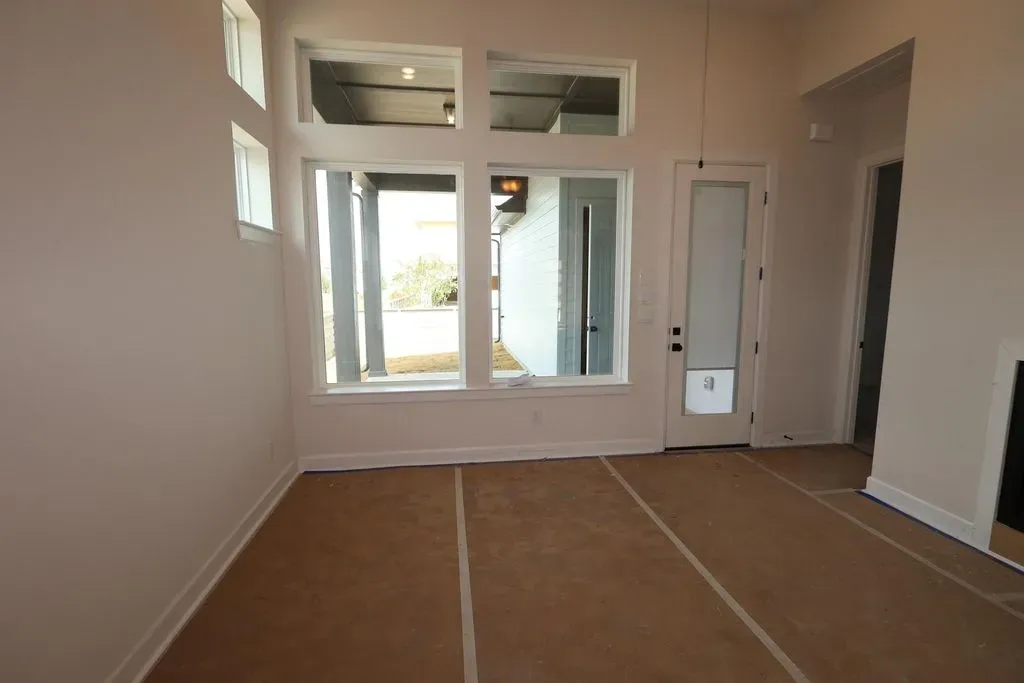
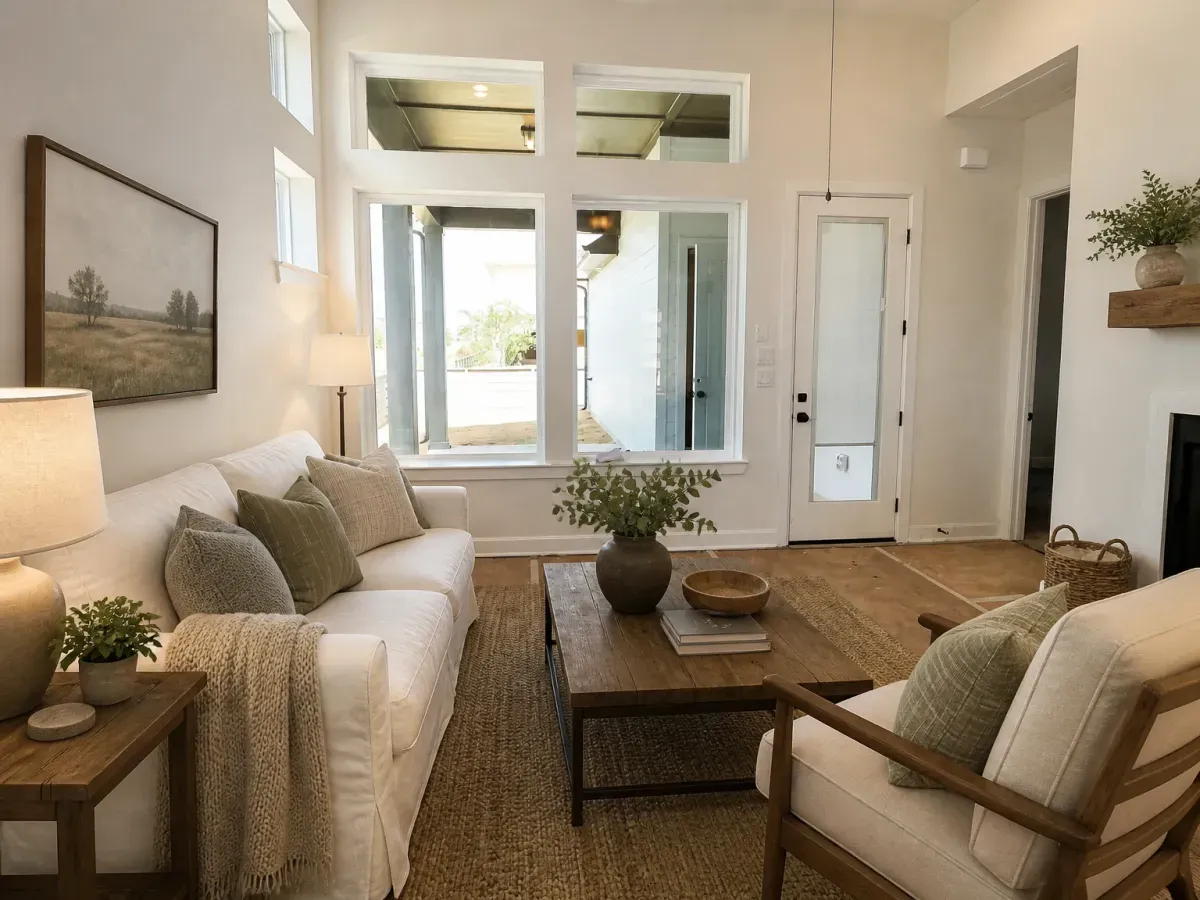
Both frames above were produced from one photograph. The staged version costs 55 credits on Shhots AI virtual staging, about $0.45, so a two-frame reel is roughly $0.90 including a regenerate.
The disclosure rule applies here as much as it does on the MLS. Caption the reel as digitally staged. A reel is a listing advertisement, and the same rules follow it onto social.
3. Day to dusk reveal
Hook: No words. The frame changes and the viewer stays for it.
Exterior at midday, then the same exterior at dusk with the windows lit. It is the shortest reel on this list and one of the highest completion rates, because the payoff arrives before anyone decides to scroll.
Shoot the exterior once at any hour and generate the twilight version rather than booking a second visit. A day to dusk edit costs about $0.45 against $100 to $400 for a photographer to return at golden hour, and the twilight window is roughly twenty usable minutes a day.
4. Narrated walkthrough
Hook: The first line of the script, not a greeting.
A presenter narrating a property over the finished gallery. This is the format that most agents cannot produce at volume, because it historically meant a videographer.
The exterior cut works better as a hook because a house is a stronger opening frame than a room:
Both were built in Real Estate Studio from the property record. Full production detail is in the real estate video marketing guide.
5. The objection answer
Hook: “You do not need 20% down.”
Pick one thing buyers or sellers say to you every week and answer it in 30 seconds, filmed on a phone with no edit. It is the cheapest reel on this list and the one most likely to produce an inbound message, because it demonstrates that you know something the viewer does not.
Keep a running note of objections you hear. That note is your content calendar.
6. Named mistake list
Hook: “Three things I would fix before this house goes live.”
Walk a listing and name specific, fixable problems. Finite lists hold retention because the viewer knows the length in advance.
Never film this in a client’s home without written permission, and never in a way that identifies a competitor’s listing.
7. Neighbourhood breakdown
Hook: “The most underrated street in [area], and what it costs.”
The highest-converting format for local pipeline and the one with the most legal exposure. Read the compliance section below before making one.
8. One-room deep dive
Hook: “This is the room that sells the house.”
One room, three angles, and a specific explanation of why it works. Slower and more informative than a tour, and it performs well with saves, which Instagram weighs.
9. Market stat in plain English
Hook: “Inventory in [area] is up 22%. Here is what that means for your offer.”
Take one number from your MLS and translate it into what a buyer or seller should do differently. Cite the source and the month on screen. Stale stats posted as current damage credibility faster than posting nothing.
10. Just-listed teaser
Hook: Three photos, hard cuts, no narration.
Six to ten seconds, the strongest three frames, address in the caption. The point is completion rate, not information. Use it to seed the algorithm before posting a longer reel on the same property.
What a week of reels actually costs
Three reels a week is the working benchmark from current agent data, and consistency across a 90-day window matters more than volume in any single week.
| Weekly mix | Production cost | Time |
|---|---|---|
| 1 narrated walkthrough, 2 phone-filmed | About $6.74 | Around 45 minutes |
| 1 walkthrough, 1 before and after, 1 phone | About $7.64 | Around 40 minutes |
| 3 phone-filmed | $0 | Around 60 minutes |
Over a quarter, the first mix is about $88 in render costs for 39 reels. The comparison worth making is against a videographer, where a single listing video runs $300 to $800 and cannot be reshot without paying again.
The constraint on posting three reels a week has rarely been money. It is that filming, editing and captioning each one used to take an evening. Generating the video from photos you already shot removes the editing hour, which is the hour that ends the habit.
Fair Housing applies to reels
This is the part most reel-ideas lists leave out, and it carries real liability.
Neighbourhood content is where agents get into trouble. Describing an area as “safe”, “family-friendly”, or “great schools” can be read as steering under the Fair Housing Act, because those phrases correlate with protected characteristics. The same applies to who appears in your footage: consistently featuring one demographic in neighbourhood reels has been treated as discriminatory advertising.
Three rules that keep you clear:
- Describe property and facts, not the people who live nearby. “Four blocks from the light rail” is fine. “Great neighbourhood for families” is not.
- Cite school data as data with a source, or leave it out. Do not characterise schools as good or bad.
- If you boost a reel as a paid ad, Meta’s Housing Special Ad Category applies, which removes age, gender and most detailed targeting and limits radius targeting. The rules and what survives them are in the real estate advertising guide.
Disclosure runs alongside this. Virtually staged frames, day to dusk edits and AI-generated walkthroughs should be labelled in the caption. Most MLS rules require it on the listing, and the reason for the rule does not stop at the portal.
Real estate reels FAQ
How long should a real estate reel be?
15 to 30 seconds for most formats. Instagram says the most important thing it predicts is whether you will watch a reel all the way through, so completion rate is what you are optimising and length is only the lever. A 10-second reel watched to the end beats a 60-second reel abandoned a third of the way in. Under 15 seconds rarely fits a hook plus one useful idea, and past 60 seconds most listing content loses people before the end.
How often should real estate agents post reels?
Three a week, sustained for at least 90 days. Consistency over that window matters more than volume in any single week, and agents who hold three a week for six months are the ones who report measurable pipeline. One reel a day for two weeks followed by nothing performs worse than three a week for three months.
What makes a good real estate reel hook?
A specific number, an open loop, or a flat contradiction of something the viewer believes, delivered in the opening line. “This kitchen added $40,000 to the sale price” works. “Hi, I’m a realtor in Austin” does not, because it spends the opening on information nobody was looking for. The commonly cited three-second window is practitioner convention rather than a published Instagram threshold, but the underlying logic holds: Instagram optimises for whether people watch to the end, and an opening that gives no reason to stay does not get watched to the end.
Can I make real estate reels without filming video?
Yes. A narrated walkthrough can be generated from listing photographs, which costs 825 credits on Shhots AI, about $6.74 on the $49 Pro plan. Before and after staging reels and day to dusk reveals are built from single still photos at about $0.45 per generated frame. Phone-filmed formats like objection answers need no equipment beyond a phone.
Do I have to disclose AI-generated real estate reels?
Label virtually staged frames, day to dusk edits and AI-generated walkthroughs in the caption. Most MLS rules require staged imagery to be disclosed as digitally enhanced, and a reel promoting a listing is listing advertising. Check your local MLS wording, since some markets also require the unaltered original to appear alongside.
What should I not say in a neighbourhood reel?
Anything characterising the people who live there. Terms like “safe”, “family-friendly” and “good schools” can be read as steering under the Fair Housing Act. Describe distances, amenities and facts about the property instead, and cite school data to a source rather than rating it yourself.
Related reading
- Real estate video marketing guide for the full strategy these reels sit inside
- Real estate advertising guide for the rules on boosting any of this as paid media
- Home staging cost in 2026 for what the staged frames cost
- Best virtual staging software if you are choosing a tool for format 2
Where to start
Pick format 2 or format 3. Both are built from one photograph you already have, both cost under a dollar, and both produce a payoff inside two seconds, which is the part most agents get wrong. Once those are running weekly, add a narrated walkthrough for your newest listing.
Real Estate Studio generates the walkthrough, the staged frames and the twilight edits from one property record on a single $49 plan.