Disclosure: Shhots AI is our product.
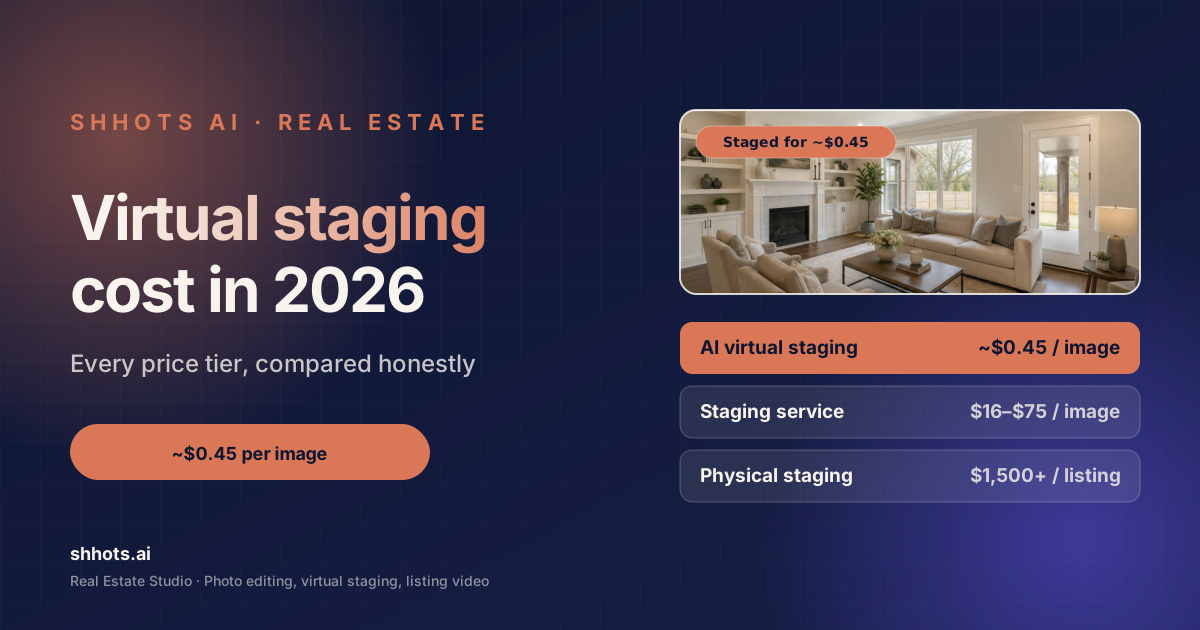
Virtual staging cost in 2026 falls into three tiers that are far enough apart to be different products: roughly $0.45 per image with AI, $16 to $75 per image with a managed service, and $832 to $2,917 per listing for real staging with rented furniture.
Those headline numbers hide most of what you actually pay. This guide covers the per-image prices, the fees that do not appear on the quote, what a real month of listings costs at each tier, and how to work out which one your pipeline can justify.
If you want to skip the analysis and see the per-image maths, the AI virtual staging page has the plan breakdown.
How much does virtual staging cost?
Virtual staging costs about $0.45 per image with AI on Shhots AI, $2 to $25 per image on other AI tools, $16 to $75 per image from a managed service with a human designer, and $832 to $2,917 per listing for physical staging. Here is the whole market in one table.
| Approach | Cost | Turnaround | Revisions | Minimum |
|---|---|---|---|---|
| AI virtual staging (Shhots AI) | About $0.45 per image | Under a minute | Regenerate for 55 credits | None |
| AI virtual staging (other tools) | $2 to $25 per image | Minutes to hours | Usually capped | Often a monthly plan |
| Managed virtual staging service | $16 to $75 per image | 24 to 72 hours | 1 to 2 free, then billed | Often 3 to 5 images |
| Physical staging | $832 to $2,917 per listing, $3,000 to $6,000 if vacant | 1 to 2 weeks | Not applicable | 2 to 3 month rental |
The Shhots AI figure is 55 credits per generated image on the Pro plan, which is $49 a month for 6,000 credits. That is about 109 generated images a month, and the same credits also cover photo correction, object removal, 4K upscaling, and listing video rather than staging alone.
Why the spread is so wide
The three tiers are pricing three different things.
Physical staging is renting furniture and paying people to move it. NAR publishes a periodic profile of home staging that is a better source on what sellers and agents actually spend than any vendor page. The cost is dominated by logistics and inventory, and it does not fall much with volume.
A managed virtual staging service is paying a designer’s time. Somebody opens your photo, builds the scene, and exports it. That is why the turnaround is measured in days and why the third revision costs money.
AI virtual staging is paying for compute. The marginal cost of one more image is small, which is why the price per image is small and why regenerating a bad result is not a negotiation.
How much does it cost to stage a house?
Staging a house costs $832 to $2,917 in most cases and averages about $1,849, per HomeGuide’s 2026 cost data. The 2025 NAR Profile of Home Staging, released May 2025, puts the median at $1,500 when a seller hires a staging service and $500 when the listing agent stages it themselves.
That $1,000 gap is the whole story of traditional staging pricing. Very little of it is design skill. It is furniture, trucks, and hours.
Home staging cost by scope
| Scope | Cost | What drives the number |
|---|---|---|
| Agent stages it, seller’s own furniture | About $500 | Consultation and rearranging, no rental |
| Consultation only, no staging | $150 to $600 | Two to four hours of a stager’s time |
| Occupied home, partial staging | $1,000 to $3,000 | Light rental, mostly editing what is already there |
| Vacant home, full staging | $3,000 to $6,000+ | Every room needs rented furniture delivered |
| Per room | $300 to $700 | Scales with room count, not house value |
| Furniture rental, per room per month | $100 to $700 | Keeps accruing while the listing sits |
Two things fall out of that table. Staging cost tracks room count rather than sale price, so a modest four-bedroom can cost more to stage than a small luxury condo. And a vacant house is the expensive case, because there is nothing to work with and every room starts from a delivery truck.
Home staging cost by room
NAR reports which rooms agents actually stage and which ones buyers say matter. The two lists do not line up perfectly, which is useful if you are staging on a budget.
| Room | Staged by sellers’ agents | Named most important by buyers | Cost to stage |
|---|---|---|---|
| Living room | 91% | 37% | $500 to $1,500 |
| Primary bedroom | 83% | 34% | $400 to $1,200 |
| Dining room | 69% | Not in the top three | Not separately reported |
| Kitchen | 68% | 23% | Not separately reported |
Dining rooms get staged more often than kitchens and matter to buyers least of the four. If you are cutting one room from a physical staging quote, that is the one.
The rental clock is the part people miss
A staging quote is usually written against an initial period, most often two or three months. Furniture rental at $100 to $700 per room per month keeps running after that period ends.
A five-room stage at $300 per room per month is $1,500 a month in rental alone. A listing that takes five months instead of two adds roughly $4,500 that never appeared on the original quote. This is the number that turns a $2,000 staging decision into a $6,500 one, and it is worst on exactly the listings that were hard to sell in the first place.
Virtual staging has no equivalent clock. The images are yours once they are rendered, and a listing that sits for nine months costs the same as one that sells in nine days.
Does staging pay for itself?
The honest answer is that the published evidence is agent opinion rather than measured price lift. In the 2025 NAR report, 29% of sellers’ agents said staging produced a 1% to 10% increase in the dollar offered, and 49% said it reduced time on market. 83% of buyers’ agents said staging made it easier for a buyer to picture themselves in the home.
Those are perceptions collected by survey, not a controlled comparison of staged and unstaged versions of the same house. Treat them as directional. The arithmetic still favours staging at the low end: on a $400,000 sale, a 1% improvement is $4,000, which covers the average $1,849 stage twice over. It is just not a guarantee, and the survey does not tell you how often staging produced no lift at all.
Virtual staging vs real staging
| Real staging | Virtual staging | |
|---|---|---|
| Cost, typical listing | $832 to $2,917 | $4 to $600 for a full gallery |
| Cost if the home is vacant | $3,000 to $6,000+ | Unchanged |
| Ongoing cost while unsold | $100 to $700 per room per month | None |
| Turnaround | 1 to 2 weeks | Under a minute to 72 hours |
| Changes the listing photos | Yes | Yes |
| Changes the in-person viewing | Yes | No |
| Change your mind after seeing it | Reshoot and re-rent | Regenerate |
| MLS disclosure needed | No | Yes, in most markets |
The distinction that matters is the last three rows. Both approaches produce a staged photograph. Only one of them also changes what a buyer walks into, and only one of them has to be labelled.
Where virtual staging genuinely loses
A buyer who liked the photos and then walks into an empty room feels the gap. That reaction is real and it is the main argument for spending the extra money. It is sharpest on vacant properties in the price bands where buyers view several homes in an afternoon and compare them from memory.
Virtual staging also carries a disclosure obligation almost everywhere. Most MLSs require staged images to be labelled as digitally enhanced, and some require the unstaged original in the gallery too. Check your local rules before the listing goes up, not after a complaint. Full detail is in what virtual staging is.
The rule that decides it for most listings
Spend on physical staging when the viewing is the bottleneck. Spend on virtual staging when the click is the bottleneck.
If a listing gets showings but no offers, furniture may fix it. If a listing gets no showings at all, the photographs are the problem, and $2,000 of furniture that nobody comes to see does nothing. Most vacant listings that stall are stalling at the photograph.
Virtual staging prices by tool, verified August 2026
Generic ranges hide the decisions, so here are the named players. Every price below was checked against the vendor’s live pricing page in August 2026; where a page doesn’t state something, the cell says so rather than guessing. Prices marked “billed yearly” are the yearly-billing monthly rates the vendor headlines, month-to-month costs more.
| Tool | Type | Staging price (as of Aug 2026) | Turnaround | Notes |
|---|---|---|---|---|
| Shhots AI | AI studio | ~$0.45/image (55 credits; Pro $49/mo ~ 109 images) | Under a minute | Same credits cover photo correction, removal, and listing video |
| Virtual Staging AI | AI app | $16-$79/mo billed yearly (6-150 photos/mo) | ~10 seconds | $2.67/photo on Basic down to $0.53 on Enterprise |
| REimagineHome | AI app | $14-$99/mo (30-900 credits), billed monthly | Minutes | 5-design free trial, no card |
| StageHQ | AI, credit packs | $19/$39/$69 one-time (20/100/250 photos) | ~30 seconds | Credits never expire; advertises MLS-compliant output |
| Collov AI | AI + human-assist tier | $19-$127/mo billed yearly (60-526 credits) | Minutes | Premium adds virtual tours, 360, 3D |
| AI HomeDesign | AI app | $19-$49/mo billed annually (30-200+ photos) | Not disclosed | $0.49/photo on annual Enterprise |
| BoxBrownie | Human service | $30/image | Under 48 hours | Unlimited free revisions for 2 months |
| Styldod | Human service | $16/image (8+ photos), $23 below that | 24-48 hours | Rush: +$6/image for 24h, +$12 for 12h |
Three single-sentence takeaways from that table. The cheapest human-designed staging on the market is Styldod at $16 per image in batches of eight or more. The cheapest AI staging per photo is StageHQ’s $69 pack at about $0.28, if you’re happy paying up front for 250 photos. And the only option where the staging budget also covers photo correction and a listing video is Shhots AI’s credit pool, at about $0.45 per generated image on the $49/month Pro plan.
For the fuller tool-by-tool comparison, photo caps, watermark policies, free trials, and what each one does beyond staging, see the Virtual Staging AI alternatives guide.
The costs that are not on the quote
The per-image figure is the number vendors advertise. These are the ones that show up later.
Revision fees. Most managed services include one or two rounds and bill after that. If the first attempt puts a farmhouse dining set in a downtown loft, round three is on you. On a per-generation model a revision costs the same as the original.
Rush fees. A Friday afternoon shoot that needs to go live Saturday morning attracts a surcharge at most services, when it is possible at all. AI pricing does not have a weekend rate.
Minimum orders. Plenty of services will not take a single image. A three or five image minimum turns a $30 job into a $150 job when you only needed the living room.
Per-room versus per-image. Read this carefully in a quote. Two photos of the same living room from different angles is one room and two images, and services differ on which one they bill.
Physical staging rental periods. The headline figure usually covers an initial period, commonly two or three months. A listing that sits longer keeps accruing rental, and that is the number that hurts on a slow sale.
Your own time. Briefing a designer, reviewing the return, and requesting changes is maybe twenty minutes per image across the thread. At the volume most agents work, that is the largest hidden cost in the table.
What a real month costs
Abstract per-image pricing is hard to reason about, so here is the same workload priced three ways. Assume a solo agent with four listings a month, each needing five staged images, so twenty staged images total.
| Approach | Monthly cost | Notes |
|---|---|---|
| AI virtual staging (Shhots AI Pro) | $49 | 20 images uses 1,100 of 6,000 credits. The remaining 4,900 covers correction and video for all four listings |
| AI virtual staging (per-image tool at $8) | $160 | Plus a base subscription on many tools |
| Managed service at $30 per image | $600 | Plus revisions, plus any minimum order |
| Physical staging, one listing only | $1,849 average | Realistically you stage one property, not four |
Now the same maths for a small brokerage running fourteen listings a month with twenty edited images each, so 280 images, of which maybe eighty need staging.
| Approach | Monthly cost | Notes |
|---|---|---|
| Shhots AI Scale | $99 | 12,000 credits, about 218 generated images. Covers staging plus a correction pass on the rest |
| Managed service at $25 per image | $2,000 | Staging only. Correction billed separately at $1.50 to $3.00 an image |
| Outsourced correction plus staging | $2,400+ | Two vendors, two turnarounds, two invoices |
The gap at brokerage volume is where this stops being a preference and starts being a budget line.
Virtual staging cost by room
Some services price by room type rather than flat per image, on the reasoning that a living room takes longer to furnish than a bathroom. Typical shape when they do:
- Bathrooms and small spaces. Cheapest tier. Little furniture to place.
- Bedrooms. Mid tier. One large object dominates the composition.
- Living rooms and open-plan spaces. Most expensive. The most pieces and the most judgement about layout.
- Exteriors and outdoor spaces. Often quoted separately or refused outright.
Flat per-generation pricing removes this variable entirely, which mostly matters because the rooms that cost the most under room-based pricing are the rooms that move a listing most.
Does cheaper virtual staging look worse?
Sometimes, and it is worth being specific about where the difference actually shows up rather than pretending it never does.
A good human designer still beats a generated image on the hardest compositions. Rooms with unusual geometry, tricky mixed lighting, or a strong existing style that has to be matched exactly are where a person’s judgement earns the fee.
Where the price difference does not show up is the ordinary case, which is most of your shoot. The before and after examples are all generated output, and the checklist there is the fairest way to judge whether a cheaper result actually costs you anything. A rectangular bedroom with reasonable light, staged Scandinavian, comes back essentially indistinguishable at $0.45 and at $40.
There is also a quality argument that runs the other way. When a staged image costs a dollar, you generate three versions and pick the best one. When it costs $40, you accept the first one because asking for another costs money and two more days. Iteration is a quality mechanism, and only one of these price points allows it.
Free virtual staging: what you actually get
Free tools exist, and they are genuinely useful for deciding whether you like the workflow before you pay for anything.
For live listing work they run into the same three limits:
- Watermarks. A logo across the image, which no MLS will accept.
- Resolution caps. Output well below MLS minimum dimensions, so the file is unusable even without the watermark.
- Daily generation limits. Two or three images a day, which does not cover one room properly, let alone a shoot.
Shhots AI has no free tier. That is worth stating directly rather than implying otherwise: virtual staging is on the Pro plan at $49 a month and the Scale plan at $99 a month, at full resolution and watermark-free with a commercial licence.
If your requirement is genuinely free, the honest answer is that free tools will not produce an MLS-ready staged image in 2026, and you are better off staging one hero shot at a paid tier than five at a free one.
How to work out what you should pay
Three questions settle it faster than a comparison table.
How many images a month? Under five, a managed service is defensible and the total is small either way. Over twenty, per-image pricing becomes the dominant line in your marketing budget and a flat plan wins clearly.
How fast do you need it? If listings can wait two days for photos, turnaround is not a constraint and you can shop on price alone. If you are photographing on Saturday and listing on Sunday, a 24 to 72 hour service is not a real option regardless of what it costs.
Do you need anything besides staging? This is the one people miss. A listing shoot is never only a staging job. The exteriors need a sky, the kitchen needs decluttering, the phone photos need exposure fixing, and the portal wants a video. Paying separately for each of those is how a $30 staging quote becomes a $200 listing. A studio that bundles them, like the Real Estate Studio workflow, changes the comparison from staging price to listing price.
What virtual staging costs on Shhots AI
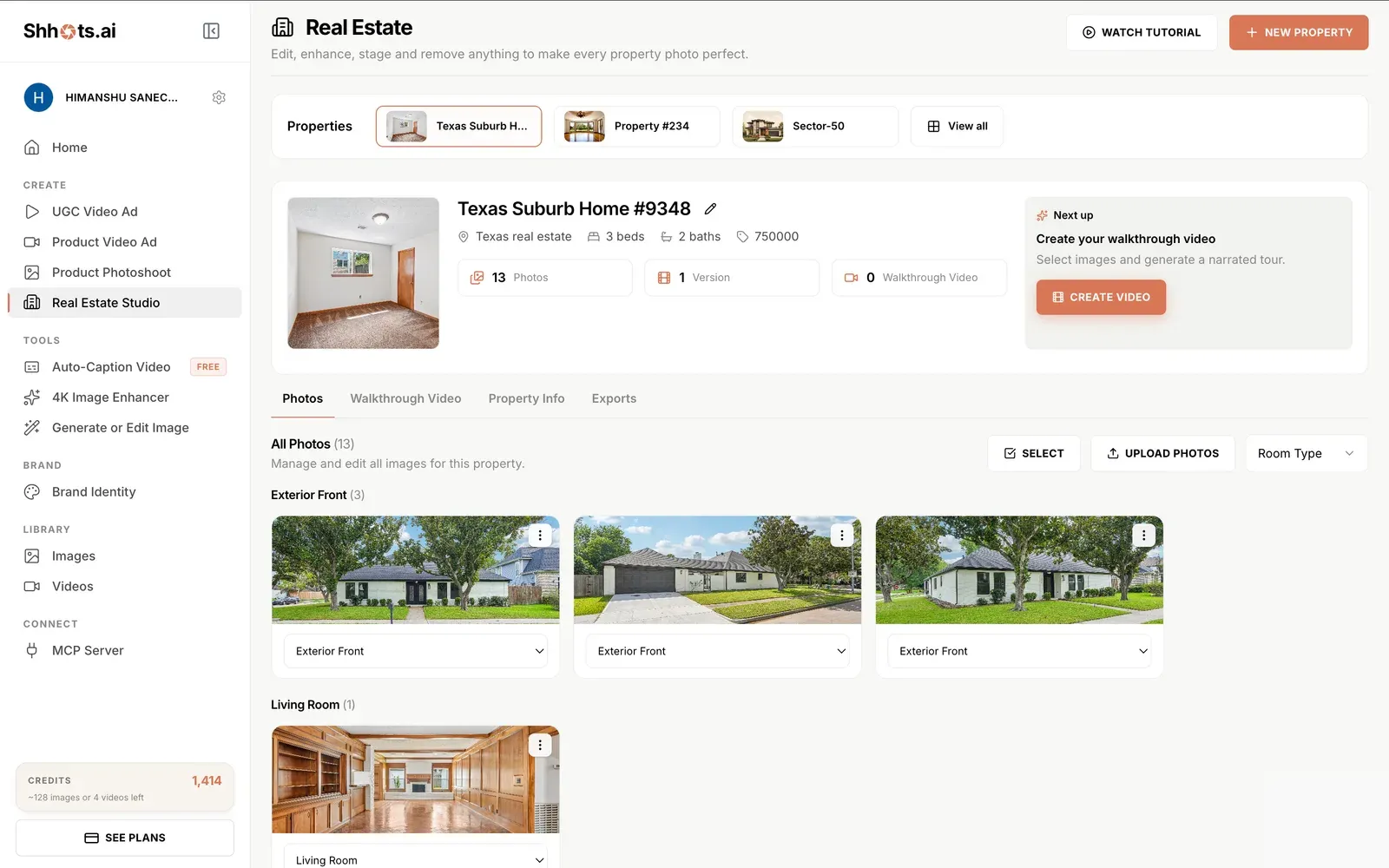
Every image generation is 55 credits, whether it is a staging, a correction, or an object removal. There is no per-listing minimum and no per-photo invoice.
| Plan | Price | Credits | Generated images | Roughly |
|---|---|---|---|---|
| Pro | $49 a month | 6,000 | About 109 | 5 full listings at 20 edited photos each |
| Scale | $99 a month | 12,000 | About 218 | 10 full listings, more on a lighter pass |
Credits are one shared pool across every feature, so the $0.45 per image figure is a ceiling rather than a forecast. Spend some of the pool on listing video and you get fewer images, which is the correct trade rather than a catch.
One more cost that is easy to forget: every staged image carries a disclosure obligation, which is free to satisfy but not free to ignore. See is virtual staging legal.
Two things that are included and often are not elsewhere:
- Watermark-free output at full resolution on every plan, with a full commercial licence covering MLS, portals, brochures, and paid ads.
- The untouched original kept beside every generated version, which matters for disclosure requests and costs nothing.
Full plan detail is on the pricing page.
When the higher price is right anyway
None of this argues that physical staging is obsolete. It wins in specific, identifiable situations.
High-value listings where the viewing decides it. A buyer walking through an empty $3M house feels the emptiness. No photograph fixes that.
Properties with difficult layouts. An awkward room reads badly in person, and physical furniture is the only thing that demonstrates a workable arrangement.
Long-vacant homes. Empty properties develop a smell and an atmosphere. Furniture changes the room in ways a photo edit cannot.
The two approaches also combine. Physically stage the main living space, virtually stage the bedrooms, and put the whole thing on the portal. That is often the cheapest route to a listing that performs both online and at the open house.
Three ways people overspend
Patterns worth checking against your own invoices.
Paying per image for correction and staging separately. Two vendors, two rates, two turnarounds, and the same twenty photos passing through both. A single workspace that does both removes an entire invoice and a day of waiting.
Staging rooms that do not need it. Every staged image costs money and adds a disclosure obligation. A furnished room that already photographs well gains nothing from a restyle. Stage what is hard to read, not everything.
Buying capacity you do not use. The reverse mistake. A plan sized for a brokerage sitting unused on a solo pipeline is worse value than a per-image service. Count your real monthly volume before choosing a tier.
Virtual staging cost over a year
Monthly figures understate the gap, because the per-image tiers scale with your volume and the flat tier does not.
Take the solo agent from earlier, four listings a month with five staged images each. Over twelve months that is 240 staged images.
| Approach | Annual virtual staging cost | What else it covers |
|---|---|---|
| Shhots AI Pro | $588 | Photo correction, removal, upscaling, and listing video on every listing |
| Per-image AI tool at $8 | $1,920 | Staging only |
| Managed service at $30 | $7,200 | Staging only, plus revisions |
The middle column is the one to weigh, and it is the reason a straight per-image comparison misleads. A listing shoot is never only a staging job. Once you add correction at $1.50 to $3.00 an image across the full gallery, the two right-hand rows grow by another four figures a year while the left one does not move.
Home staging cost FAQ
How much does it cost to stage a house?
Between $832 and $2,917 for most homes, averaging about $1,849. A vacant house needing furniture in every room runs $3,000 to $6,000 or more. NAR’s 2025 figures put the median at $1,500 through a staging service and $500 when the listing agent stages it using the seller’s own furniture. Add $100 to $700 per room per month in rental if the listing outlasts the initial period.
What is the difference between virtual staging and real staging?
Real staging puts rented furniture in the house, so it changes both the listing photos and the in-person viewing, and costs $832 to $2,917 plus monthly rental. Virtual staging adds furniture to the photographs only, costs $0.45 to $75 per image, and leaves the house empty at the showing. Virtual staging also has to be disclosed as digitally enhanced in most MLS markets. Real staging does not.
Is staging a house worth the cost?
The evidence is agent survey data rather than measured price lift, so treat it as directional. In NAR’s 2025 report, 29% of sellers’ agents said staging raised the dollar amount offered by 1% to 10%, and 49% said it cut time on market. On a $400,000 sale a 1% improvement is $4,000, which covers an average stage twice over. The survey does not report how often staging produced no lift.
Which rooms should I stage if I can only afford a few?
The living room and the primary bedroom. Buyers named those two most often as the rooms that matter, at 37% and 34%, and they are also the two most commonly staged, at 91% and 83%. Dining rooms get staged by 69% of agents but did not make buyers’ top three, so that is the room to cut first from a quote.
How much does home staging cost per room?
$300 to $700 per room to stage, plus $100 to $700 per room per month in furniture rental. A living room runs $500 to $1,500 and a primary bedroom $400 to $1,200. Because staging is priced by room rather than by home value, a large mid-market house can cost more to stage than a small expensive one.
How much does virtual staging cost per photo?
Between about $0.45 and $75 per photo depending on the approach. AI virtual staging on Shhots AI is 55 credits per generated image, roughly $0.45 on the $49 a month Pro plan. Other AI tools generally run $2 to $25 per image. Managed services with a human designer charge $16 to $75 per image, usually with a minimum order.
Is virtual staging cheaper than physical staging?
Substantially. Physical staging runs $832 to $2,917 for a listing and $3,000 to $6,000 if the home is vacant, plus rental that keeps accruing if the property sits. Virtual staging costs between $0.45 and $75 per image, so even a fully staged gallery of ten images comes in below the cheapest physical quote. The trade is that virtual staging only affects the photographs, and the house is still empty at the viewing.
Why is virtual staging so cheap now?
Because the cost driver changed. A managed service is paying a designer’s time per image, which does not get cheaper with volume. An AI tool is paying for compute, where the marginal cost of one more image is small. That is also why turnaround dropped from days to under a minute, since there is no queue of human work.
Are there hidden fees in virtual staging?
Often. The common ones are revision fees after the first round or two, rush fees for same-day turnaround, minimum order requirements of three to five images, and the difference between per-room and per-image billing. Physical staging adds furniture rental that continues past the initial period if the listing does not sell.
How much should I budget for staging a whole listing?
For a typical listing with five to eight rooms worth staging, budget roughly $4 on AI staging, $120 to $500 at a managed service, and $832 to $2,917 for physical staging, or $3,000 to $6,000 if the home is empty. The wider number to plan around is the whole listing rather than staging alone, since a shoot also needs correction and increasingly needs video.
Does virtual staging cost more for larger homes?
Under per-image pricing, yes, because a larger home has more rooms worth staging. Under per-room pricing, the larger rooms often sit in a higher tier as well. Flat per-generation pricing removes the size penalty entirely, which is why it suits agents working larger properties or higher volume.
Is free virtual staging software any good?
Useful for evaluation, not for listings. Free tiers watermark the output, cap resolution below MLS requirements, and limit daily generations to a handful. Any one of those makes the file unusable on a real listing. Treat a free tier as a demo of the workflow rather than a way to stage a property.
Related reading
- What is virtual staging?, the ground-level explanation, if you are still deciding whether you need it
- Virtual staging before and after, what you actually get at each price point
- Virtual Staging AI alternatives, seven staging tools compared with prices verified August 2026
- Best virtual staging software, the full category roundup with per-photo rates and pricing models
- BoxBrownie alternatives, what the per-image service model costs against a flat plan, with every vendor screenshotted
- Videographer cost vs AI video, the same cost question, applied to listing video
- Real estate photo editing outsourcing, the editing side of the same invoice, with break-even math
Where to start
Work out your real monthly image count first, then compare against that rather than against a per-image sticker price. Most agents are surprised by how quickly twenty images a month makes a flat plan the cheaper option.
Start on Pro at $49 a month and stage one empty room in two styles for 110 credits, or read what virtual staging is if you are still deciding whether you need it.