Disclosure: Shhots AI is our product.
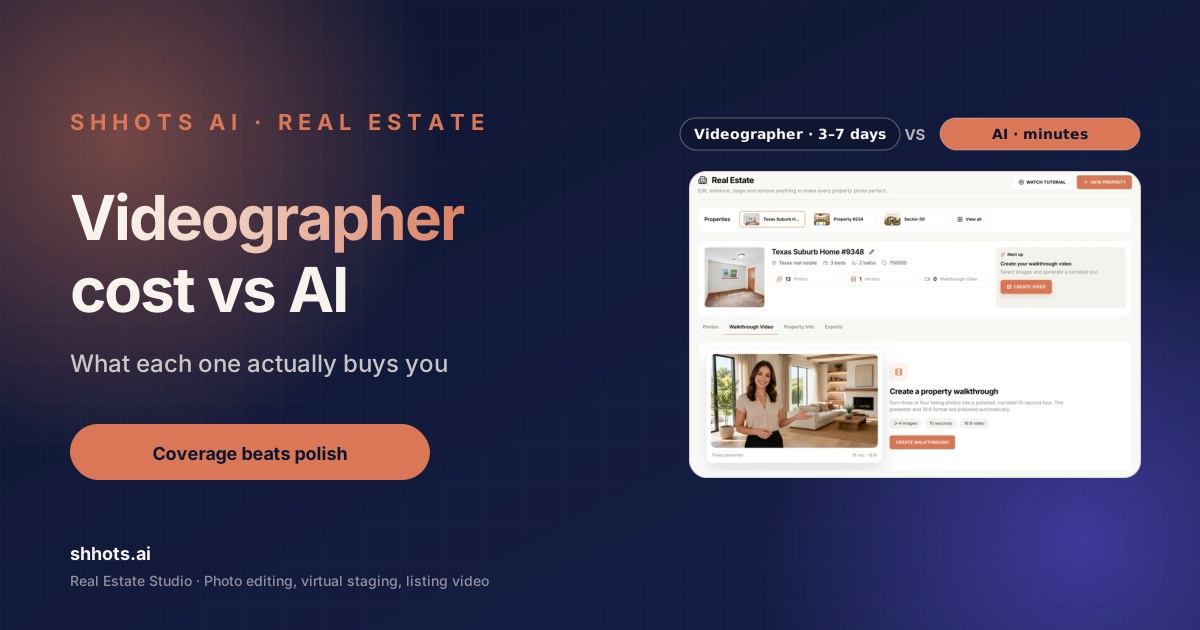
Real estate videographer cost typically runs several hundred dollars per listing with a three to seven day turnaround. AI video tools produce a shorter, simpler walkthrough for credits from a subscription, in minutes.
Those are not competing products so much as competing strategies. One buys you a better film on a few listings. The other buys you a decent film on all of them. This guide works through the actual numbers, what each option genuinely delivers, and how to decide which one your pipeline needs. The production side is covered in how to make a real estate video, and the channel plan in the real estate video marketing guide.
The headline comparison
| Videographer | AI video tools | |
|---|---|---|
| Cost per listing | Several hundred dollars, varies by market | Credits from a monthly plan |
| Turnaround | 3 to 7 days | Minutes |
| On-site shoot | Required | None, built from photos |
| Scheduling | Coordinate with seller and shooter | None |
| Revisions | Billed, adds days | Regenerate immediately |
| Length | Whatever you commission | Typically 15 seconds |
| Motion | Real camera movement through the space | Built from stills |
| Aerial and drone | Available | No |
| Realistic coverage | Your top listings | Every listing |
The last row is the one that decides most of these arguments.
What a real estate videographer actually costs
Pricing varies enormously by market, property size, and what is included, so treat any single figure with suspicion. The structure is more stable than the number.
The base shoot. A standard interior and exterior walkthrough of an average home. This is the bulk of the quote.
Property size. Larger homes take longer to shoot and considerably longer to edit. Most videographers band their pricing by square footage or bedroom count.
Drone and aerial. Usually a separate line item, and it requires an operator holding an FAA Part 107 remote pilot certificate in the US. Worth it on properties where the land or the setting is part of the value.
Twilight shoots. A second visit at the right hour, priced accordingly, and weather dependent.
Agent on camera. Adds shoot time and usually a small premium, since it means multiple takes and audio setup.
Editing turnaround. Standard is three to seven days. Rush delivery is a surcharge where it is available at all.
Revisions. Typically one round included. Changes after that are billed, and each round adds days.
The cost that never appears on the quote is coordination. Finding a slot that works for the videographer, the seller, and the property being presentable is often the slowest part of the whole process, and it lands on you rather than on the invoice.
What AI video tools cost
The structure is simpler because there is no human labour per video.
On Shhots AI’s AI real estate video generator, a walkthrough script costs 1 credit and the render is billed from the same shared credit pool as photo editing and virtual staging. The plans are $49 a month on Pro for 6,000 credits and $99 a month on Scale for 12,000 credits.
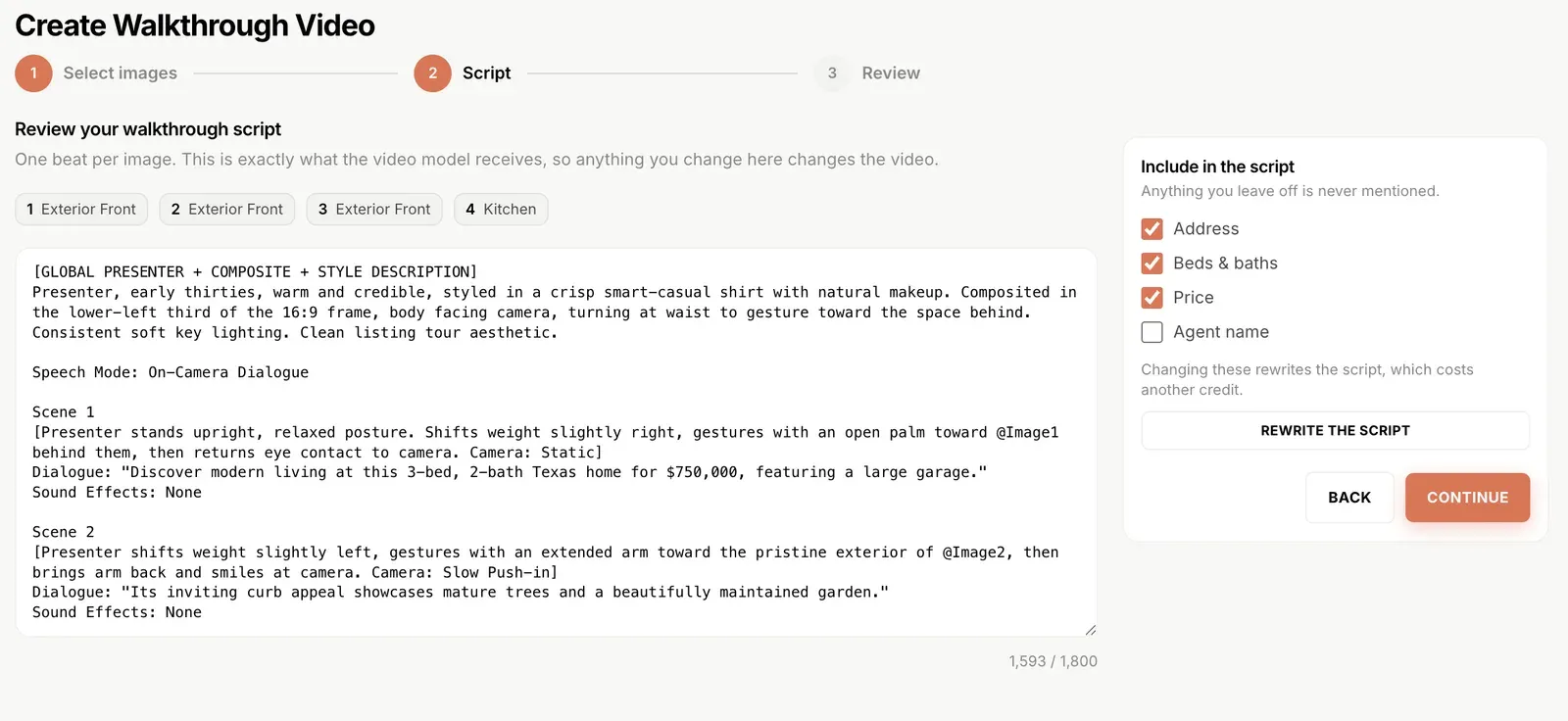
Practically, that means video is not a per-listing decision. It comes out of a pool you are already spending on photo correction and staging, so the marginal cost of adding a walkthrough to a listing you were already editing is small.
There is no rush fee, no scheduling, no minimum, and no revision cost. Generating a second cut with a different opening room costs the same as the first.
Where the videographer genuinely wins
This is not a close call on quality, and pretending otherwise would be silly.
Real camera motion through a space. A gimbal walking through a doorway, down a hallway, and out onto a terrace communicates flow in a way that cuts between stills cannot. On a property where the layout is the selling point, that is the whole video.
Land, views, and setting. Drone footage of acreage, a coastline, or a city skyline has no substitute. If the property’s value is partly in what surrounds it, you need to fly.
Exceptional properties. At the top of any market, the video is part of the product. A buyer looking at a flagship listing expects production values that match the price, and a fifteen-second generated teaser undersells it.
The listing pitch. Sometimes the video exists because you promised it to win the instruction. That is a business reason, and it is a good one.
Anything needing a human on camera in the actual space. An agent walking a buyer through a property, pointing at things, reacting to the room. That is a different piece of content from a narrated photo sequence, and it builds a personal brand that generated video does not.
Where AI video wins
Coverage. This is the entire argument, and it is stronger than it sounds. Most agents commission video for their best listings and give everything else a photo gallery. That split was never about buyer preference. It was about the cost per listing. When a walkthrough costs minutes, the split stops making sense.
Speed on listing day. A property that goes live with a walkthrough on day one captures the burst of attention every new listing gets. A three to seven day turnaround means the video arrives after that window has closed.
Iteration. Because a second cut costs nothing, you can produce an exterior-led version for the portal, a kitchen-led version for Instagram, and a price-led version for the brokerage page. A videographer bills that as three deliverables.
Consistency across a team. Every agent in a brokerage produces the same format, because it comes out of the same generator rather than from whichever freelancer each agent uses.
Listings that do not justify a shoot. Rentals, small units, and lower-value listings where the video budget was always going to be zero. This is the largest category by volume for most agents.
The comparison that actually matters
Set the same budget against both options and the trade becomes clear.
Take an agent with twelve listings a month and a video budget in the low hundreds per month.
With a videographer, that budget covers roughly one listing. Eleven listings get photos only.
With a generated workflow on a $49 or $99 plan, all twelve get a fifteen-second walkthrough, and the budget also covers photo correction and staging across the whole pipeline.
The videographer’s single video is unquestionably better than any of the twelve. The question is whether one excellent video plus eleven photo-only listings beats twelve decent videos. For most agents in most markets, it does not, because the eleven listings with no video are competing against listings that have one.
The hybrid that most teams land on
The answer that survives contact with a real pipeline is not choosing.
Book a videographer for flagship listings. The properties where the video is part of the product and the commission justifies the spend.
Generate for everything else. Which is most of the pipeline, and which currently has no video at all.
Film yourself for personal brand content. Market updates, neighbourhood pieces, and the occasional listing walk. The creator-style formats worth making are covered separately, and presenter options in AI avatar tools for real estate walkthroughs. This is what buyers recognise you from, and no avatar replaces it.
That combination gives you production values where they matter, coverage everywhere else, and a personal presence in your market. Each piece is doing the job it is actually good at.
What decides it for you
Three questions.
How many listings a month? Under three and the per-listing cost of a videographer is manageable. Over ten and it is a budget line you cannot fund at full coverage.
How fast do listings need to go live? If you can wait a week for video, turnaround is not a constraint. If you photograph on Saturday and list on Sunday, a three to seven day edit is not an option regardless of price.
What is the video for? A video that exists to win an instruction should be commissioned. A video that exists to stop the scroll on a portal thumbnail should be generated. These have different jobs and different quality bars.
Quality: an honest read
A generated walkthrough is a narrated sequence of your listing photos with an on-camera presenter. It is competent, consistent, and clearly not a film crew.
It will not fool anyone into thinking you hired a videographer, and trying to sell it that way is a mistake. What it does is beat the realistic alternative, which for most listings is a slideshow with a music bed or nothing at all.
The quality ceiling is set by your photographs, and that is the part agents underestimate. A generated walkthrough built from corrected, staged photos looks substantially better than one built from raw phone shots, because the video inherits everything in the stills and holds it on screen for three seconds. Running the shoot through photo correction and virtual staging first is the highest-use thing you can do to the video.
What this means for videographers
Worth addressing directly, since plenty of people reading this shoot for a living.
The listings AI video takes are the ones that were never going to book a shoot. Mid-market properties with no video budget are not lost revenue, because they were not revenue.
Where it does bite is the low end of the market, where a videographer was competing on price for basic walkthroughs. That work is going.
The response that works is moving up: flagship properties, drone and aerial, agent-on-camera content, and brand work for brokerages. Some photography companies have also added AI editing to their own service, using tools like bulk real estate photo editing to remove the post-production bottleneck and take more listings per week rather than defending a price point.
Working out your own number
The general comparison only gets you so far, because per-listing videographer pricing varies by market more than almost anything else in real estate marketing. Here is how to price it for your own business in about ten minutes.
Step one: get a real quote. Not a website starting price. Call a videographer you would actually use and ask what a standard listing costs in your market, what is included, what drone adds, and what the turnaround is. Ask specifically about revisions, because that is where quotes diverge.
Step two: count your listings. How many went live in the last three months? Divide by three. That is your monthly number, and it is usually higher than people estimate because the quiet months get remembered and the busy ones do not.
Step three: multiply. Monthly listings times the quote. That is what full video coverage costs with a videographer. For most agents the number is uncomfortable, which is precisely why coverage is currently partial.
Step four: compare against the subscription. A monthly plan covering photo correction, staging, and video across the whole pipeline is a fixed number regardless of how many listings you take. Set the two side by side.
Step five: decide what the shoot budget buys. Whatever you were spending on video is now available for the listings where a real shoot changes the outcome. This is the part people miss: the honest conclusion is usually to keep hiring videographers, and to move that budget off ordinary listings and concentrate it on the ones where production values matter.
The hidden costs on both sides
Neither option costs only what the invoice says.
On the videographer side. Coordination time is the big one, and it lands on you rather than on the bill. Finding a slot that suits the videographer, the seller, and a presentable property routinely takes longer than the shoot. Then there is the delay cost: a listing that waits five days for video has spent its opening attention window on a photo gallery.
On the AI side. The photos have to be good first, and if your current workflow ships unedited phone shots then correction is new work rather than free. It is cheap work, but it is not zero. There is also a learning curve of roughly one listing before the workflow becomes automatic.
On both sides. Someone has to read the script or brief before it goes out, and on generated video that check is more important rather than less, because a script written from a property record will state whatever the record says.
Real estate videographer cost by property type
Quotes vary by market, and they also vary by what you are asking someone to shoot. Rough shape of how a real estate videographer cost is usually built up:
Standard residential. The base package. Interior and exterior walkthrough of an average home, edited to two or three minutes.
Large or luxury residential. More rooms, more setups, and considerably more editing. Usually a higher band rather than a surcharge.
Land and acreage. Drone becomes essential rather than optional, which adds a licensed operator and a separate line item.
Commercial. Often quoted bespoke, because the brief varies from a simple space tour to something closer to a brand film.
Rentals and small units. Frequently declined or priced at a minimum that makes no sense for the listing, which is precisely the gap generated video fills.
The pattern worth noticing is that real estate videographer cost rises with exactly the properties where a commissioned shoot is most justified, and stays stubbornly high on the properties where it is least justified. That is the shape that makes a hybrid approach obvious rather than clever.
Videographer cost vs AI FAQ
How much does a real estate videographer cost?
Typically several hundred dollars per listing, varying widely by market, property size, and inclusions. Drone footage, twilight shoots, and agent-on-camera segments are usually separate line items, and standard editing turnaround is three to seven days with one revision round included. The uncosted part is coordination time, which often takes longer than the shoot.
Is AI video cheaper than a videographer?
Substantially, because the pricing model is different rather than discounted. A generated walkthrough costs credits from a monthly plan that also covers photo editing and staging, so the marginal cost of adding video to a listing you were already editing is small. A videographer bills per property regardless of what else you have going on.
Is AI video good enough for real estate listings?
For most listings, yes, and it is clearly not a film crew. A generated walkthrough is a narrated sequence of your photos with an on-camera presenter, and it comfortably beats the realistic alternative for a mid-market listing, which is a music-bed slideshow or nothing. On a flagship property where the video is part of the product, commission a shoot.
Should I fire my videographer?
Probably not. The pattern that works for most teams is booking a shoot for flagship listings, generating for the rest of the pipeline, and filming yourself for personal brand content. Those three do different jobs, and the listings that shift to generated video are usually the ones that never had a video budget.
What can a videographer do that AI cannot?
Real camera motion through a space, which is how you show flow and layout. Drone and aerial work, which matters when the land or the setting carries value. Genuine agent-on-camera presence in the actual property. And the judgement to shoot an unusual property in a way that makes it read correctly.
Does AI video quality depend on my photos?
Completely. A generated walkthrough is assembled from the stills you supply and holds each one on screen for around three seconds, so a blown-out window or a cluttered counter is far more visible than in a gallery. Correcting exposure and staging empty rooms before you build the video is the single biggest quality lever available.
How long does each option take?
A generated walkthrough takes about five minutes from a finished gallery, and a second cut with a different opening takes a few minutes more. A videographer needs a scheduled shoot plus three to seven days of editing, and coordinating the slot with the seller frequently takes longer than either.
Related reading
- How to make a real estate video, the generated route, step by step
- Real estate video marketing guide, budget allocation across a whole pipeline
- AI UGC video for real estate, the content a videographer is not the right tool for
Where to start
Take one listing this month that would never have got a video and give it one. Compare the portal engagement against a comparable listing with photos only. That single test tells you whether coverage is worth anything in your market, which is the real question underneath the price comparison.
Start on Pro at $49 a month, compare plans on pricing, or see the walkthrough format in full on the AI real estate video generator page.