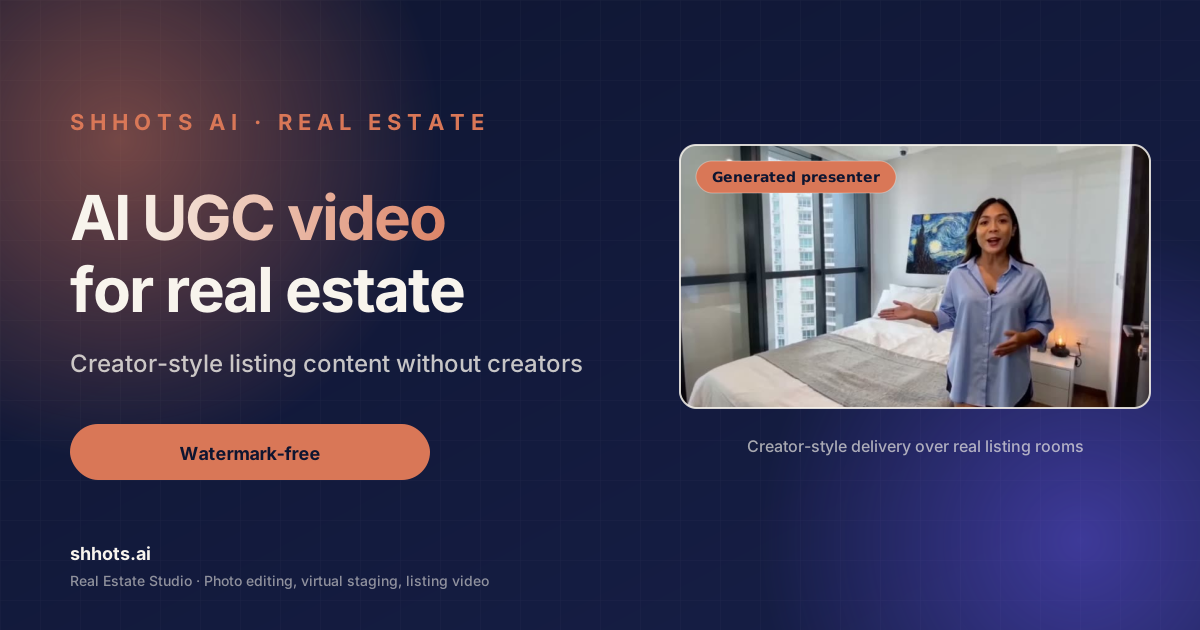
Disclosure: Shhots AI is our product. Of the tools compared here it is the only one we use daily; the others are assessed from their published pricing and documentation, not from months of production use.
AI UGC video for real estate means creator-style content, the kind that looks like a person talking to a phone camera rather than a produced advert, generated instead of filmed. For agents it solves a specific problem: the content that performs on social does not look like the content real estate marketing usually produces.
This guide covers which UGC formats genuinely work for property, which ones fall flat, how AI generation fits, and where the honesty line sits when the person in your video is synthetic. For the presenter tools themselves, see AI avatar tools for real estate walkthroughs, and for the wider plan, the real estate video marketing guide.
Why UGC-style content works for property
Polished real estate marketing has a credibility problem on social feeds. A colour-graded advert with sweeping music reads as a sales message, and viewers have learned to scroll past sales messages in under a second.
Creator-style content reads differently. A person talking directly to camera in a normal room with normal lighting looks like a recommendation rather than an advert, and the feed treats it accordingly.
For real estate this matters in a specific way. Buyers are not choosing between properties on a feed. They are deciding whether an agent is worth following, and whether a neighbourhood is worth thinking about. That is a relationship job, and relationship content looks like a person, not a brochure.
The catch is production. Filming yourself three times a week is the thing every agent agrees they should do and almost nobody sustains past month two.
The six formats that work for real estate
1. The talking-head listing intro
Twenty seconds of a person delivering the three most interesting facts about a property, cut against listing photos.
This is the workhorse and it is the closest UGC format to a conventional listing walkthrough. What makes it UGC rather than an advert is the delivery: direct address, conversational, no music bed swelling underneath.
Works because it gives the viewer a subject to look at. A face holds attention that a slow pan across a kitchen does not.
2. The neighbourhood explainer
A person walking through what it is actually like to live somewhere. Commute, coffee, what the street is like on a Saturday.
The highest-value format for building a local following, because it is useful to people who are not ready to buy yet. Those people become sellers in three years.
3. The objection answer
Thirty seconds answering one question a buyer actually asks. Why this property has been listed twice. What the service charge covers. Whether the extension has permission.
Extremely effective and almost nobody makes it, because it requires knowing what people actually ask rather than what you want to tell them.
4. The before and after reveal
The listing was dark, cluttered, and empty. Here is the same room corrected and staged.
This is the format most likely to be shared, because transformation content travels. It also demonstrates competence to prospective sellers more directly than any pitch deck.
Requires the before and after to be real. Pull the pair from your own gallery, and check the virtual staging before and after guide for what makes a comparison hold up.
5. The market update
Short, specific, local. What happened to prices on these five streets this quarter.
Boring to make and reliably effective, because it is the content sellers search for and the content that positions you as the person who knows the area.
6. The day-in-the-life
Behind the scenes on a listing day. Setting up an open house. What actually happens at a viewing.
Works for personality and recognition. Does not sell any specific property, which is the point.
Where AI generation fits, and where it does not
Be precise about this, because the category name covers two very different things.
Generated presenter, real property. An AI presenter delivers a script over your actual listing photos. This is what a listing walkthrough generator does, and it is legitimate: the property visuals are real, only the narrator is synthetic.
Generated presenter, generated property. An AI presenter in an AI-generated room. This has no place in property marketing. The room is not real, and there is no disclosure that makes showing a buyer a house that does not exist acceptable.
Generated testimonial. A synthetic person describing an experience they did not have. Do not make these. A fabricated client review is a fabricated client review whether it is text or video, and it is the kind of thing that ends a licence rather than a campaign.
The line is simple. Generate the delivery. Never generate the evidence.
Formats one, two, five, and six on the list above work with a generated presenter, because the presenter is delivering factual information rather than personal testimony. Format three usually works. Format four works, provided the before and after are genuinely your own images.
The honest limits of generated UGC
Three things a generated presenter does not do.
It does not build recognition of you. Buyers hire agents they feel they know. A synthetic presenter is a format, not a person, and no amount of it makes people recognise you in a coffee shop. Personal brand content has to be you.
It does not carry genuine enthusiasm. The best listing videos have an agent who is actually excited about a house. That comes through, and generation does not reproduce it.
It does not survive close inspection as authentic. Viewers are getting better at spotting synthetic presenters. Presenting one as a real person is a mistake that will age badly.
What generated UGC does well is volume and consistency. It is the answer to the content nobody has time to film, not a replacement for the content that matters most.
The pattern that works for most agents is filming themselves for personal brand and neighbourhood content, and generating the listing-specific pieces that would otherwise not exist.
Producing it without hiring creators
The conventional route to UGC content is hiring creators, which for real estate has an obvious problem: a creator cannot make content about a property they have never been to, and flying someone to a listing is not a scalable plan.
The generation route runs like this.
Start from finished photos. UGC or not, the property visuals come from your gallery, so correct and stage first. A creator-style video built from unedited phone photos looks like a creator-style video built from unedited phone photos. Run the shoot through photo correction and stage the empty rooms with virtual staging.
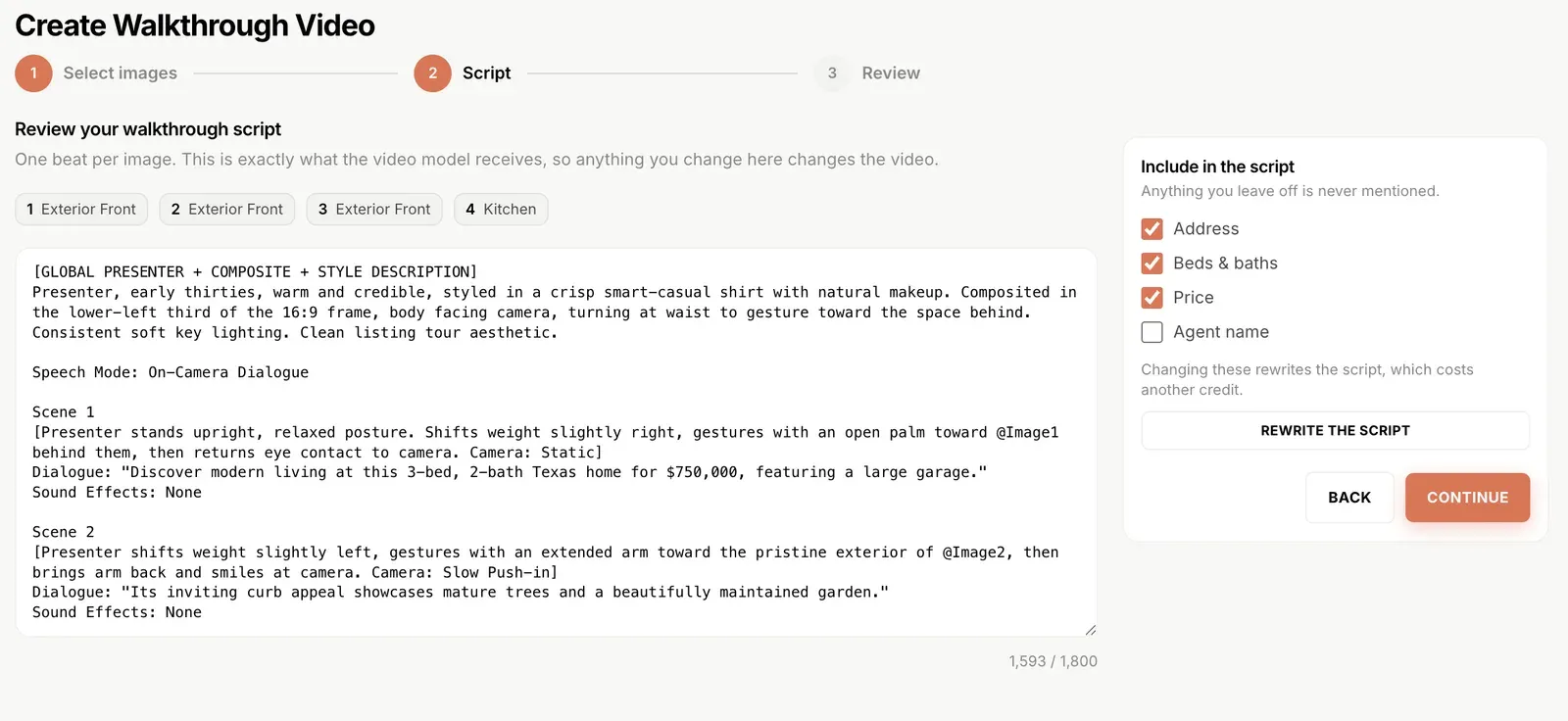
Write to a spoken register. UGC content fails most often on script. Marketing copy read aloud sounds like marketing copy read aloud. Write the way you would explain the property to a friend, contractions included, then cut every adjective that carries no information.
Keep it short. Fifteen to thirty seconds. Completion rate is the metric that matters and short wins it.
Caption everything. Most social viewing is silent. An uncaptioned talking-head video loses its entire script to the majority of its audience. The caption generator handles this.
Make several, publish the ones that work. The advantage of generation over filming is that a second version costs minutes. Use it.
Shhots AI produces UGC-style video across a range of creator profiles and twelve languages, which matters in markets where a meaningful share of buyers are not first-language English speakers. The listing-specific walkthrough format is on the AI real estate video generator page.
What is the best UGC video creation service for real estate marketing?
For listing content specifically, the tool that fits best is the one that starts from the property rather than from a script box. Most AI UGC platforms are built around a product URL or a pasted script, which means you supply the property context manually every time. A listing workflow supplies it from the property record.
Here is the honest state of the market in August 2026.
| Tool | Published price | Per-video math | Real estate fit |
|---|---|---|---|
| Shhots AI | $49/mo Pro, 6,000 credits | About $6.74 per 15-second video | Built around a property record; the same credits cover correction, staging and video |
| HeyGen | $29/mo Creator (600 credits), $49/mo Pro (1,000) | Varies by avatar tier: 3 credits a minute on Avatar III, 20 on Avatar IV and V | Strongest presenter quality, but no listing workflow |
| Creatify | $39/mo Starter (100 credits), $99/mo Pro (300) | About $0.39 a credit on Starter | Built around product URLs, which do not map cleanly to listings |
| Arcads | No public pricing page | Not verifiable | Ad-creative focus rather than property |
| MakeUGC | API tiers reported at $99 for 2,000 credits | About $4.95 a video at API volume | Volume generation, no property context |
On those prices. HeyGen and Creatify were read from their own live pricing pages in August 2026. Arcads has no public pricing page: /pricing has returned a 404 since at least July 2026 and plan details require creating an account, so there is no vendor-published number to quote and we will not repeat a third-party one as fact. Our own Arcads pricing breakdown explains what that opacity costs you. MakeUGC’s figures come from our earlier review rather than a current vendor page.
What a listing video actually costs to generate
A 15-second listing video on the Pro plan is 825 credits for the render plus 1 credit for the script. At $49 for 6,000 credits, that is about $6.74.
| Output | Credits | Cost on Pro |
|---|---|---|
| 15-second listing video | 825 + 1 | About $6.74 |
| Staged photo | 55 | About $0.45 |
| Corrected photo | 55 | About $0.45 |
| A listing: 20 photos corrected, 6 staged, 1 video | 2,256 | About $18.43 |
That last row is the number worth holding onto. A full listing’s visual package, correction through staged rooms through a narrated video, runs about $18 in credits. A videographer alone starts at $300.
Reviews of AI UGC video creators for real estate
Most published reviews of these tools are affiliate content, and it shows in a specific way: they rank tools by feature count and almost never mention the thing that decides whether you keep using one.
Four questions worth more than any review score:
Does it know what a property is? A tool that takes a script and an avatar will make you a video. It will not know the beds, the baths, the neighbourhood or which photo is the kitchen. You supply that every time, for every listing, forever. That is the difference between a tool you use twice and one you use weekly.
What does the second version cost? UGC works by iteration. If a re-render costs a meaningful fraction of a plan’s monthly allowance, you will stop iterating, and the format stops working.
Are captions and upscaling included or billed separately? Several platforms quote a per-video price and then bill captions, actor swaps and upscaling on top. Compare the finished, published-ready video, not the raw generation.
Can you see pricing before creating an account? A vendor that hides its pricing behind a signup is telling you something about how it expects the negotiation to go.
On review scores generally: treat any roundup that has not disclosed which tools the author actually paid for as a directory rather than a review. That standard applies to this page too, which is why the disclosure above names exactly what we use and what we only read about.
What to avoid
Fake testimonials. Covered above and worth repeating. A synthetic person describing a transaction that did not happen is fabricated evidence.
Generated property interiors. The room in the video has to be the room in the property.
Implying the presenter is you. If a viewer could reasonably think the synthetic presenter is the agent they would be dealing with, that is a problem.
Fair housing language. UGC register encourages casual, personal framing, and casual framing about who a neighbourhood suits is exactly where fair housing exposure lives. This needs a human read on every script, and it is the strongest argument against publishing generated scripts unreviewed.
Over-produced UGC. A creator-style video with a colour grade and a music swell is an advert wearing a costume, and viewers read it as one instantly.
Disclosure
Two obligations, both straightforward.
Staged rooms shown in a video need the same label the stills need. Article 12 of the REALTOR Code of Ethics makes no distinction between the gallery and the video slot, and neither do most MLS photo policies.
Synthetic presenter rules are still being written and vary by jurisdiction. The safe practice regardless: do not imply the presenter is a specific real person, do not use anyone’s likeness without agreement, and keep every factual claim in the script checkable against the property.
More in the virtual staging rules and disclosure guide.
Building a repeatable content week
Most agents abandon video because “make more content” is a wish rather than a process, so it competes with showings and loses every time.
A week that actually holds looks like this.
Monday: the listing batch. Whatever went live or is about to go live gets its walkthrough and its vertical cut. This is the non-negotiable one because it is tied to a listing date rather than to your motivation. Fifteen minutes per property once the gallery is finished.
Wednesday: one objection answer. Take a question a buyer actually asked you in the last seven days and answer it in thirty seconds. You are not inventing a topic, you are transcribing a conversation you already had. This is the easiest content to make and the most useful to watch.
Friday: one neighbourhood or market piece. Film this one yourself. It is the piece that builds recognition, and recognition is what wins the seller pitch in two years.
That is three touchpoints a week, one of which is automatic, one of which writes itself from your inbox, and one of which needs a phone and four minutes. The failure mode to avoid is trying to produce five polished pieces and producing none.
Batch the generated work. If four listings go live in a week, do all four walkthroughs in one sitting. The setup cost is per session rather than per video, so four in a row takes less than twice as long as one.
Keep a running note of questions. Every time a buyer asks something twice, write it down. That note is your content calendar for the objection format, and it never runs dry.
What good looks like after three months
Reasonable expectations, so you can tell whether to keep going.
Month one. Nothing much. You are learning what your market responds to and your account has no history of video for the algorithm to work with. Judge yourself on whether you actually published, not on reach.
Month two. You should be able to see which format performs. Usually one of the four pulls clearly ahead, and it is often not the one you expected. In most local markets the objection answers and neighbourhood pieces outperform the listing content, which surprises people because the listing content feels more directly commercial.
Month three. Enquiries start mentioning it. Not many, but the first time a seller says they have seen your videos, the content has done its job. That is also the point where the seller pitch changes, because you can show a prospective client the video you would make for their property instead of describing it.
The thing that does not happen is a viral moment that remakes your pipeline. What happens is a slow accumulation of recognition in a small geographic area, which is exactly what local property marketing has always been.
Scripting for a spoken register
Script is where creator-style content fails most often, and the failure is consistent enough to be worth naming.
Marketing copy read aloud sounds like marketing copy read aloud. “Nestled in a sought-after location, this stunning residence offers” is a sentence nobody has ever said out loud, and a viewer clocks it inside two seconds regardless of how good the presenter looks.
Four adjustments that fix most of it:
Write it as a spoken answer. Imagine a friend asked what the place is like. Start from that sentence rather than from the listing description.
Use contractions. People say “it’s” and “you’ll”. Listing copy avoids them, which is part of why listing copy reads as formal.
One idea per sentence. Subordinate clauses are a written device. Spoken language runs shorter and lands harder.
Cut every adjective that carries no information. Stunning, gorgeous, immaculate, must-see. Replace each one with a fact or delete it. “Three bedrooms and a south-facing garden” beats “a stunning family home” because the first one tells the viewer something.
Read the finished script out loud before you render. If you stumble over a line, so will the presenter, and so will the viewer.
AI UGC video for real estate FAQ
What is the best UGC video creation service for real estate marketing?
For listing work, the deciding factor is whether the tool starts from the property or from a blank script box. Shhots AI builds the script from the property record and shares credits across correction, staging and video, at about $6.74 for a 15-second listing video on the $49 Pro plan. HeyGen has the strongest presenters at $29 to $49 a month but no listing workflow. Creatify is built around product URLs at $39 to $99 a month. Arcads publishes no pricing at all.
How much does an AI UGC real estate video cost?
About $6.74 for a 15-second listing video on the Shhots AI Pro plan, which is 825 credits for the render plus 1 for the script against $49 for 6,000 credits. A full listing package of 20 corrected photos, 6 staged rooms and one video comes to roughly 2,256 credits, about $18.43. Comparable platforms run $5 to $11 a video depending on plan, with captions and upscaling often billed separately.
Are reviews of AI UGC video creators reliable?
Most are affiliate content ranked by feature count. Check whether the author discloses which tools they actually paid for, whether the quoted price is the finished video or just the raw generation, and whether the tool has any concept of a property rather than a generic script. A roundup with no disclosure is a directory, not a review.
What is AI UGC video for real estate?
It is creator-style video content for property marketing, generated rather than filmed. Instead of a polished advert, it looks like a person talking to a phone camera, which is the register that performs on social feeds. In practice the presenter is synthetic and the property visuals are your real listing photos.
Does UGC-style content work for property listings?
It works better than polished advertising for reach on social, because viewers scroll past anything that reads as a sales message. The formats that perform are talking-head listing intros, neighbourhood explainers, objection answers, and before-and-after reveals. Straight adverts with music beds underperform all of them.
Can I use an AI presenter for real estate content?
Yes for factual delivery, no for testimony. A synthetic presenter narrating verifiable facts about a property over your real photos is legitimate. A synthetic person describing a client experience they did not have is a fabricated testimonial, and that is a different category of problem entirely.
Should I still film myself?
Yes, for personal brand and neighbourhood content. Buyers hire agents they feel they know, and a generated presenter does not build recognition of you specifically. The split most agents land on is filming themselves for brand content and generating the listing-specific pieces that would otherwise never get made.
What makes an AI UGC real estate video look fake?
Script register, mostly. Marketing copy read aloud sounds like marketing copy read aloud no matter how good the presenter is. The other giveaways are over-production, since a colour grade and swelling music contradict the creator format, and property visuals that were never corrected, which look exactly as rough in video as they do in a gallery.
Do I need to disclose an AI presenter in a listing video?
Check your jurisdiction, since synthetic media rules are actively being written. The clearer obligation is disclosing virtual staging visible in the video, which most MLS photo policies require. Never imply the presenter is a specific real person, and keep the script factual.
How long should AI UGC real estate videos be?
Fifteen to thirty seconds. Completion rate is the metric that decides reach on social, and short videos win it comfortably. A thirty second video watched to the end outperforms a ninety second video abandoned at fifteen, even when the longer one reports more views.
Related reading
- AI avatar tools for walkthroughs, seven presenter options compared for listing video
- Real estate video marketing guide, the channel plan and posting cadence
- Virtual staging before and after, source material for the reveal format
Where to start
Pick one listing and make two pieces: a fifteen-second talking-head intro built from your best three photos, and a before-and-after reveal from the same gallery. Post both, caption both, and compare completion rate.
Start on Pro at $49 a month, compare plans on pricing, or see the walkthrough format on the AI real estate video generator page.