
Disclosure: Shhots AI is our product.
Real estate video marketing stopped being a question of whether and became a question of how much. Listing portals surface properties with video above properties without, social feeds reward it structurally, and the cost of producing a listing video collapsed in about eighteen months.
What has not changed is that most agents still treat video as something you commission for the top ten percent of listings. This guide is about closing that gap: what to make, where each piece goes, how often to post, and how to tell whether any of it is working.
The strategy in one paragraph
Put a short narrated walkthrough on every listing on the day it goes live. Cut a vertical version for social with burned-in captions. Book a videographer only for flagship properties where the film is part of the product. Film yourself for market and neighbourhood content, because that is what builds recognition. Measure portal engagement and viewing requests rather than views.
Everything below is the detail. For the wider picture of which listing jobs are worth automating, see AI for real estate agents.
Why the economics changed
The old rationing made sense. A listing videographer bills per property with a three to seven day turnaround, so agents reserved video for listings where the commission justified it. Everything else got a photo gallery.
That split reflected the price of a shoot rather than anything buyers wanted. Buyers looking at a $400,000 house want to see it move just as much as buyers looking at a $2M house.
Once a walkthrough can be generated from photos you already have in about five minutes, the constraint disappears and the question inverts. It stops being which listings deserve video and becomes why any listing would go out without one.
The competitive angle matters too. When one agent in a market covers every listing with video and the others cover ten percent, the difference shows up in the seller pitch long before it shows up in engagement data.
The four video types worth making
1. The listing walkthrough
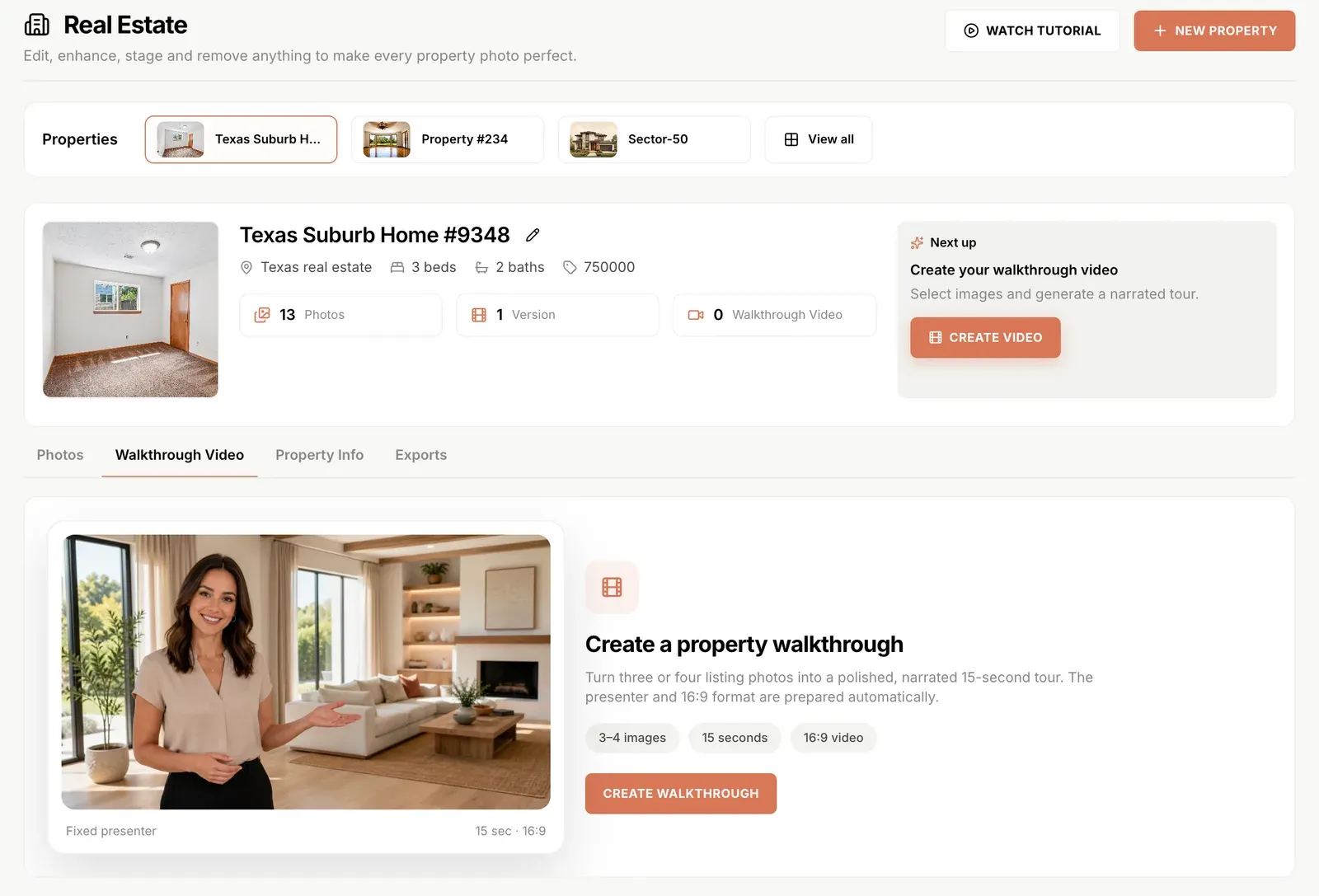
The core asset. Fifteen seconds, narrated, showing three or four rooms.
Its job is to earn the click into the full gallery. Presenter options are compared in AI avatar tools for real estate walkthroughs. It is a trailer rather than a tour, which is why length discipline matters: a room-by-room deep tour buries the hook and loses viewers before the kitchen.
Make one per listing, on the day it goes live. Then make a second cut with a different opening room for a different channel. Details on the AI real estate video generator page, and the step by step is in how to make a real estate video.
2. The vertical social cut
Same content, 9:16, built for Reels and TikTok.
This is where most agents lose the value of their video, by posting a 16:9 file vertically and letting the platform letterbox it. A letterboxed video reads as repurposed, because it is.
Two non-negotiables for vertical: burned-in captions, since most social viewing happens with the sound off, and an opening frame that works as a static thumbnail.
3. Personal brand content
Market updates, neighbourhood guides, answering the question a buyer asked you three times this week.
This is the content that makes people recognise you, and it is the one category where filming yourself beats any generated alternative. The formats worth filming are in AI UGC video for real estate. Buyers hire agents they feel they know, and no synthetic presenter produces that.
Frequency matters more than production quality here. A weekly phone video beats a quarterly polished one.
4. The flagship film
The commissioned shoot. Real camera motion, drone where the setting justifies it, agent on camera.
Reserve it for properties where the video is part of the product and the commission funds it. See videographer cost versus AI video tools for where that line sits.
Where each piece goes
| Asset | Format | Channel | Why |
|---|---|---|---|
| Listing walkthrough | 16:9, 15s | Listing portal, MLS video slot | Portals rank listings with video higher |
| Listing walkthrough | 16:9, 15s | Email to buyer list | Opens far better than a gallery link |
| Vertical cut | 9:16, 15s | Instagram Reels, TikTok | Native format, algorithmic reach |
| Vertical cut | 9:16, 15s | Instagram and Facebook Stories | Short-window local reach |
| Walkthrough | 16:9 | Paid social, geotargeted | Open house promotion |
| Walkthrough | 16:9 | Brokerage listing page | Time on page |
| Personal brand | 9:16 or 16:9 | Reels, YouTube, LinkedIn | Recognition, seller pitch |
| Flagship film | 16:9, 60s+ | YouTube, listing page | Production values on premium stock |
The WhatsApp case deserves a note. Sending a fifteen-second video file directly to interested buyers gets opened far more reliably than a link to a gallery, and it is the single most underused channel in most agents’ toolkits.
Publishing cadence
Every listing, day one. The walkthrough goes live with the listing. New listings get a burst of portal attention in the first seventy-two hours, and video added on day five has missed it.
Two cuts per listing minimum. One 16:9 for the portal and email, one 9:16 for social. Different openings if you can, since it also tells you which room hooks better in your market.
Personal brand weekly. Consistency beats production values. One phone video a week outperforms a polished monthly piece.
Open house promotion, three to five days out. Geotargeted paid social around the property, running into the weekend.
The production sequence that works
The order is not a preference. Get it wrong and you redo the work.
Correct the photos first. A generated walkthrough is assembled from your stills and holds each one on screen for around three seconds, so a blown-out window is far more visible in video than in a gallery. Fix exposure, white balance, and perspective through photo correction before anything else.
Stage what is empty. An empty room in a gallery gets skipped. An empty room in a video sits on screen with a presenter talking over it. Virtual staging handles it for about $0.45 a room. Keep one style across every room that appears in the video, so the cut reads as one house.
Build the video from the finished versions. Not the originals. This is the mistake people make when they are moving fast.
Cut vertical and caption it. Then post.
Teams running this across many listings a month should look at bulk real estate photo editing, which covers the whole-shoot workflow rather than the single-listing one.
What to say in a listing video
Fifteen seconds is about forty words: one specific hook, two or three concrete facts, the location, and a single call to action. The full script recipe, including the toggles that control what a generated script mentions, is in how to make a real estate video.
What matters at the strategy level is the guardrail. Adjectives carry no information, the script must never claim anything the photos do not show, and unpublished prices stay out. Above all, anything touching schools, demographics, or neighbourhood character framed as a value judgement is a fair housing exposure, and it is exactly the kind of line a generated script will produce if nobody reads it before rendering. Build the human read into the process rather than trusting each agent to remember.
Measuring whether it works
Views are the metric everyone reports and the least useful one available.
Portal engagement. Saves, shares, and enquiry rate on listings with video against comparable listings without. This is the closest thing to a direct read.
Completion rate on social. More informative than view count. A fifteen-second video with sixty percent completion is working. A sixty-second video with fifteen percent completion is not, even if it has more views.
Viewing requests attributed to video. Ask. A single line in your enquiry intake asking where they saw the property is worth more than any platform dashboard.
Time on the listing page. If your brokerage site reports it, video usually moves it substantially.
Seller pitch win rate. The one nobody tracks and the one that often matters most. Showing a prospective seller the video you would make for their property is a strong close, and it is worth knowing whether it is landing.
Run a real comparison rather than a vibe check. Take ten listings with video and ten comparable without, over the same period, and look at enquiry rate. That is a test you can act on.
Compliance
Two obligations attach to listing video and both are easy to satisfy.
Staging disclosure carries into video. If the rooms in the walkthrough were virtually staged, the video shows furniture that is not in the property and needs the same label the stills need. The REALTOR Code of Ethics Article 12 obligation to present a true picture covers the video slot as much as the gallery, and most MLS photo policies apply to both.
Fair housing applies to the script. Narration describing who a neighbourhood suits, or framing schools and demographics as selling points, creates exposure. Generated scripts need a human read specifically for this before they render.
More detail in the virtual staging rules and disclosure guide.
Common mistakes
Rationing video to premium listings. The old economics no longer apply, and the listings without video are competing against listings with it.
One cut posted everywhere. Letterboxed 16:9 on Reels signals that the video was made for somewhere else.
No captions. Most social viewing is silent. An uncaptioned narrated walkthrough is a slideshow to most of its audience.
Video before the photos are finished. Costs you the whole job twice.
Starting at the front door from habit. Lead with the best room. Habit is not a strategy.
Measuring views. Completion and enquiry rate tell you something. View count tells you almost nothing.
Publishing late. Day five video misses the attention window that day one video captures.
A 30-day starting plan
If none of this is currently running, do not try to launch all four content types at once. Sequence it.
Week one: listing walkthroughs only. Every listing that goes live gets a 16:9 walkthrough on day one. Nothing else changes. The goal is proving the production sequence works and finding out how long it actually takes you, which is usually less than expected once the gallery is finished.
Week two: add the vertical cut. Same listings, second cut, captions burned in, posted to Reels. Now you have two channels running from one gallery. Note which opening room you used on each and start paying attention to completion rate.
Week three: add one personal brand piece. Film it yourself. A market update or an answer to the question you have been asked most this month. Four minutes of filming, no production.
Week four: review and adjust. Compare enquiry rate on the listings from weeks one to three against the equivalent period before. Look at completion rate across the vertical cuts. Decide which opening room works in your market.
By the end of the month the listing video is automatic, the vertical cut is a habit, and you have a read on whether the brand content is worth continuing. That is a stable base you can keep running rather than a campaign that ends.
Budget allocation that works
For an agent spending on marketing rather than starting from zero, a workable split.
The fixed base. A subscription covering photo correction, staging, and video across every listing. This is the layer that gives you coverage, and it should be the first thing funded because it applies to your whole pipeline rather than to individual properties.
The flagship fund. Whatever remains goes to commissioned shoots on listings where the film is part of the product. Concentrating this rather than spreading it thin is the whole point.
Paid promotion. Geotargeted spend around open houses, running three to five days out. Small budgets work well here because the targeting is tight by definition.
The mistake is the reverse order, which is what most marketing budgets currently do: spend on a shoot for one listing, leave nothing for the other eleven, and promote none of them.
Real estate video marketing FAQ
Does video actually help sell listings?
It reliably helps listings get attention, which is upstream of everything else. Portals surface properties with video above those without, and social feeds structurally favour it. The honest framing is that video wins the click and the viewing request, while the property and the price decide the sale.
How long should a real estate marketing video be?
Fifteen seconds for portal previews and social, and sixty seconds or more only for flagship listings on YouTube. Short narrated overviews get watched to completion, while long room-by-room tours lose viewers before the kitchen. Completion rate matters more than length, and short videos win on completion.
How often should real estate agents post video?
One walkthrough per listing on the day it goes live, in at least two cuts for different channels, plus roughly one personal brand video a week. Consistency beats production values on the brand content, since recognition comes from frequency. Listing video should be automatic rather than a decision you make per property.
What is the best platform for real estate video?
Your listing portal first, since that is where buyers with intent are already looking and video affects placement. Instagram Reels second for reach in a local market. Direct sends over WhatsApp or email are the most underused channel and get opened far more reliably than a gallery link.
Do I need a videographer for real estate video marketing?
Only for flagship listings where the film is part of the product, or where drone footage and real camera motion through the space carry the property. For the rest of a pipeline, generated walkthroughs from listing photos give you coverage that a per-listing shoot budget cannot fund.
Should real estate videos have music or narration?
Narration, with music underneath if anything. A music-only slideshow gives the viewer nothing to attend to, which is why those videos underperform. A voice delivering specific facts about the property holds attention and communicates something a photo grid cannot.
How do I measure real estate video marketing?
Compare enquiry rate on listings with video against comparable listings without, over the same period. On social, track completion rate rather than views. Ask enquirers where they saw the property, since a single intake question beats most platform dashboards for attribution.
Related reading
- How to make a real estate video, the production detail behind every cut on this page
- AI avatar tools for walkthroughs, choosing a presenter platform
- AI UGC video for real estate, the creator-style formats worth adding
- Real estate reels: 10 formats that work, the short-form layer, with hooks and per-reel costs
Where to start
Pick your next ten listings and commit to a walkthrough on each, day one, in two cuts. Compare enquiry rate against the ten before them. That is a real test, it takes about a month, and it will settle the question for your market better than any general guidance including this page.
Start on Pro at $49 a month, compare plans on pricing, or read how to make a real estate video for the production detail.