Disclosure: Shhots AI is our product.
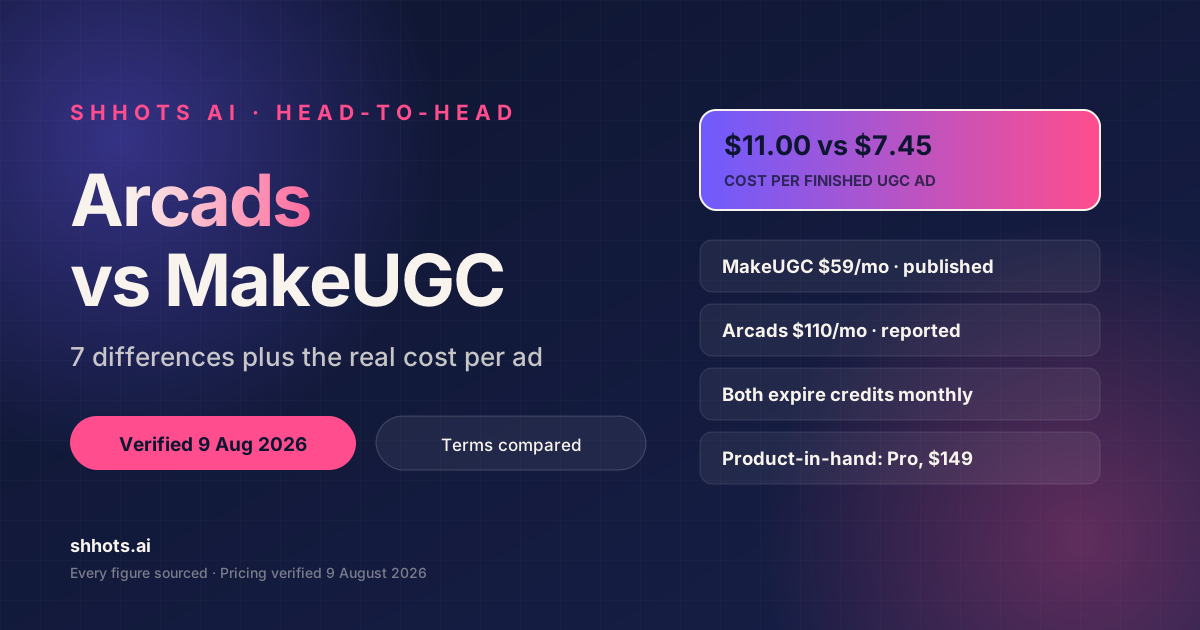
In Arcads vs MakeUGC, MakeUGC is cheaper to start ($59/month, published) and is the only one of the two that sells product-in-hand video as a named feature. But that feature sits on its $149 Pro plan, and its credits expire monthly with no rollover. Arcads has the deeper actor library and broader model catalogue, but publishes no pricing at all and rounds every video up to a full minute.
Pricing verified 9 August 2026. We re-check every price in this post quarterly and update the date above.
Arcads vs MakeUGC at a glance
| Arcads | MakeUGC | |
|---|---|---|
| Entry price | $110/mo reported, not published | $59/mo (Startup), published |
| Mid tier | $220/mo (Creator) | $79/mo (Growth), adds batch mode |
| Top self-serve | $550/mo (Pro) | $149/mo (Pro), adds product-in-hand |
| API plans | Undisclosed pricing | $99/mo (2,000 cr) · $299/mo (6,000 cr) |
| Credits at entry | 8,000 | 500 |
| Cost per finished ad | ~$11.00 | ~$11.80 - $7.45 (derived) |
| Credit rollover | No (Starter/Creator) | No, expire monthly |
| Trial | None | 3 days, $1 per the policy page title |
| Refund window | 24h / 7d / 30d, zero-usage conditions | 3 business days, scaled by credit use |
| Actor library | 1,000+ advertised | 1,000+ advertised (site figures conflict) |
| Languages | 30-35+ | 50+ (site figures conflict) |
| Product-in-hand | Presets, unreliable per reviewers | Named feature, Pro tier only |
| Ad platform integrations | None | None |
| Trustpilot | ~3.0-3.3 (~150 reviews) | 3.0/5 (90 reviews) |
Arcads vs MakeUGC on price
The headline gap looks enormous, $110 against $59, and it mostly isn’t real, because the two meter completely differently.
What MakeUGC costs per ad
MakeUGC’s plans are published: Startup $59 for 500 credits, Growth $79 for 1,000, Pro $149 for 2,000. What it doesn’t publish anywhere is a credits-per-video rate.
You can derive one from MakeUGC’s own numbers. It labels its API Starter plan (2,000 credits) as “20 videos/mo” and API Pro (6,000 credits) as “60 videos/mo”, implying roughly 100 credits per video. Applied to the platform tiers:
| Plan | Price | Credits | Implied videos | Cost per ad |
|---|---|---|---|---|
| Startup | $59 | 500 | 5 | ~$11.80 |
| Growth | $79 | 1,000 | 10 | ~$7.90 |
| Pro | $149 | 2,000 | 20 | ~$7.45 |
| API Starter | $99 | 2,000 | 20 | ~$4.95 |
| API Pro | $299 | 6,000 | 60 | ~$4.98 |
Treat those as derived rather than verified. MakeUGC says real cost varies “by model, duration, and resolution.” But the 5/10/20-video structure is corroborated by how MakeUGC’s tiers were described earlier in 2026, so the shape is right.
Note the API rows. MakeUGC’s API is roughly 33% cheaper per credit than its own platform plans. If you’re generating programmatically, that’s the tier to look at.
What Arcads costs per ad
Arcads publishes nothing: arcads.ai/pricing returned a 404 when we checked on 9 August 2026. Reported figures put Starter at $110 for 8,000 credits.
What Arcads does publish is the credit rate: 800 credits per minute, per actor, with length “always rounded up.” At $0.01375 per credit that’s $11.00 per video, and the round-up rule means a 15-second ad costs exactly the same as a 60-second one.
We break the whole thing down in the full Arcads AI pricing breakdown.
The honest read
At the entry tier, Arcads vs MakeUGC is basically a wash on cost per ad, $11.00 against $11.80. Arcads gives you 8,000 credits for $110; MakeUGC gives you 500 for $59. Different denominations, similar economics.
The gap opens at volume. MakeUGC’s Growth and Pro tiers get materially cheaper per ad ($7.90 and $7.45). Arcads’ cost per credit is flat at $0.01375 across every tier, upgrading buys features, not a volume discount. By the time you’re at MakeUGC Pro, you’re paying roughly a third less per ad than Arcads at any tier.
But MakeUGC raised prices recently. Its tiers were $49/$69/$119 earlier in 2026 for the same video counts. The current $59/$79/$149 represents roughly a 20-25% increase. Any Arcads vs MakeUGC comparison quoting the old numbers is out of date.

The trial and refund terms both make you agree to
This is the part of Arcads vs MakeUGC that almost nobody covers, and it’s where most of the one-star reviews for both products come from.
MakeUGC
MakeUGC’s pricing page advertises a “3 days free trial.” Its own policy page is titled “$1 Trial Fair Use & Anti-Abuse Policy.” Those two things are not the same, and the discrepancy is on MakeUGC’s own site.
The trial policy itself is unusually strict. One trial per person or legal entity. Multiple accounts, linked payment methods, shared payment instruments, or using a VPN or proxy trigger a charge of the full monthly subscription fee for the selected plan, “immediately and without further notice”, and “no refunds, chargebacks, or reversals shall be issued in respect of Penalty Charges.”
Read that again if you routinely browse through a VPN. It’s a documented term, not a rumour.
The refund policy is tiered by consumption: full refund within 3 business days if credits haven’t been substantially used; 50% refund if under half your credits are used; no refund at 50% or more. Nothing after two weeks of active use, and refunds are email-only through one named address.
Credits expire monthly with no rollover, which MakeUGC states plainly in its own FAQ.
Arcads
No trial at all. Arcads’ refund policy allows a full refund within 30 days if you used zero credits, a change-of-mind refund within 24 hours of first charge (zero credits, first request only), and a wrong-plan correction within 7 days. Completed generations, creative dissatisfaction and any period with credit usage are all non-refundable. Cancellation requires 72 hours’ notice before period end.
Credits don’t roll over on Starter or Creator, and hitting the limit pauses the account rather than triggering overage.
Neither policy is unusual for the category. Both are stricter than most buyers assume. The practical takeaway: on both platforms, decide within the first day or two, because generating anything meaningfully weakens your refund position.

7 differences that actually matter
1. Price transparency. MakeUGC publishes every plan. Arcads publishes none. If you need a number before a card, that decides it.
2. Billing granularity. Arcads rounds up to the minute; MakeUGC bills by model, duration and resolution. For short-form ads, MakeUGC’s model is fairer even where the headline is similar.
3. Product-in-hand video. MakeUGC sells it as a named Pro-tier feature. An actor naturally holding and presenting your product. Arcads has unboxing and product-showcase presets but reviewers report roughly a 20% failure rate on them. Neither is flawless, but only one of them is a supported product feature.
4. Batch mode. MakeUGC gates batch mode to Growth ($79) and above, with parallel generation of up to 10 videos or images. Arcads’ Workflows feature does the same job with more depth, node-based fan-out across actors and languages, but sits behind an unpublished price.
5. Model catalogue. Arcads wins comfortably: 11 video models, 8 image models and 3 talking-actor engines, including Sora 2, Veo 3.1, Kling 3.0 and Seedance 2.0. MakeUGC names fewer models and caps Veo3 output at 25 seconds.
6. API economics. MakeUGC publishes two self-serve API tiers at $99 and $299, and they’re a third cheaper per credit than its platform plans. Arcads has a documented API with no published pricing, reportedly gated to the top tier.
7. Integrations. Both are thin. MakeUGC names only ElevenLabs. Arcads has an MCP server for Claude, which is genuinely useful if you’re building automations, but neither connects to Meta or TikTok Ads Manager. Neither tool publishes your ads for you, anything claiming otherwise is describing export file specs.
Arcads vs MakeUGC on reputation
MakeUGC holds 3.0/5 across 90 reviews on Trustpilot (verified 9 August 2026), with a heavily polarised five-star/one-star split and the company responding to about 45% of negative reviews. Complaint clusters: cancellation not working, billing continuing after confirmed cancellation, refund deductions based on credit usage, and inconsistent output quality, particularly on product-in-hand video, which is the feature people upgrade for.
That refund complaint is the interesting one, because it isn’t a misunderstanding. MakeUGC’s published policy genuinely does scale refunds down by credit consumption. Reviewers are describing the policy working as written.
Arcads sits at roughly 3.0-3.3 across ~150 Trustpilot reviews, similarly polarised, with complaints concentrating on unexpected charges, refused refunds and slow support. It has no G2 listing at all, so there’s no verified-buyer counterweight.
Neither product has a clean reputation, and both have the same failure mode: the billing layer. We go deeper on the Arcads side in our Arcads AI review.
One methodological note: we found no indexed Reddit discussion for MakeUGC in any search formulation. If you see an Arcads vs MakeUGC comparison quoting “Reddit users,” check whether it links to an actual thread. Most don’t.

What each tier actually includes
Both products gate meaningful features behind tiers, and in both cases the feature you probably want isn’t on the entry plan. This is the part of Arcads vs MakeUGC that decides your real budget.
MakeUGC Startup ($59) gives 500 credits, a selection of models, parallel generation of up to 10 videos or images, HD/2K/4K export and unlimited AI scripts. What it doesn’t give you is batch mode or product-in-hand video.
MakeUGC Growth ($79) adds all AI models and batch mode, generating across multiple creators in one run. For most ad-testing workflows this is the real entry tier, not Startup.
MakeUGC Pro ($149) is where product-in-hand video lives, along with Video Agent and PDF-to-video. If the reason you’re considering MakeUGC is an actor holding your product, your price is $149, not $59. That’s worth internalising before you compare headline numbers.
Arcads Starter reportedly limits you to around 300 of the advertised 1,000+ actors, with captions and background removal excluded. Since almost every UGC ad ships with captions, that’s a functional gap rather than a nice-to-have.
Arcads Creator reportedly adds roughly 1,000 actors plus captions and background removal.
Arcads Pro is reportedly the only tier with API access, actor cloning, premium ElevenLabs voices, team collaboration and overage billing. Arcads publishes none of this gating, so treat it as third-party reporting and confirm before you buy.
The pattern is the same on both sides. The entry tier is a demo of the product rather than the product. On MakeUGC that’s transparent, because the tiers are published and you can see exactly what’s missing. On Arcads it isn’t, because nothing is published at all. You find out what your plan excludes after you’ve paid for it.
A practical way to budget: decide which single feature you’d be buying the tool for, product-in-hand, batch, captions, API, then find the cheapest tier on each platform that includes it, and compare those numbers. On that basis, Arcads vs MakeUGC for a team that needs captions and batch generation is roughly $220 against $79, which is a very different comparison from $110 against $59.
Arcads vs MakeUGC: which should you pick?
Pick MakeUGC if you want a published price, you need product-in-hand video as a supported feature, you’re at moderate volume where Growth or Pro tiers pay off, or you’re building on an API and want the $99 tier’s economics.
Pick Arcads if you need the widest model catalogue, the deepest actor library, or Workflows-grade batch automation. And you can absorb an unpublished price and per-minute round-up billing.
Pick neither if your ads are short and product-led, you’re testing at low volume, or you want your money back if it doesn’t work out. Both refund policies make that difficult by design.
For the wider field, we’ve ranked 10 MakeUGC alternatives, Arcads AI alternatives and the best AI UGC ad tools. For the other major head-to-head, see HeyGen vs Arcads.
Where Shhots AI fits
We’re the third option here, so read this as positioning. But the numbers are checkable.
Shhots AI pricing starts at $19/month for 2,000 credits, with a 10-second UGC ad costing 551 credits. That’s $6.33 per ad on Starter, $4.90 on Pro ($49) and $4.71 on Scale ($99), below both tools at every comparable tier. Prices are published, captions are unlimited and free, annual plans carry unused credits within the year, and every plan includes a full commercial licence.
The workflow is different too: you start from a product photo rather than a script, which is why product ads are the thing we’re built for rather than a tier-gated feature.
Where the other two beat us honestly: Arcads has a far deeper model catalogue and actor library, and MakeUGC’s $99 API tier is cheaper per video than our subscription if you’re generating programmatically at volume. If either of those is your requirement, buy accordingly.
Otherwise, try the AI UGC ads generator on your own product photo and compare the output.
FAQ
Is MakeUGC cheaper than Arcads?
At entry level they’re close, roughly $11.80 per ad on MakeUGC Startup versus about $11.00 on Arcads. MakeUGC gets meaningfully cheaper at higher tiers ($7.45 per ad on Pro), while Arcads’ cost per credit stays flat across all plans. MakeUGC’s entry price of $59 is also about half Arcads’ reported $110.
Which is better for product ads, Arcads or MakeUGC?
MakeUGC, on paper. It sells product-in-hand video as a named feature on its $149 Pro plan. Arcads offers unboxing and product-showcase presets, but reviewers report roughly a 20% failure rate with product elements missing or misrendered.
Does MakeUGC have a free trial?
MakeUGC’s pricing page advertises a 3-day free trial, but its own policy page is titled “$1 Trial Fair Use & Anti-Abuse Policy.” The trial is one per person or entity, and using a VPN or multiple accounts triggers an immediate, non-refundable full-month charge.
Does Arcads have a free trial?
No. Arcads offers no free trial or free video plan. It provides 100 free images per day, and a 24-hour change-of-mind refund window valid only if you’ve generated nothing.
Do MakeUGC credits roll over?
No. MakeUGC states that credits refresh each billing cycle and unused credits expire at month end. Arcads credits also don’t roll over on its Starter and Creator plans.
How many AI actors do Arcads and MakeUGC have?
Both advertise 1,000+. MakeUGC’s own site is inconsistent, different pages state 1,000+, 500+, 300+ and “over 100.” Arcads advertises 1,000+ with tier-gated access reported but not published. Verify in-app on whichever you trial.
Can either tool publish ads directly to Meta or TikTok?
No. Neither Arcads nor MakeUGC connects to Meta Ads Manager or TikTok Ads Manager. Both export files that meet platform specs, which is not the same thing.
What do MakeUGC reviews say?
MakeUGC holds 3.0/5 across 90 Trustpilot reviews as of 9 August 2026, sharply split between five-star and one-star. Negative reviews cluster on cancellation failures, post-cancellation billing, refunds reduced by credit usage, and inconsistent output on product-in-hand video.
Is MakeUGC’s API worth using?
If you’re generating at volume, yes. Its API tiers ($99 for 2,000 credits, $299 for 6,000) work out roughly a third cheaper per credit than the platform plans, at about $4.95 per video.
Final take
Arcads vs MakeUGC comes down to what you’ll tolerate. MakeUGC tells you the price, sells product-in-hand video properly, and gets cheaper as you scale. But expires your credits monthly and has a refund policy that shrinks with every generation. Arcads has the better model catalogue and the deeper actor library, and won’t tell you what it costs until you’re inside.
Neither is built primarily for short, product-led ads on a small budget. That’s the gap Shhots AI was built for, at $19/month with the rates published.
Try Shhots AI on your own product photo
Both tools gate the feature you actually want behind a higher tier. Shhots publishes every rate and puts product-led output on the entry plan.
- $19/month, $6.33 per 10-second UGC ad, dropping to $4.71 on Scale.
- Annual plans carry unused credits within the year rather than expiring them monthly.
- Full commercial licence, unlimited free captions, 12 languages on every plan.
See Shhots AI pricing → · Try the AI UGC ads generator → · Book a demo →