Disclosure: Shhots AI is our product.
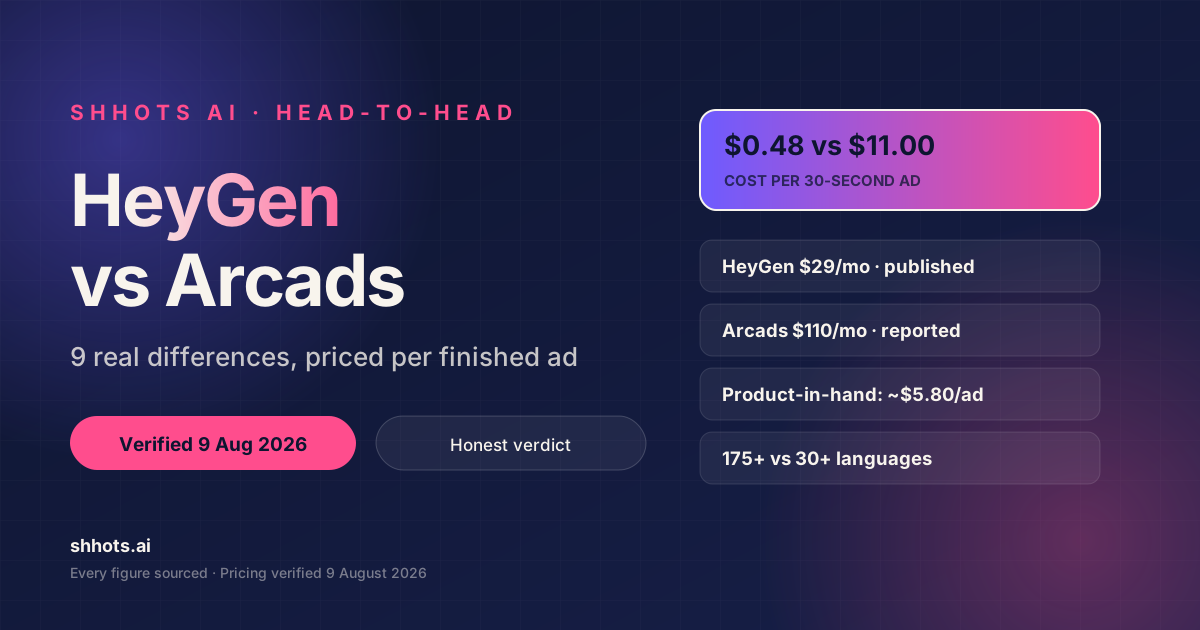
In HeyGen vs Arcads, HeyGen is dramatically cheaper for talking-head video, roughly $0.48 versus $11.00 for a 30-second ad, while Arcads is purpose-built for UGC ad testing with 1,000+ actors and hook tooling HeyGen simply doesn’t have. The catch nobody mentions: the moment you need your product visibly in the creator’s hands, HeyGen’s cost jumps to about $5.80 per ad and its entry plan caps you at five of them a month.
Pricing verified 9 August 2026. We re-check every price in this post quarterly and update the date above.
HeyGen vs Arcads at a glance
| HeyGen | Arcads | |
|---|---|---|
| Entry price | $29/mo (Creator), $24/mo annual | $110/mo reported, not published |
| Pricing transparency | Published on site | arcads.ai/pricing returns 404 |
| Free plan | Yes, 3 videos/mo, 720p, watermarked | No video free tier; 100 free images/day |
| 30-second talking ad | ~$0.48 (Avatar IV) | ~$11.00 |
| 30-second product-in-hand ad | ~$5.80 (Veo 3.1) | ~$11.00 |
| Stock avatars | 500+ free / 700+ paid | 1,000+ advertised |
| Languages | 175+ | 30-35+ |
| Billing granularity | Per second (3s = 1 credit) | Rounded up to the minute |
| Hook / ad-script tooling | None | Hook repurposer, presets |
| Ad platform push | None | None |
| Trustpilot | ~2.5/5 (~2,000 reviews) | ~3.0-3.3/5 (~150 reviews) |
| G2 | 4.8/5 (1,941 reviews) | No listing |
That table already contains the whole argument, but the numbers underneath it are where the decision actually gets made.
HeyGen vs Arcads on price: what a 30-second ad really costs
Comparing $29 against $110 tells you almost nothing, because the two tools meter completely differently.
How HeyGen’s credits work
HeyGen publishes its rates, and they’re specific. From HeyGen’s credit documentation, verified 9 August 2026:
| Engine | Credit cost |
|---|---|
| Avatar III | 3 credits per minute |
| Avatar IV / Avatar V | 20 credits per minute |
| Custom Expressive Motion | 40 credits per minute |
| Video Agent | 40 credits per minute (120 in Seedance mode) |
| Veo 3.1 in Product Placement | 30 credits per 8-second scene |
| Video translation | 2-10 credits per minute |
| Image assets | 2 credits per image |
Plans give you 600 credits on Creator ($29), 1,000 on Pro ($49) and 1,500 on Business ($149, plus $20 per extra seat). Crucially, HeyGen bills by actual generation seconds, three seconds is one credit on Avatar IV. There’s no minimum.
So a 30-second Avatar IV ad is 10 credits. On Creator that’s $0.48. On the cheaper Avatar III engine it’s $0.07.
How Arcads’ credits work
Arcads bills talking-actor video at 800 credits per minute, per actor, and its help centre states that length is always rounded up. At the reported Starter rate of $110 for 8,000 credits, $0.01375 per credit, that’s $11.00 per video, whether the video is 15 seconds or 60.
This is the crux of HeyGen vs Arcads on cost. HeyGen charges you for the seconds you use. Arcads charges you for the minute you started. For 15-30 second UGC ads, which is what most of these get used for, that difference is enormous.
We’ve broken the whole thing down in our full Arcads AI pricing breakdown.

The “unlimited videos” asterisk on HeyGen
HeyGen’s Creator plan advertises unlimited videos up to 30 minutes long. That’s true, at 3 credits per minute on Avatar III.
Do the arithmetic on the engine you’d actually want for an ad:
- Avatar III at 3 cr/min: 600 credits = 200 minutes of video a month.
- Avatar IV at 20 cr/min: 600 credits = 30 minutes a month.
- Custom Expressive Motion at 40 cr/min: 15 minutes.
- Video Agent in Seedance mode at 120 cr/min: 5 minutes.
“Unlimited” is doing a lot of work there. The photoreal engine costs 6.7× more than the one the unlimited claim is based on. This is verifiable from HeyGen’s own help centre, and it’s the single most useful thing to know before you pick a plan.
Arcads, to its credit, doesn’t make an unlimited claim at all. Its credit budget is what it is.

HeyGen vs Arcads on product-in-hand ads
This is where the comparison flips, and it’s the part that matters most if you sell physical products.
HeyGen has an AI Product Placement feature: you upload a product image, pick an avatar, and it generates the avatar holding or demonstrating the product. Under the hood, multi-scene output routes through Veo 3.1 at 30 credits per 8-second scene.
A 16-second two-scene product ad is 60 credits: $2.90 on Creator. A 24-second three-scene ad is 90 credits, about $4.35. A 32-second four-scene ad is $5.80. And with 600 monthly credits, Creator gives you roughly five to ten product-placement ads a month before you’re out.
HeyGen’s own documentation is candid about the limits: it “works best with small or handheld products like cosmetics, gadgets, or packaged items,” and warns that “larger objects like desks or furniture may appear scaled down.” The output aspect ratio also inherits from your source product image rather than snapping to a 9:16 ad preset, which means manual reframing on almost every asset.
Arcads has product-showcase and unboxing presets at 200-800 credits, but reviewers consistently flag physical-product rendering as its weakest area, with one hands-on reviewer reporting roughly a 20% failure rate on unboxing presets where product elements came out missing or wrong.
The honest verdict on this dimension: neither tool is really built for it. Both are avatar platforms that added product handling. If your ads live or die on the product being recognisably itself, that’s a structural limitation of the category, not a bug in either product.
9 differences that actually matter
1. Price transparency. HeyGen publishes every plan. Arcads publishes none. Its pricing URL 404s, and every figure in circulation is third-party sourced. If you can’t get a price without a card, that’s information about the company.
2. Billing granularity. Per-second versus rounded-up-to-the-minute. On 15-second ads, this is a 4× difference.
3. Actor library depth. Arcads advertises 1,000+ actors built for ad creative; HeyGen offers 500-700 stock avatars skewed toward corporate and spokesperson use, plus a dedicated UGC line. For pure face variety in ad testing, Arcads is the stronger library.
4. Hook and script tooling. Arcads has a hook repurposer, an ad preset library and a public hook generator. HeyGen has none of this. It renders the script you bring. In HeyGen vs Arcads terms, HeyGen is a renderer and Arcads is a creative engine.
5. Localisation. HeyGen supports 175+ languages with three tiers of lip-sync precision. Arcads claims 30-35+ and doesn’t publish a list. If you run multi-market ad sets, this is not close.
6. Free entry. HeyGen’s free plan gives 3 videos a month at 720p with a watermark, enough to judge output quality before paying. Arcads gives no free video at all, only 100 free images per day.
7. Video length. HeyGen goes to 30 minutes on Creator and 60 on Business. Arcads’ model ceilings are much tighter, 8 seconds on Veo 3.1, 15 on Kling 3.0, 20 on Sora 2 Pro, with auto-extend adding 7 seconds per pass. For ads, both are plenty; for anything longer, only HeyGen qualifies.
8. API access. HeyGen’s API is pay-as-you-go from $5 with no commitment, at roughly $3-5 per minute of output. Arcads has a documented API but no published pricing, and third-party reporting suggests it’s gated to the top tier.
9. Iteration cost. A G2 reviewer put HeyGen’s version bluntly in July 2026: “re-rendering after a small script edit costs you the same as a fresh video.” That’s true of Arcads too. Neither tool discounts iteration, which is what ad testing is made of, budget for it on both.
HeyGen vs Arcads on reputation
This is where HeyGen’s numbers get strange, and it’s worth understanding before you read any review score.
HeyGen holds 4.8/5 across 1,941 reviews on G2 and 4.7/5 across 315 on Capterra, but roughly 2.5/5 across about 2,000 reviews on Trustpilot. That’s a two-point spread on comparable volume.
The explanation is structural, not sinister. G2 and Capterra reviews are solicited from active, logged-in users who are broadly having a good time. Trustpilot is open, and it’s where people go when they’ve been charged unexpectedly. Recent one-star Trustpilot reviews cluster hard on billing: a $30 plan billed at $119, charges after cancellation, double-charging after a payment-method update.
HeyGen’s refund policy states that payments are “generally non-refundable,” with a 15-day discretionary window that may be denied if a significant amount of credits has already been used.
Arcads sits at roughly 3.0-3.3 on Trustpilot across about 150 reviews, with a sharply polarised 5-star/1-star distribution and no G2 listing at all. Its refund terms are actually more specific than HeyGen’s, a documented 24-hour change-of-mind window and a 30-day zero-usage window. But they require you to have generated nothing.
Read both products’ reviews on both platform types before you decide. A 4.8 on G2 and a 2.5 on Trustpilot describe the same company; the gap between them is mostly a billing-experience gap. More on Arcads’ side of this in our Arcads AI review.
HeyGen vs Arcads: which should you pick?
Pick HeyGen if you’re producing spokesperson-style video, you need serious localisation, your ads are talking-head first, or you want to test output quality before paying anything. At $29/month with per-second billing, it’s the cheapest credible avatar video in the category by a wide margin.
Pick Arcads if your creative process is high-volume hook testing across many faces, your ads genuinely run close to a minute, and you have the budget to absorb $110/month plus retries. The actor library and preset system are built for exactly that workflow and HeyGen’s aren’t.
Pick neither if your ads are 10-20 seconds, product-led rather than person-led, and you’re testing at modest volume. That’s a real and very common case, and both tools price it badly. HeyGen through its product-placement credit burn, Arcads through round-up billing.

How to test HeyGen vs Arcads without wasting money
Both tools make evaluation expensive in different ways, so sequence matters. Here’s the cheapest honest way to run the comparison.
Step 1, Use HeyGen’s free plan first, and use it properly. Three videos a month at 720p with a watermark is enough to answer the only question that matters early: does the avatar clear the uncanny valley for your audience? Generate the same 15-second script three times with three different avatars, on the Avatar IV engine specifically. Don’t judge the free tier’s 720p output as a proxy for paid quality, judge the face, the cadence and the lip-sync.
Step 2, If HeyGen’s output passes, test product placement before you subscribe. This is where the plan choice actually gets decided. Ten credits gets you nowhere near a Veo 3.1 product scene, so you’ll need at least one paid month. Budget $29, generate five product-placement ads immediately, and evaluate on day one, not day twenty.
Step 3, Only then consider Arcads. There’s no free tier, so the entry cost is a full month at a reported $110. Two things protect you: generate nothing for the first few hours while you audit the actor library and the presets, because the change-of-mind refund window is 24 hours and only valid at zero credits used. And set a calendar reminder for four days before your renewal date, because cancellation requires 72 hours’ notice.
Step 4, Compare on cost per usable ad, not cost per render. This is the number people skip. If 30% of generations are unusable, which is roughly what one hands-on Arcads reviewer reported, your real cost isn’t $11, it’s closer to $16. Run the same calculation on HeyGen. A tool with a low render cost and a low hit rate can easily lose to one with a higher render cost and a higher hit rate.
Step 5, Test the same script on both, at the same length. Most HeyGen vs Arcads comparisons you’ll read compare different scripts at different lengths, which tells you nothing. Use one 20-second script, one product, one hook. The differences show up fast.
A practical note on order: do all of this in a single week. Both platforms’ refund windows are short and usage-conditional, and both auto-renew. Spreading the evaluation over a month costs you two subscriptions and forfeits both refund options.
Where Shhots AI fits
We built Shhots for the third case, so we’ll be direct about the trade-off rather than pretending we win everywhere.
Shhots starts at $19/month for 2,000 credits. A 10-second UGC ad costs 551 credits and a 15-second one costs 826, which works out to $6.33 per ad on Starter, $4.90 on Pro and $4.71 on Scale. There’s no round-up penalty and no separate charge for captions. They’re unlimited on every plan. Every plan includes a full commercial licence and watermark-free exports, and pricing is published.
The workflow difference is the point: you upload one product photo and get UGC video, cinematic ads, product photography and static image ads out of it. That’s a different starting position from “write a script, pick an avatar.”
Where the other two are genuinely better: HeyGen beats us on raw talking-head cost and on languages, $0.48 per 30-second Avatar IV ad and 175+ languages are both real advantages, and we support 12 languages. Arcads beats us on actor variety, if you want to test forty different faces on one script, its library is deeper than ours.
If you want the wider field instead of a head-to-head, we’ve compared 11 best AI avatars for UGC product ads, the AI UGC creator options available across tools, and a list of Arcads AI alternatives. For the other major head-to-head, see Arcads vs MakeUGC.
You can try our AI UGC ads generator or the AI product video generator and judge the output yourself.
FAQ
Is HeyGen cheaper than Arcads?
Yes, substantially, for talking-head video. A 30-second Avatar IV ad costs about $0.48 on HeyGen’s $29 Creator plan versus roughly $11.00 on Arcads. The gap narrows for product-in-hand ads, where HeyGen routes through Veo 3.1 at about $5.80 per 30-second ad.
Which is better for UGC ads, HeyGen or Arcads?
Arcads is built for UGC ad testing, 1,000+ actors, hook repurposing and ad presets. HeyGen is a general avatar video platform that’s cheaper per second but has no hook or ad-script tooling. If volume hook testing is your workflow, Arcads fits it better despite costing more.
Does HeyGen really offer unlimited videos?
Unlimited in count, not in quality tier. The unlimited claim applies to Avatar III at 3 credits per minute. The photoreal Avatar IV engine costs 20 credits per minute, so the 600-credit Creator plan gives you about 30 minutes of it per month.
Can HeyGen make a video of someone holding my product?
Yes, through AI Product Placement. HeyGen’s documentation says it works best with small handheld items like cosmetics, gadgets and packaged goods, and warns that larger objects may appear scaled down. Multi-scene output uses Veo 3.1 at 30 credits per 8-second scene.
Does Arcads publish its pricing?
No. arcads.ai/pricing returned a 404 when we checked on 9 August 2026, and there is no pricing link in the site navigation. Every Arcads price you see online is third-party reported.
Do HeyGen or Arcads push ads directly to Meta or TikTok?
Neither does. Both export files that meet ad platform specs, but neither connects to Meta Ads Manager or TikTok Ads Manager to publish. Any page claiming otherwise is describing export formats, not an integration.
Why is HeyGen rated 4.8 on G2 but 2.5 on Trustpilot?
Because the two platforms capture different populations. G2 reviews are solicited from active users; Trustpilot is open and attracts billing disputes. HeyGen’s recent one-star Trustpilot reviews cluster on unexpected charges and post-cancellation billing. Read both before deciding.
Which has better lip-sync, HeyGen or Arcads?
Neither is consistently better. Both draw quality complaints. HeyGen reviewers flag mouth and teeth rendering as the weak point; Arcads reviewers report sync drift on fast-paced scripts and weaker results in non-English languages. Generate a test in both before committing.
Is there a free way to compare HeyGen vs Arcads?
Partly. HeyGen’s free plan gives 3 watermarked 720p videos a month, which is enough to judge avatar quality. Arcads has no free video tier, only 100 free images a day, so a paid month or a 24-hour refund window is the only way to evaluate it.
Final take
HeyGen vs Arcads isn’t really a fight about which is better. It’s a fight about what you’re buying. HeyGen sells cheap, per-second, multilingual avatar rendering and expects you to bring the creative. Arcads sells an ad-testing workflow and charges a per-minute premium for it.
If your ads are short and product-led, both will cost you more than the headline suggests. HeyGen through product-placement credit burn, Arcads through round-up billing. That’s the gap we built Shhots AI to sit in, at $19/month with the rates published.
Try Shhots AI on your own product photo
If neither HeyGen nor Arcads fits short, product-led ads, that's the gap we built for. Upload one product photo and get UGC video, cinematic ads and studio product shots from the same input.
- $19/month to start, $6.33 per 10-second UGC ad on Starter, $4.71 on Scale.
- Product-first, not avatar-first, no product-placement credit burn, no 5-ads-a-month ceiling.
- 12 languages, 22+ ad templates, unlimited free captions, full commercial licence.
See Shhots AI pricing → · Try the AI UGC ads generator → · AI product video generator →