Disclosure: Shhots AI is our product.
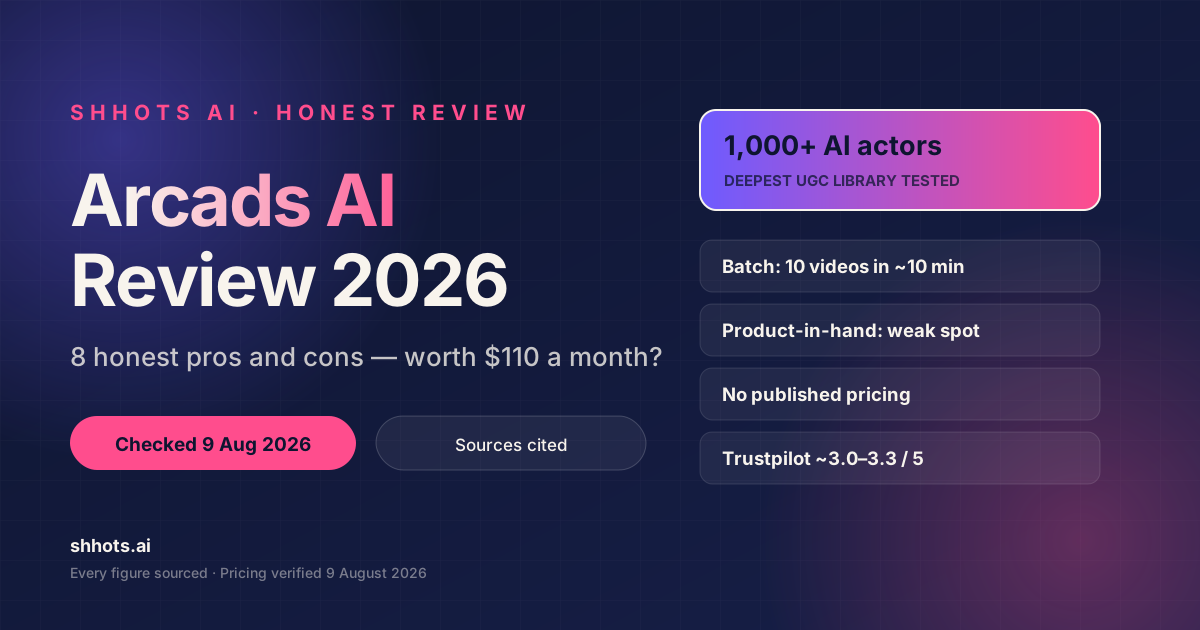
Short version of this Arcads AI review: Arcads is a genuinely strong AI UGC ad tool with a 1,000+ actor library and one of the deepest model catalogues in the category, held back by three things: no published pricing, per-minute round-up billing, and weak handling of physical products. If your ads are talking-head first and close to a minute long, it’s excellent. If they’re 15 seconds with a product in frame, you’ll fight it.
Features and reputation data verified 9 August 2026. We re-check this post quarterly and update the date above.
Arcads AI review 2026: the verdict up front
| Assessment | |
|---|---|
| Best for | High-volume talking-actor UGC, hook testing across many faces, multi-language ad sets |
| Weakest at | Products visibly held or demonstrated, short-form ads, editing, price transparency |
| Entry price | $110/month reported. Arcads publishes no pricing |
| Free trial | None for video. 100 free images/day |
| Actor library | 1,000+ advertised |
| Standout feature | Workflows, node-based batch generation across actors and languages |
| Biggest risk | Billing surprises; cancellation requires 72 hours’ notice |
| Overall | Strong tool, opaque commercial model |
What Arcads actually is in 2026
Most of the Arcads AI review content online describes a 2024 product: an AI actor generator that makes talking-head UGC. That’s now roughly a third of what it does.
Arcads’ own platform guide documents a catalogue of 8 image models, 11 video models and 3 talking-actor models, plus more than 30 standalone tools. The video lineup includes Sora 2 and Sora 2 Pro, Veo 3.1, Kling 2.6 and 3.0, Seedance 1.5 and 2.0, and Grok Video. The image side runs GPT Image 1.5 and 2, Nano-Banana Pro and 2, Seedream 4.5 and 5 Lite.
In other words, Arcads has repositioned from “AI UGC actors” into a multi-model generative media aggregator with an ad-creative interface on top. That’s a meaningful shift and it changes who the product suits.
The three talking-actor engines are differentiated by Arcads itself:
- Arcads 1.0, the credit-efficient default, best with scripts over 1,500 characters
- Audio-Driven, described by Arcads as the model where lip-sync is “more natural / realistic”, for use with existing voiceover
- OmniHuman 1.5, the most expressive, with full-body gestures, best under 400 characters
That first description is worth reading carefully. If Audio-Driven is the one with natural lip-sync, the others by implication are not, which lines up with what reviewers report.

Clip length limits
From Arcads’ own documentation, verified 9 August 2026:
| Model | Maximum duration |
|---|---|
| Sora 2 Pro | 20 seconds |
| Kling 3.0 | 15 seconds |
| Veo 3.1 | 8 seconds |
| Arcads 1.0 / Audio-Driven / OmniHuman 1.5 | No hard limit |
Auto-extend adds 7 seconds per pass, with a maximum input of 30 seconds, giving 37 seconds total. For most ad formats that’s ample.
4 things Arcads does genuinely well
1. Actor variety at scale. The 1,000+ actor library is the deepest in the purpose-built UGC category, and it’s paired with custom actor creation from a headshot, self-cloning, and voice cloning on the top tier. If your creative testing strategy is “same script, forty faces,” nothing else in this space is set up for it as well.
2. Batch throughput. Reviewers consistently praise generation speed. One hands-on reviewer reported ten videos in roughly ten minutes, with individual generations landing in 2-5 minutes. The Workflows feature, launched in June 2026, formalises this into node-based automation: one script fanned out across actors and languages in a single run.
3. Model breadth without model juggling. Access to Sora 2, Veo 3.1, Kling 3.0 and Seedance 2.0 under one subscription and one interface is a real convenience, and each model is individually priced in credits so you can trade cost against quality per shot.
4. Developer surface. Arcads ships a documented REST API with products, folders, scripts and generation endpoints, plus an MCP server at mcp.arcads.ai that plugs into Claude as a custom connector. Very few tools in this category have either. Note that API access is reportedly gated to the top tier and Arcads publishes no API pricing.
4 things Arcads does badly
No honest Arcads AI review can stop at the strengths, and these four limitations come up in every source we checked.
1. Physical products. This is the most consistent criticism across every source. Arcads is built around a person talking to camera; when the job is a product held, opened or demonstrated, results get unreliable. One hands-on reviewer who spent roughly $450 across 30+ campaigns reported an approximate 20% failure rate on unboxing presets, with product elements missing or incorrectly rendered.
2. Output consistency. The same reviewer estimated that around 30% of generated actors show visible AI tells, robotic cadence, unnatural eye movement, stiff gestures, and that only roughly the top 20% pass a scroll test. Lip-sync drift was reported in about 15% of videos, particularly on fast-paced scripts, and reviewers flag noticeably weaker lip-sync in some non-English languages including German and Hebrew.
That’s not a damning statistic on its own. Every generative tool has a hit rate, and 20% ship-ready from a batch of ten in ten minutes is workable. But it’s a real multiplier on your effective cost per usable ad, and it should be in your budget model.
3. It isn’t an editor. There’s no timeline, no music library assembly, no sequencing. Reviewers describe finishing in CapCut or Premiere. Arcads’ homepage lists “AI Video Editing, Soon!” which confirms the gap rather than closing it.
4. Commercial opacity. No published pricing, no published API pricing, no published overage rate, no published language list, and no published seat counts. When we checked the site on 9 August 2026, feature pages were still running a “50% OFF, Cyber Monday” promotional banner. None of this makes the product worse, but it does make it hard to evaluate before paying, and that’s a legitimate factor in any Arcads AI review.

What Arcads costs (the short version)
Full detail lives in our full Arcads AI pricing breakdown. Here’s just enough to frame the verdict.
| Plan | Reported price | Credits | Roughly |
|---|---|---|---|
| Starter | $110/mo | 8,000 | ~10 one-minute videos |
| Creator | $220/mo | 16,000 | ~20 one-minute videos |
| Pro | $550/mo | 40,000 | ~50 one-minute videos |
Two facts do most of the work here. Talking-actor video is billed at 800 credits per minute, per actor, and length always rounds up, so a 15-second ad costs the same as a 60-second one, roughly $11 either way. And credits don’t roll over on Starter or Creator; when you hit the limit, the account pauses until renewal.
There is no free trial. The nearest thing is a 24-hour change-of-mind refund window that’s only valid if you’ve generated nothing.
Arcads AI review: what real users say
This is where an honest Arcads AI review has to be careful, because the review data is thin and unusually shaped.
Trustpilot: roughly 140-160 reviews, with the score reported in the 3.0-3.3 range. The distribution is the notable part. One third-party analysis of 100 reviews found 43% five-star and 39% one-star, with almost nothing in between. You can read Arcads’ Trustpilot reviews directly.
G2: no Arcads listing exists. That means there’s no verified-buyer dataset to balance Trustpilot against, which is unusual for a company at this revenue scale.
Product Hunt: 4.7/5, from three reviews. Statistically meaningless, and worth saying so, because several pages cite it as if it carries weight.
SourceForge: listing exists with zero reviews.
The complaint clusters, from reviews quoted by third-party analyses:
- Billing surprises. Charges at trial or period end that reviewers describe as unexpected, some in the $339-$447 range. Structurally, this lines up with Arcads’ terms: cancellation requires 72 hours’ notice before the period ends, and subscriptions renew tacitly.
- Credits spent on unusable output, with support declining to restore them. Which matches the published policy that dissatisfaction with creative output isn’t refundable.
- Support response times, with reported waits of 15+ days.
- Price resentment, summarised by one widely-quoted user as a “luxury tax” for the volume you get.
Balanced against that: batch speed is praised almost universally, and at least one Product Hunt reviewer reported the company going beyond a refund after a downtime incident.
Our read: a U-shaped review distribution with no G2 presence usually means a product that works well for the users it fits and generates real friction at the billing layer for everyone else. Nothing here suggests a bad product. It suggests a commercial model that surprises people.
Is Arcads legitimate?
Yes. Arcads announced a $16M seed round in December 2025 led by Eurazeo, and reported 6,000+ clients, 100,000 assets generated per month, and profitability. It ships real features on a fast cadence, Workflows and the MCP server both landed in 2026. This is a well-funded, actively developed product.
One thing to read before you upload anything: Arcads’ terms grant you a “non-exclusive, personal and non-transferable license” on generated videos rather than outright ownership, and you grant the operating company a worldwide licence over your scripts, prompts and uploaded assets including for AI model training. That’s not unusual in this category, but it’s worth knowing if you’re uploading unreleased product imagery.

Workflows and MCP: the two features worth the upgrade
Two 2026 additions deserve more attention than they get in the average Arcads AI review, because they’re the features that actually change how the tool fits into a team.
Workflows, launched in June 2026, is node-based batch automation. Instead of generating one video at a time, you build a graph, a script, a set of actors, a set of languages, a chain of tools. And run it once. Arcads’ own framing is “build once, generate at scale,” with an example of 20 clips from a single script fanned across actors and languages.
If your production model is “one winning script, forty variants,” this is the single most valuable thing Arcads offers, and it’s a genuine differentiator against most of the category. It’s also the feature that makes the flat per-credit pricing sting less, because throughput is where the cost per tested variant drops rather than the cost per render.
The MCP server at mcp.arcads.ai connects Arcads to Claude as a custom connector. Practically, that means you can drive generation from a conversation or an agent rather than the web app, describe the ad you want, and the model calls Arcads to make it. It requires an active subscription and consumes plan credits normally.
Very few tools in this category ship an MCP server at all. If you’re building internal automation around ad production, pulling product data from a catalogue, generating variants, pushing results into a review queue. This is a meaningful capability rather than a checkbox. (For context, we shipped our own MCP server for the same reason.)
The caveat on both: neither is priced publicly, and API access is reportedly gated to the top tier. So the two features most likely to justify Arcads for a serious team sit behind the part of the pricing table nobody outside the product can see. That’s a recurring theme in this Arcads AI review, and it’s the main thing standing between a good product and an easy recommendation.
How to evaluate them fairly: if Workflows or MCP is your reason for considering Arcads, ask sales directly which tier includes each and what the overage rate is, in writing, before you subscribe. Both questions have documented answers internally and no public ones.
Who Arcads is right for: and who it isn’t
If you take one thing from this Arcads AI review, make it this section.
Buy Arcads if: you run talking-head UGC at volume, your ads run 45-60 seconds, you need many distinct faces, you localise into several languages, and $110+/month sits comfortably inside a test budget.
Don’t buy Arcads if: your ads are 10-20 seconds (round-up billing makes this expensive), your product needs to be visibly and accurately in frame, you’re testing at low volume, you need in-app editing, or you need to know the price before you enter a card.
For head-to-heads against the tools people most often weigh it against, see HeyGen vs Arcads, Arcads vs MakeUGC and Creatify vs Arcads. For the wider field, we’ve ranked 13 cheaper Arcads AI alternatives and the best AI UGC ad tools.
Where Shhots AI differs
We’re a competitor, so treat this as positioning rather than a neutral verdict. But the difference is structural enough to be useful.
Arcads starts from a script and an actor. Shhots starts from one product photo and produces UGC video, cinematic ads, product photography and static image ads from it. That makes us better at the thing Arcads is weakest at, the product being recognisably itself, and worse at the thing Arcads is strongest at, which is sheer face variety.
On cost, Shhots AI pricing is published and starts at $19/month, with a 10-second UGC ad working out to $6.33 on Starter and $4.71 on Scale. There’s no round-up penalty, captions are unlimited and free, and every plan includes a full commercial licence.
Where Arcads wins outright: actor library depth, model breadth, and Workflows-style batch automation. If those are what you’re buying, buy those.
You can try our AI UGC ads generator on your own product photo and compare the output directly.
FAQ
Is Arcads AI worth it?
The short answer from this Arcads AI review: it’s worth it if your ads are close to a minute long and you need heavy actor variety. The per-video cost is competitive at that length and the library is the deepest in the category. It’s poor value for 15-second ads, because Arcads rounds every video up to a full minute regardless of length.
Is Arcads AI legit?
Yes. Arcads raised $16M in seed funding in December 2025, reports 6,000+ clients and profitability, and ships features actively. The complaints in circulation concern billing and refunds, not product legitimacy.
Does Arcads AI have a free trial?
No free trial and no free video plan. Arcads does provide 100 free images per day from Nano Banana Pro and 100 from Seedream 4.0. A 24-hour change-of-mind refund is available if you’ve used zero credits.
How good is Arcads’ video quality?
Mixed and model-dependent, which is the consistent finding across every hands-on Arcads AI review we could locate. A hands-on reviewer who ran 30+ campaigns estimated roughly 30% of actors show visible AI tells and about 20% of output is genuinely scroll-stopping. Lip-sync drift was reported in around 15% of videos and is weaker in some non-English languages.
Can Arcads show my actual product in the video?
Poorly, in most reports. It offers unboxing and product-showcase presets, but reviewers report a roughly 20% failure rate on unboxing output with product elements missing or misrendered. Arcads is strongest when a person is talking about a product rather than handling one.
Does Arcads AI have an editor?
No. There’s no timeline editor, sequencing or music assembly. Users report finishing in CapCut or Premiere. Arcads’ site lists AI video editing as coming soon.
How many AI actors does Arcads have?
Arcads advertises 1,000+ AI actors. Third-party reporting indicates the full library is tier-gated, with roughly 300 available on the entry plan and the larger library opening up on higher tiers. Arcads doesn’t publish the gating, so verify it in-app.
What do Arcads reviews on Trustpilot say?
Every Arcads AI review that cites user sentiment draws on the same dataset. Arcads holds roughly 140-160 Trustpilot reviews with a reported score of 3.0-3.3. The distribution is sharply polarised between five-star and one-star, with complaints concentrating on unexpected charges, refused refunds and support response times.
Does Arcads have an API?
Yes. A documented REST API with products, folders, scripts and generation endpoints, plus an MCP server for Claude. API access is reportedly limited to the top plan, and Arcads publishes no API pricing or rate limits.
Final take
This Arcads AI review lands somewhere more nuanced than most: it’s a capable, well-funded, fast-moving product with a genuinely best-in-class actor library, wrapped in a commercial model that hides its price and charges by the minute in a category that works in seconds.
If you’re a performance team running long-form talking-actor tests at volume, that trade is fine. If you’re a DTC brand trying to make short product ads on a defined budget, the arithmetic works against you. And you should read the full Arcads AI pricing breakdown before committing to a month.
Try Shhots AI on your own product photo
Arcads starts from a script and an actor. Shhots starts from your product photo, and produces UGC video, cinematic ads, studio product photography and static image ads from that one input.
- $19/month, published, $6.33 per 10-second UGC ad on Starter, $4.71 on Scale.
- No round-up billing, no separate captions charge, no unpublished tier gating.
- Full commercial licence and watermark-free exports on every plan.
See Shhots AI pricing → · Try the AI UGC ads generator → · Book a demo →