
Disclosure: Shhots AI is our product. Fees, eligibility rules and protocol status were read on OpenAI, Stripe, Shopify, Google, Microsoft, Visa and PayPal pages and in the ACP and UCP GitHub repositories on 17 November 2026.
The Agentic Commerce Protocol (ACP) is an open standard that lets an AI agent buy from a store on a shopper’s behalf. OpenAI and Stripe published it on 29 September 2025 under the Apache 2.0 license, and Meta joined them as a lead maintainer in April 2026. ACP defines how the agent reads your product feed, opens a checkout with your store, passes a scoped payment token and completes the order, while you stay the merchant of record. The latest stable version is dated 2026-04-17 and the spec is still labelled beta (ACP on GitHub).
The part most guides miss: ChatGPT no longer completes most purchases inside the chat. Since March 2026, OpenAI sends shoppers to the merchant’s own checkout and focuses on product discovery. In-chat buying for Shopify stores now happens in Microsoft Copilot, Google AI Mode and Gemini, and Meta AI, and Google and Microsoft run it on a second standard, the Universal Commerce Protocol (UCP). Paid placement in ChatGPT is a separate system: ChatGPT ads show below answers on the Free and Go plans and are bought in OpenAI’s Ads Manager.
If you sell on Shopify, most of this is already switched on for you, with no extra fee. Your work is product data. This guide covers how ACP works, how it compares to UCP and AP2, what Shopify turns on by default, what it costs and a readiness checklist. Platform rules and fees below were read on each platform’s own pages on 17 November 2026.
What is agentic commerce?
Agentic commerce is shopping where an AI assistant does the legwork: it searches, compares and, where the merchant allows it, places the order. The shopper describes what they need and approves the purchase. The agent handles the steps in between.
Two things have to work for that to happen. The agent needs structured product data it can trust (price, stock, variants, shipping). And it needs a safe way to pay without seeing or storing the shopper’s card. ACP, UCP and AP2 are the standards that define those two handoffs.
What is the Agentic Commerce Protocol?
ACP is a written specification. It describes the API calls between three parties: the AI agent, the business selling the product and the payment provider. Any agent or merchant can implement it, and merchants choose which agents they accept (agenticcommerce.dev).
| ACP fact | Detail (as of 17 November 2026) |
|---|---|
| Created by | OpenAI and Stripe |
| Lead maintainers | OpenAI, Stripe and Meta (MAINTAINERS.md); Meta was added on 24 April 2026 |
| License | Apache 2.0 |
| Status | Beta |
| Released versions | 2025-09-29 (initial), 2025-12-12, 2026-01-16, 2026-01-30, 2026-04-17 (latest stable) |
| What 2026-04-17 added | Cart, product feed, orders, delegated authentication and an MCP binding (changelog) |
| Merchant of record | The business, always |
| Payments | Works with your existing payment processor; Stripe supports it through Shared Payment Tokens |
Stripe now describes ACP as “an open standard created by Stripe, OpenAI, and Meta” in its developer docs. The GitHub README still names OpenAI and Stripe as the founding maintainers.
How does ACP work?
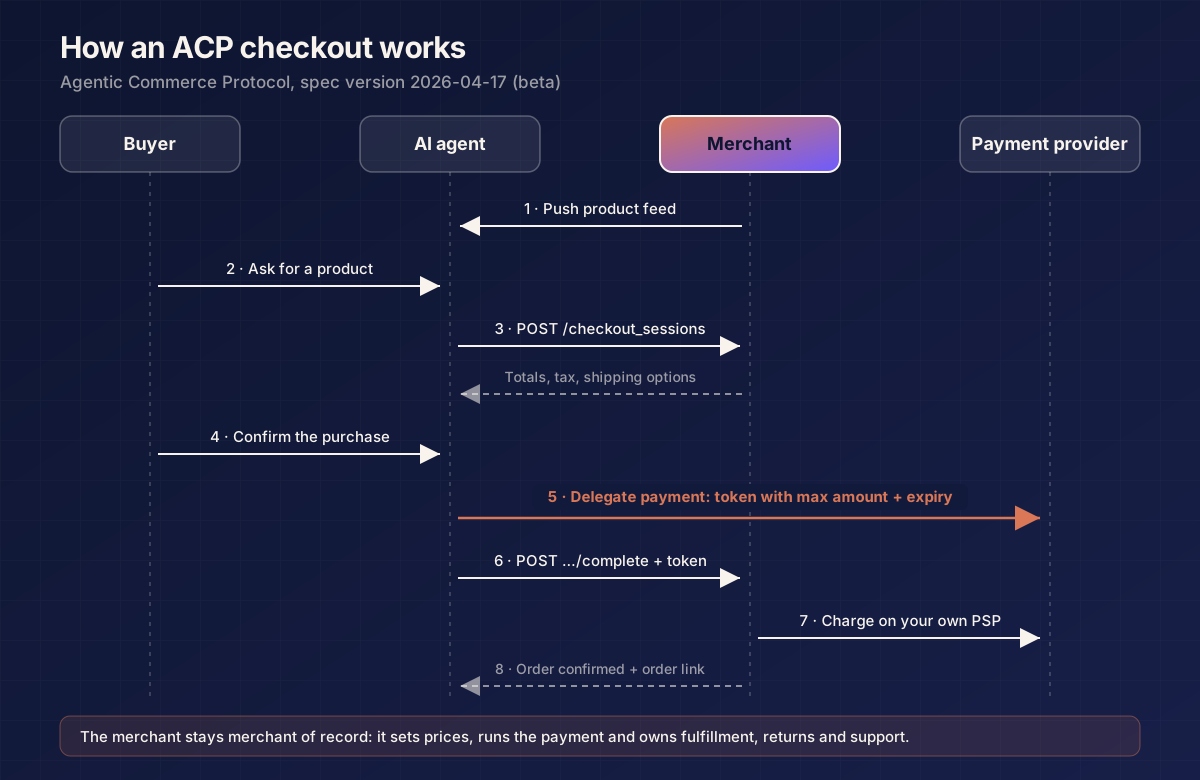
ACP splits a purchase into four building blocks. A merchant can implement them directly or let a platform such as Stripe run them.
1. Product feed
The merchant sends its catalog to the agent. In the 2026-04-17 version this is a push model: merchants call POST /feeds and PATCH /feeds/{id}/products on an endpoint the agent hosts, or upload a products.jsonl file that replaces the whole product set. Each record carries price, availability, images and variants.
2. Agentic checkout API
The merchant hosts five endpoints. The agent calls them to run the cart.
| Endpoint | What it does |
|---|---|
POST /checkout_sessions | Creates a checkout from the items and buyer details |
POST /checkout_sessions/{id} | Updates items, address or shipping choice |
GET /checkout_sessions/{id} | Returns the current state |
POST /checkout_sessions/{id}/complete | Completes payment with the delegated token |
POST /checkout_sessions/{id}/cancel | Cancels the session |
Every response returns the authoritative cart: line items, totals, tax, fulfillment options and any error messages, such as an out-of-stock item. Prices, tax and shipping always come from your server.
3. Delegated payment
The agent never hands your store a raw card number. It calls POST /agentic_commerce/delegate_payment on a payment provider and gets back a token that only works within an “allowance”: a maximum amount, a currency, an expiry time and a merchant (delegate payment RFC). Your existing processor charges that token like any other payment.
Stripe’s version is the Shared Payment Token. Stripe says it may use network tokens from Mastercard Agent Pay, Visa Intelligent Commerce and American Express ACE Kit behind the scenes, and a merchant on another processor can resolve the token into network credentials and charge it there. Shared Payment Tokens are available in the US, Canada and 32 European countries and territories.
4. Orders and webhooks
After the order is placed, the merchant sends order events (confirmed, shipped, delivered, refunded) back to the agent so the buyer can track it in the chat. Fulfillment, returns and support stay with you.
What happened to Instant Checkout in ChatGPT?
ChatGPT was ACP’s first and best-known agent. That relationship has changed, and most ranking articles still describe the 2025 version.
| Date | What happened |
|---|---|
| 29 Sep 2025 | OpenAI launches Instant Checkout in ChatGPT for US shoppers buying from US Etsy sellers, built on ACP with Stripe, with Shopify merchants “coming soon” (TechCrunch) |
| 26 Jan 2026 | Shopify products go live in ChatGPT checkout with a 4% OpenAI fee on those sales, confirmed by a Shopify spokesperson to The Information (PYMNTS) |
| 24 Mar 2026 | OpenAI says it will let merchants use their own checkout and focus on product discovery (OpenAI) |
| Nov 2026 | ChatGPT sends Shopify shoppers to the store’s own checkout; Shopify lists no ChatGPT-specific fee |
Here is how buying in ChatGPT works today, according to OpenAI’s commerce docs:
- Discovery. ChatGPT finds products from the public web, private API integrations and, for retail, merchant product feeds.
- Checkout on your site. The purchase moves to your website through ChatGPT’s cloud browser, or to a plugin you build. The cloud browser signs its requests with Web Bot Auth, and Akamai, Cloudflare, HUMAN and Vercel verify those signatures automatically.
- ChatGPT Wallet. The shopper can pay on your existing checkout page with ChatGPT Wallet. You receive a network token, not the card number, and no Wallet-specific integration is needed.
- Plugins. Merchants with engineering time can build a headless plugin (an MCP server plus skills) so ChatGPT calls cart and checkout tools directly. This is the same plugin system ChatGPT’s always-on Dots agents use.
In-chat checkout has not vanished from OpenAI’s docs. The product feed spec still has an is_eligible_checkout flag and says checkout “requires a separately enabled integration.” OpenAI does not publish who qualifies, so treat native ChatGPT checkout as invite-only.
ACP vs UCP vs AP2: how do the agentic commerce protocols compare?
ACP is one of several standards, and they overlap less than the headlines suggest. UCP covers the whole shopping journey and is what Google and Microsoft run on. AP2 is a payment authorization layer that UCP uses. Card networks add their own agent identity and token programs underneath.
| Standard | Who’s behind it | What it covers | Status (17 Nov 2026) | Where shoppers meet it | What a merchant does | Merchant fee |
|---|---|---|---|---|---|---|
| ACP (Agentic Commerce Protocol) | OpenAI, Stripe, Meta | Product feed, checkout sessions, delegated payment, cart, orders | Beta, stable version 2026-04-17 | Agents connected through Stripe’s Agentic Commerce Suite; ChatGPT checkout by separate integration | Use Stripe’s suite, or host the five checkout endpoints | None for the protocol; Stripe does not list a separate suite fee |
| UCP (Universal Commerce Protocol) | Co-developed by Google, Shopify, Etsy, Wayfair, Target, Walmart, Amazon, Microsoft, Meta, Salesforce and Stripe (ucp.dev) | Catalog search, cart, checkout, identity linking, orders | Open source, latest release v2026-08-25 (GitHub) | Google AI Mode, Gemini, Microsoft Copilot Checkout | Shopify: automatic. Others: Merchant Center feed plus a UCP integration | Google lists none; Shopify charges none beyond processing |
| AP2 (Agent Payments Protocol) | Google; standards work continues at the FIDO Alliance (ap2-protocol.org) | Signed checkout and payment “mandates” that prove what the shopper approved | v0.2.0, released 28 April 2026 | Inside UCP checkouts | Usually nothing: your platform and processor handle it | Not stated |
| Visa Intelligent Commerce Connect | Visa | One integration that accepts agent payments over Trusted Agent Protocol, MPP, ACP and UCP | Pilot with select partners since 8 April 2026 (Visa) | Pilot partners only | Ask your acquirer or processor | Not stated |
| MCP (Model Context Protocol) | Open standard introduced by Anthropic | How AI apps call tools; ACP and UCP both offer MCP bindings | Current, used across AI apps | ChatGPT plugins, Claude connectors | Build an MCP server only if you want direct tool access | None |
The practical reading for a merchant:
- ACP and UCP solve the same checkout problem with different backers. Stripe supports both: its Agentic Commerce Suite runs on ACP, and it also offers a Stripe Payments handler for merchants running their own UCP checkout.
- Several companies sit on both sides. Meta is an ACP maintainer and a UCP co-developer. Stripe co-created ACP and co-develops UCP.
- Shopify merchants do not choose. Shopify maps your catalog to each AI channel and handles the protocol behind it. You only switch channels on or off.
What do Shopify merchants get automatically?
Shopify calls this agentic storefronts. It is active by default for eligible stores, and you manage it under Sales channels > Agentic in the Shopify admin (Shopify Help Center). Products reach AI channels through Shopify Catalog, which syndicates titles, descriptions, options, images, price and availability. You do not build a separate feed for ChatGPT, Copilot or Meta.
| AI channel | How products get there | Where the shopper pays | Default | Shopper countries | Extra fee |
|---|---|---|---|---|---|
| ChatGPT | Shopify Catalog | Your online store checkout, in ChatGPT’s in-app browser (app) or a new tab (web) | On | You must sell to the US; your store can be anywhere | None |
| Microsoft Copilot | Shopify Catalog | Shopify-powered direct checkout inside Copilot | Direct checkout on | US | None |
| Google AI Mode and Gemini | Google Merchant Center, through the Google & YouTube channel or another feed | Direct checkout inside Google, rolling out gradually | Direct checkout on for eligible stores | US, Canada, Australia | None |
| Meta AI and Muse | Shopify Catalog; the Facebook & Instagram channel for shoppable ads | Direct checkout on Meta surfaces | Direct checkout on | Australia, Brazil, Canada, India, Japan, Mexico, New Zealand, Singapore, South Korea, UK, US | None |
| Personal agents connected to Shop | Shopify Catalog | Shop Pay | No activation needed | Not stated | Not stated |
“None” means Shopify lists no channel fee. You still pay your normal payment processing.
Orders from these channels show up in your Shopify admin with channel or referrer attribution. Shopify’s agentic storefronts page also shows catalog insights that score description completeness, image coverage, price competitiveness and policy completeness.
What do Shopify merchants need to check or switch on?
Default-on only helps if your store passes eligibility. Open Sales channels > Agentic. If an Ineligible warning shows, it names the reason.
Store requirements for Shopify Catalog (requirements page):
- Starter plan or higher, with no storefront password (private mode)
- Terms of service, privacy policy and return and refund policy filled in under Settings > Policies
- Every product has a title, at least one image and a price above $0
- Products published to the Online Store, Hydrogen or Headless channel, with a product URL, and not set to Unlisted
- Account in good standing: verified identity, two-step authentication, a low chargeback rate and invoices paid on time
- Not B2B-only. Wholesale-only products are excluded when Shopify can detect them
Excluded categories. Alcohol, tobacco and vapes, CBD, prescription and medical products, weapons, fireworks, adult products, sexual wellness, event tickets, financial products, live animals, and add-ons such as warranties and subscriptions never enter Shopify Catalog. If you sell in one of these, agentic storefronts will not list those products.
Google needs one extra step. AI Mode and Gemini read from Google Merchant Center, not Shopify Catalog. Install the Google & YouTube channel with product and shipping auto-sync on, and keep your return policy in sync.
Direct checkout has limits. On Copilot, Google and Meta, the in-chat checkout does not support:
- Subscription-only products, bundles and customizable products (a product with a one-time option sells one-time only)
- Local delivery, store pickup and pickup points
- Forced sign-in before checkout
- Most checkout apps and blocks, such as upsells and custom fields
Shopify Functions for shipping, discounts and validation still run, and so do automatic discounts and discount codes.
Your tracking will miss these sales. Google Analytics and custom pixels do not fire in direct checkout. Only server-to-server pixels for checkout started and completed fire. If you run Meta or Google ads, those AI-channel orders will not show up in browser-pixel reporting, so read the channel numbers in the Shopify admin and make sure your server-side events are set up. Shopify also asks you to put legal disclosures in the first 6,000 characters of each product description for ChatGPT and Meta.
To switch a channel off, turn off “Allow Shopify to manage for me,” pick the channel and turn off direct checkout or Shopify Catalog access. Catalog sharing can take up to 7 days to stop, and products can still surface through web crawling. To hide a product everywhere, set it to Unlisted.
Can stores that don’t use Shopify sell through AI agents?
Yes, through several routes. None is automatic, and each AI platform runs its own onboarding.
| Route | Who it suits | What you do | Where it sells | Availability |
|---|---|---|---|---|
| Stripe Agentic Commerce Suite (ACP) | Stores that process on Stripe; Stripe named Wix, Squarespace, WooCommerce, BigCommerce, Etsy and commercetools as platform partners at launch in December 2025 (Stripe) | Upload a CSV catalog, then click Request connection for each agent in the Dashboard | Agents that accept the connection | US, Canada and 32 European countries and territories |
| OpenAI Business Hub | Any brand that wants richer ChatGPT discovery | Claim your business, verify identity, upload a feed by file, hosted URL or SFTP | ChatGPT discovery; checkout on your site | Standard feeds target the US |
| Google UCP | Merchant Center users | Join the UCP waitlist and integrate native checkout (REST recommended; MCP in beta) | AI Mode and Gemini | Google does not list countries |
| Microsoft Copilot Checkout | Merchants with Microsoft Merchant Center | Submit a UCP-compliant feed through an approved onboarding path | Copilot.com and the Copilot app | English-language merchants selling to US buyers in USD |
| Perplexity Instant Buy | PayPal merchants | Use your existing PayPal setup | Perplexity shopping | US shoppers, launched 25 November 2025 |
| Shopify Agentic plan | Brands whose storefront is not on Shopify | Verify your business, add an external URL to each product, set up payments for direct checkout | Same AI channels as above | Price not listed on Shopify’s pricing page on 17 Nov 2026 |
For a DTC brand on Stripe, the Agentic Commerce Suite is the shortest path to ACP. Stripe recommends uploading product data once a day and inventory and price updates every 15 minutes, because a price mismatch between the feed and checkout makes the purchase fail.
How much does agentic commerce cost merchants?
Selling through AI agents is cheap on paper. The real costs are payment processing, engineering time if you build your own endpoints, and the analytics gap above.
| Channel or tool | Merchant fee (verified 17 November 2026) |
|---|---|
| Shopify agentic storefronts, ChatGPT | No ChatGPT-specific fees; standard payment processing only |
| Shopify direct checkout on Copilot, Google AI Mode and Gemini, Meta | No fees for direct checkout; standard payment processing only |
| ChatGPT Instant Checkout for Shopify stores (Jan to Mar 2026) | 4% of the order, as reported by PYMNTS; no longer charged now that ChatGPT sends shoppers to your checkout |
| Stripe Agentic Commerce Suite | No separate suite fee listed in Stripe’s docs; ask Stripe before you plan margins on it |
| OpenAI product feeds and Business Hub | No fee stated in OpenAI’s commerce docs |
| Google UCP checkout | No fee listed in Google’s UCP docs |
| Microsoft Copilot Checkout | No fee stated on Microsoft’s merchant page |
| The protocols themselves (ACP, UCP, AP2) | Free and open source (Apache 2.0) |
So far, AI platforms charge merchants nothing to be listed or to check out. The one commission that was tried, OpenAI’s 4% on Shopify orders, lasted about two months.
How do AI assistants choose which products to show?
None of the platforms publish a ranking formula. OpenAI’s feed spec says eligibility “does not guarantee display.” What the docs do show is which data each agent reads, and that tells you where to spend time.
1. Complete feed fields. OpenAI’s product feed schema requires nine fields on every row (item_id, title, description, url, brand, seller_name, image_url, availability, price) plus target and store country. It asks for titles under 150 characters and plain-text descriptions under 5,000. Variants need a shared group_id and their own price, stock and image.
2. Reviews in the feed. OpenAI accepts review_count and star_rating per product, and UCP’s catalog format carries a rating with a review count. If your reviews live only in a widget that loads after the page, an agent reading your feed may not see them.
3. Images. Every row needs a main image of that exact variant, plus additional_image_urls for other angles. Shopify Catalog drops products with no image, and its insights score image coverage. If your variants share one photo, AI product photography is one way to fill those gaps without a reshoot.
4. Accurate price and stock. A feed that says “in stock” when the item is sold out fails at checkout. Stripe’s 15-minute inventory guidance exists for that reason.
5. Policies and brand facts. Shipping, returns and seller details are fields in every schema. Shopify’s knowledge base feature lets agents answer questions about returns and shipping times. Shopify is deprecating its separate Knowledge Base app on 15 January 2027, and stores with more than 1,000 facts in it have to move the extras by hand.
6. The open web still counts. ChatGPT also uses public web results, and every Shopify store now serves an /agents.md file plus /llms.txt. Structured data on product pages, crawlable reviews and mentions on sites AI assistants cite all feed the same answers. Our list of GEO tools covers how to track whether ChatGPT and Gemini mention your brand, and Shopify SEO services covers the on-site work.
If you’ve run Meta catalog ads, this will feel familiar. The feed is the ad. A clean title, the right variant photo and a real review count do the job that creative does in a paid placement.
Agentic commerce readiness checklist for merchants
Work through this in order. Steps 1 to 7 happen inside the Shopify admin.
- Open Sales channels > Agentic in Shopify and clear any Ineligible warning.
- Fill in all three store policies (terms, privacy, returns) under Settings > Policies.
- Audit product titles for brand, product type and key variant, under 150 characters.
- Give every variant its own image, plus at least one extra angle.
- Move legal disclosures into the first 6,000 characters of each description.
- Install the Google & YouTube channel with auto-sync on if you want AI Mode and Gemini.
- Decide on direct checkout per channel. Leave it on unless you rely on subscriptions, bundles, pickup or checkout upsells.
- Set up server-side conversion events, since browser pixels do not fire in direct checkout.
- Check that your CDN allows verified ChatGPT browser visits (OpenAI’s agent access guide), or ChatGPT shoppers may fail at your checkout.
- Claim your ChatGPT business profile through the ChatGPT Business app or Business Hub to see how often ChatGPT mentions you.
- Not on Shopify? Start with Stripe’s Agentic Commerce Suite if you process on Stripe, or Google’s UCP waitlist if Merchant Center is your main feed.
- Recheck monthly. OpenAI, Shopify, Google and Microsoft all changed these rules during 2026.
FAQ
What is the agentic commerce protocol?
The Agentic Commerce Protocol (ACP) is an open standard that defines how an AI agent reads a merchant’s product feed, opens a checkout, passes a scoped payment token and completes an order. OpenAI and Stripe released it on 29 September 2025. The merchant stays merchant of record.
Who created the agentic commerce protocol?
OpenAI and Stripe created ACP, and Meta became a lead maintainer on 24 April 2026. It is open source under Apache 2.0, and any AI platform or merchant can implement it.
Is ACP the same as Google’s Universal Commerce Protocol?
No. ACP comes from OpenAI and Stripe. UCP was co-developed by Google, Shopify and others and powers checkout in Google AI Mode, Gemini and Microsoft Copilot. Both define checkout between agents and merchants, and Stripe supports both.
Can Shopify merchants sell in ChatGPT?
Yes. Shopify’s agentic storefronts list eligible products in ChatGPT through Shopify Catalog by default, with no feed to build. Shoppers pay on your own Shopify checkout, which opens in ChatGPT’s in-app browser or a new tab. Your store must sell to US customers.
Does ChatGPT still have Instant Checkout?
Not as the default. In March 2026 OpenAI said it would let merchants use their own checkout and focus on product discovery. OpenAI’s feed spec still lists checkout as a separately enabled integration, without saying who qualifies.
How much does it cost to sell through AI agents on Shopify?
Shopify lists no fees for agentic storefronts or direct checkout on ChatGPT, Copilot, Google AI Mode, Gemini or Meta, as of November 2026. You pay your standard payment processing. A 4% ChatGPT checkout fee reported in January 2026 no longer applies.
How do I turn off agentic storefronts on Shopify?
Go to Sales channels > Agentic, turn off “Allow Shopify to manage for me,” select the channel and turn off direct checkout or Shopify Catalog access. Data sharing can take up to 7 days to stop.
Do I need to integrate ACP myself?
Most merchants don’t. Shopify stores get AI channels through Shopify Catalog, and Stripe merchants can use the Agentic Commerce Suite. A direct ACP integration makes sense only for retailers with their own checkout stack and engineers to maintain five checkout endpoints.
Start with the Agentic tab
Open Sales channels > Agentic in your Shopify admin today and check two things: whether the store is eligible, and how many products made it into Shopify Catalog. If the count is lower than your live catalog, the missing products need a title, an image or a price fix before any AI assistant can recommend them.
More on AI Marketing
All AI Marketing posts- What Are the Best AI SEO Tools in 2026? The best AI SEO tools in 2026 by job: Semrush from $139/mo, Ahrefs $129, Surfer $49, Screaming Frog $279/yr, plus free Search Console and Bing. Nov 2026.
- Best AI Ad Copy Generators in 2026: 11 Tools Compared on Price and Platform Fit The best AI ad copy generators for Meta, Google and TikTok in 2026: 11 tools compared, from free plans to Jasper at $59/seat. Prices verified November 2026.