
Disclosure: Shhots AI is our product. Every price below was read on the vendor's own pricing page on 17 November 2026. We have not run these tools head to head; this guide compares what each vendor publishes.
The best AI SEO tool depends on the job. For most ecommerce brands, the right setup is two free tools (Google Search Console and Bing Webmaster Tools) plus one paid suite: Semrush from $139 a month or Ahrefs from $129 a month. Add a crawler such as Screaming Frog ($279 a year) once the store passes 500 URLs. Add a content optimizer such as Surfer (from $49 a month, billed yearly) only if you publish guides or category copy every week.
This guide sorts 14 tools by the job they do: keyword research, content briefs, technical audits, rank tracking (including AI Overviews), internal linking, backlinks, and AI agents such as Claude connected to Search Console. Every price was read on the vendor’s own pricing page on 17 November 2026. Tools that track brand mentions inside ChatGPT and Perplexity have their own guide: the best GEO tools.
The 14 tools compared
| Tool | Main job | Starting price (verified Nov 2026) | Free option | AI features | Ecommerce fit |
|---|---|---|---|---|---|
| Google Search Console | Queries, positions, indexing | Free | Yes | Generative AI report: impressions in AI Overviews and AI Mode | Product and collection pages by query, indexing errors |
| Bing Webmaster Tools | Bing data, Copilot citations | Free | Yes | AI Performance report: citations in Copilot and Bing AI summaries | IndexNow pings for price and stock changes |
| Semrush | All-in-one suite | $139/mo ($117.33 billed annually) | 10 reports a day, 7-day trial | AI visibility tracking, MCP from the $199 Starter plan | Competitor keyword gaps, Site Audit |
| Ahrefs | Backlinks, keywords | $129/mo Lite ($29/mo Starter) | Ahrefs Free for verified sites | Brand Radar prompt tracking, MCP on Lite and up | Backlink research on competitor stores |
| SE Ranking | Budget all-in-one | $129/mo ($103.20 billed annually) | 14-day trial, no card | 25 AI prompts a day on 5 engines, AI Writer, MCP | 2,000 tracked keywords on the entry plan |
| Moz Pro | Keywords, links, rank tracking | $49/mo Starter, $99/mo Standard | Free trial offered | AI Overviews by keyword, 150 tracked prompts | 300 tracked keywords on Standard |
| Surfer | Content optimization | $49/mo billed yearly | ”Start for free” button, terms not stated | Surfy AI assistant, 1-click internal linking on Pro | Category and buying-guide copy |
| Clearscope | Content briefs and grading | $129/mo | 14-day trial | Query tracking in ChatGPT and Gemini | Buying guides, comparison pages |
| Frase | Briefs plus an AI writing agent | $49/mo ($39 billed yearly) | 7-day trial, no card | Agent that can auto-publish, MCP and CLI on every plan | Blog and guide production |
| MarketMuse | Topic planning | Not stated | Not stated | Briefs and topic gaps, now part of Siteimprove | Large content libraries |
| Screaming Frog | Technical crawl | $279/year per licence | 500 URLs, full features | Connects to OpenAI, Gemini, Anthropic and Ollama models | Faceted URLs, duplicate titles, missing alt text |
| Sitebulb | Technical audit with explanations | $18/mo Lite, $42/mo Pro | 14-day trial | MCP access on every plan | 500,000 URLs per audit on Pro |
| Alli AI | Applies on-page fixes | $299/mo ($249 billed annually) | 10-day trial | AI schema and internal-linking automation | Shopify listed; 1,250 pages on Business |
| Claude or ChatGPT with MCP | Analysis over your own data | Claude free, Pro $20/mo | Claude Free allows 1 custom connector | Reads GSC, Semrush, Ahrefs or Sitebulb data in chat | Finds product pages losing clicks |
“Monthly” means billed monthly unless the cell says otherwise. Claude prices come from claude.com/pricing and its connector limits from Claude’s help center.
What counts as an AI SEO tool in 2026?
Three kinds of product now carry the label.
- Classic SEO suites with AI added. Semrush, Ahrefs, SE Ranking and Moz still sell keyword, backlink and rank data. Their AI layer is prompt tracking, AI Overview flags and an MCP server so Claude or ChatGPT can query the data.
- Content optimizers. Surfer, Clearscope, Frase and MarketMuse score a draft against the pages that already rank and suggest what to cover. Most now write drafts too.
- AI assistants connected to your data. Claude or ChatGPT with an MCP connector to Search Console or a paid suite. You ask a question in plain English and the assistant pulls the rows.
A fourth group, GEO tools such as Profound and Peec AI, measures how often AI assistants mention your brand. That is a separate budget line with its own buying logic, covered in the best GEO tools.
Which AI SEO tool is best for keyword research?
Semrush or Ahrefs for most stores. SE Ranking if the budget is closer to $100 a month.
- Semrush costs $139 a month for its SEO plan (5 websites, 500 keywords tracked daily) or $117.33 billed annually. The $199 Starter plan adds keyword research and optimization tools, competitor insights and MCP access. Pro+ at $299 adds historical data, content optimization and keyword cannibalization analysis. The free plan gives 1 demo project and 10 reports a day.
- Ahrefs Lite costs $129 a month with 750 tracked keywords, 150 AI prompt checks and 6 months of history. Standard is $249 with 2,000 tracked keywords and 2 years of history. A cut-down Starter plan costs $29 a month.
- SE Ranking Core costs $129 a month or $103.20 billed annually. It tracks 2,000 keywords daily, audits 250,000 pages a month and includes MCP access. That is more tracked keywords than Semrush’s or Ahrefs’ entry plans.
- Moz Pro Standard costs $99 a month, or $79 billed yearly, for 300 tracked keywords on 3 sites. A $49 Starter plan covers one website.
For a store, keyword research splits into two lists. Category and collection pages target commercial terms (“linen bedding”, “women’s trail running shoes”). Blog guides target the questions buyers ask before they shop. Every suite above finds both. The difference that matters is competitor research: pasting a competitor store’s domain and seeing which collection pages bring it traffic. Semrush and Ahrefs are strongest there, and free tools cannot do it at all.
Which tool is best for AI content briefs and optimization?
Surfer for category and guide copy, Clearscope for editorial teams, Frase if you want an agent to draft and publish.
| Tool | Entry price (Nov 2026) | Volume on the entry plan | Notable AI feature |
|---|---|---|---|
| Surfer Discovery | $49/mo billed yearly | 120 documents, 10 pages tracked | Surfy AI assistant and Humanizer |
| Surfer Pro | $182/mo billed yearly | 360 documents | 1-click internal linking, cannibalization report, MCP |
| Clearscope Essentials | $129/mo | 50 tracked queries, 50 pages, 20 drafts a month | Shows the web searches AI platforms run to build an answer |
| Frase Starter | $49/mo, $39 billed yearly | 10 articles, 50 audit pages a month | Agent that drafts and can auto-publish |
| MarketMuse | Not stated | Not stated | Topic gaps and briefs, now sold by Siteimprove |
Surfer’s pricing page only shows yearly billing; its FAQ says annual plans save “up to 17%” against monthly. Frase’s agent publishes on its own only when you switch that on.
For an ecommerce brand, these tools earn their keep on a small set of pages: category intros, buying guides and comparison posts. They are the wrong tool for 2,000 product descriptions. A content score rewards covering the same terms as the top results, and product pages rank on product data, reviews and images more than on word count.
Which tool is best for technical SEO audits on a store?
Screaming Frog for most stores, Sitebulb if you want the issues explained in plain English.
Ecommerce sites break in ways blogs do not. Filters and sort orders create thousands of near-duplicate URLs. Product variants split ranking signals. Out-of-stock pages return the wrong status code. Google’s own documentation says crawlers will “typically access a very large number of faceted navigation URLs” before working out they are useless, and recommends blocking filtered URLs in robots.txt for most sites (Google Search Central).
- Screaming Frog is free up to 500 URLs with the full feature set. A licence costs $279 a year, with no URL cap beyond your machine’s memory. Both versions connect to OpenAI, Gemini, Anthropic and Ollama models. Screaming Frog’s AI prompts tutorial shows how to run up to 100 prompts against crawled pages, and lists drafting alt text for images flagged “Missing Alt Text” as a common use. You pay the model provider for the API calls.
- Sitebulb Lite costs $18 a month for 10,000 URLs per audit. Pro costs $42 a month for 500,000 URLs, raisable to 2 million. Every plan includes MCP access, so Claude can read an audit directly. The trial is 14 days and needs no card.
- Suite audits inside Semrush, Ahrefs and SE Ranking are good enough for a store under a few thousand URLs. Ahrefs Free audits verified sites at 5,000 crawl credits per project per month (Ahrefs).
A Shopify store with 300 products, 40 collections and a blog can sit under 500 URLs, which makes the free Screaming Frog crawl enough. Variants, tag pages and filtered collections push most catalogs past that line quickly.
Which tools track rankings and AI Overviews?
Google and Bing now report AI visibility for free. Paid trackers add competitors and daily positions.
| Source | What it shows | Cost |
|---|---|---|
| Search Console Generative AI report | Impressions in AI Overviews and AI Mode, by page, country, device and date | Free |
| Search Console Performance report | Clicks, impressions and average position for every query you appear for | Free |
| Bing AI Performance report | Citations in Copilot and Bing AI summaries, grounding queries, cited pages | Free |
| Moz Pro | AI Overviews by keyword, prompts tracked in GPT, Gemini and Google AI Mode | From $79/mo billed yearly |
| Semrush | Daily positions, AI search performance, custom prompt monitoring | From $139/mo |
| Ahrefs | Tracked keywords plus AI prompt checks (150 on Lite) | From $129/mo |
Google launched the Generative AI reports on 3 June 2026 and says they reached all websites worldwide on 31 August 2026 (Google Search Central Blog). The report counts impressions only. It shows no clicks and no queries, so you learn which pages appear in AI Overviews but not which searches triggered them.
Bing’s report, launched on 10 February 2026, covers Microsoft Copilot, AI summaries in Bing and “select partner integrations”. Bing notes the grounding-query data is a sample of overall citation activity. In June 2026 Bing added Intents, Topics, Citation Share and Compare views (Bing blog).
Can Claude track keyword rankings?
Not on its own. Claude has no ranking data. Connected to Search Console through an MCP server, it reads your average position for every query you already get impressions on, which works as a free rank tracker for your own site. It cannot tell you where a competitor ranks or where you rank for a term with zero impressions. For that you need a paid tracker, and Semrush, Ahrefs and SE Ranking all expose theirs to Claude through MCP.
Which tool is best for internal linking?
Surfer Pro or Frase Professional if you already pay for a content tool. Screaming Frog if you want to audit links yourself.
- Surfer lists 1-click internal linking on its Pro plan ($182 a month billed yearly).
- Frase Professional ($129 a month, $103 billed yearly) includes internal linking suggestions.
- Alli AI sells AI internal-linking automation that it applies through a code snippet.
- Screaming Frog reports inlinks for every URL and lists “Semantic Similarity & Content Clustering” among its features, which helps spot pages that cover the same topic.
On a store, the internal links that move rankings usually run from collection pages to products and from buying guides to collections. Google’s ecommerce guide has a full page on site structure and navigation for this. A tool suggests links; deciding which collection deserves the link is still a merchandising call.
Which tool is best for backlinks?
Ahrefs. Backlinks are what Ahrefs built its index for, and its free tier shows up to 1,000 backlinks for any site you verify (Ahrefs). Semrush and Moz both sell backlink data too; Moz Pro Standard includes 5,000 backlink queries a month.
AI does little here. A tool can list competitor links and draft outreach emails. It cannot make a journalist or a gift guide editor link to your store. Google’s spam policies list buying links and excessive link exchanges as link spam. Use the tools for research and keep link building human.
Can an AI SEO agent do the work for you?
Partly. Two kinds of agent exist in November 2026.
Agents that change your site. Alli AI installs through a WordPress plugin, a JavaScript snippet or a tag manager and applies on-page changes, schema and internal links from there. Business costs $299 a month ($249 billed annually) for 5 sites and 1,250 pages, with a 10-day trial. Shopify is on its list of supported platforms. Frase has an agent that drafts content and, if you switch it on, publishes it. Both save time. Both also mean software is editing a live store, so review every change before it ships.
Assistants that read your data. This is the Claude-based workflow, and it is the cheapest useful AI in SEO right now:
| Connection | What Claude can read | Requirement |
|---|---|---|
| mcp-gsc (open source, MIT) | Search analytics, URL inspection, sitemaps for your Search Console properties | Runs locally in Claude Desktop, not the claude.ai website |
| Semrush MCP | Keyword, competitor and audit data | Semrush plan with MCP access, from the $199 Starter plan |
| Ahrefs MCP | Ahrefs data; Lite includes 200,000 API units a month | Lite plan or higher; no extra fee for the MCP itself |
| Sitebulb MCP | Your crawl audits | Any Sitebulb plan, from $18/mo |
mcp-gsc is a community project built on Google’s Search Console API, not a Google product. It signs in with your own Google account through OAuth, and its destructive tools (deleting sites or sitemaps) are off by default.
A workable weekly routine for a store owner with Claude and Search Console connected:
- Ask for product and collection pages whose clicks fell more than 30% versus the previous 28 days.
- Ask which queries those pages lost, and whether average position or click-through rate moved.
- Ask for queries with high impressions and an average position between 8 and 20. Those are the pages a better title or an extra section can move.
- Check the pages Claude names yourself before changing anything. The assistant reads the numbers well. It does not know your margins or which products are about to go out of stock.
If you want to see how MCP connections work in general, our guide to the Shhots MCP server walks through connecting a server to Claude and ChatGPT.
What does an ecommerce store need that a blog does not?
Most “best AI SEO tools” lists are written for blogs and SaaS sites. A store has four jobs those lists skip.
- Product data for Google. Google’s ecommerce documentation covers structured data for products, sharing product data with Google, URL structure and pagination. Check product markup with Google’s free Rich Results Test.
- Faceted navigation control. Covered in the audit section above. This is where a crawler pays for itself.
- Image search. Google says it uses alt text, computer vision and page content to understand an image, and warns that stuffing alt attributes with keywords “may cause your site to be seen as spam” (Google Images guidance). One specific sentence per image, naming the product and what is in the frame, is the standard.
- Enough product images to rank. Image results need distinct images, and many catalogs ship one packshot per product. Shhots AI (our product) turns one product photo into lifestyle and studio shots, on plans from $19 a month. For marketplace image rules, see our guide to Amazon product image requirements.
If the job is bigger than one person with a tool stack, compare Shopify SEO services. If you want products to show up inside AI shopping assistants, read about the Agentic Commerce Protocol.
A lean SEO stack by budget
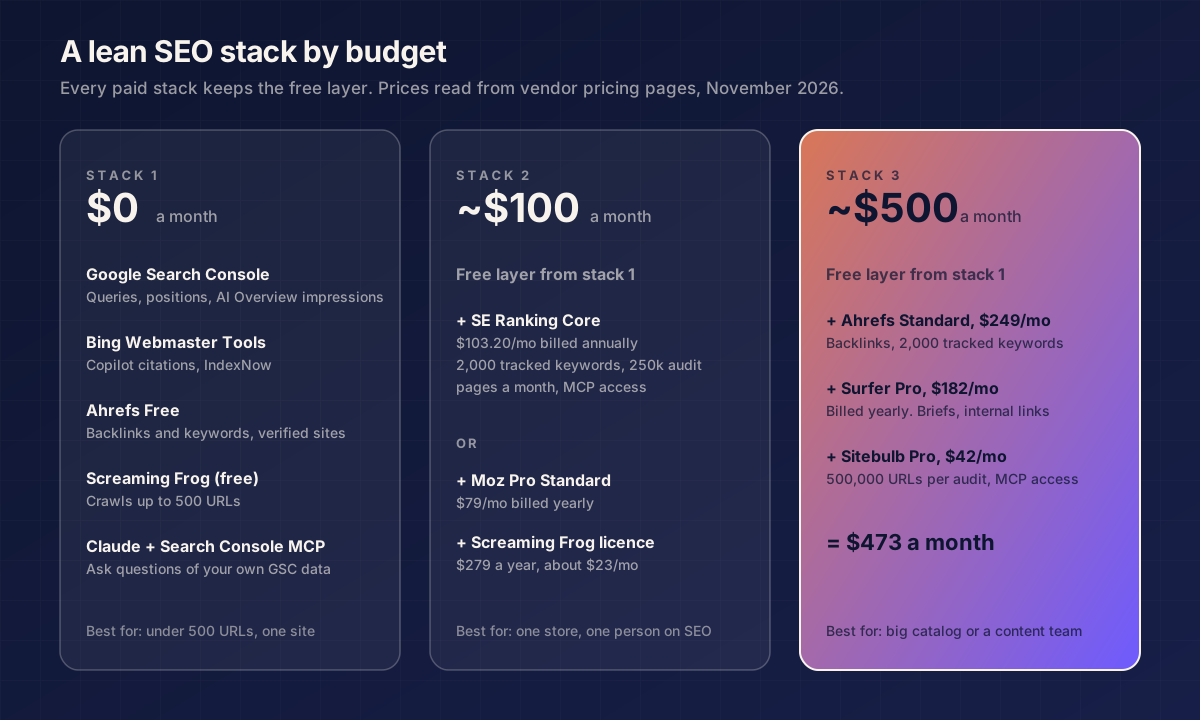
| Budget | Stack | Monthly cost (Nov 2026) | Covers | Gap |
|---|---|---|---|---|
| $0 | Search Console, Bing Webmaster Tools, Ahrefs Free, Screaming Frog free, Semrush free plan, Claude with mcp-gsc | $0 | Your own queries and positions, AI Overview impressions, Copilot citations, backlinks to your site, a 500-URL crawl | No competitor data, 10 Semrush reports a day |
| ~$100 | Free layer + SE Ranking Core billed annually | $103.20 | Competitor keywords, 2,000 tracked keywords, 250,000 audit pages, 25 AI prompts a day | Content briefs are basic |
| ~$100, alternative | Free layer + Moz Pro Standard billed yearly + Screaming Frog licence | $79 + about $23 = about $102 | Rank tracking, AI Overviews by keyword, unlimited crawl | 300 tracked keywords |
| ~$500 | Free layer + Ahrefs Standard + Surfer Pro billed yearly + Sitebulb Pro | $249 + $182 + $42 = $473 | Backlinks, 2,000 tracked keywords, content optimization and internal linking, 500,000-URL audits, MCP across all three | No tool that edits the site for you |
How to pick: start with the $0 stack and run it for a month. If your questions are about competitors (“which collections bring them traffic?”), move to a suite. If they are about your own pages (“why did this category drop?”), the free stack plus Claude is usually enough. Add a content optimizer only when someone writes at least one guide a week.
What can’t AI do in SEO?
Google’s position is plain. “Appropriate use of AI or automation is not against our guidelines,” it wrote in February 2023, and it judges content on quality rather than on how it was made (Google Search Central Blog). The limits are about scale and accuracy.
- AI can’t mass-produce pages safely. Google’s spam policies define scaled content abuse as many pages “generated for the primary purpose of manipulating search rankings and not helping users”. The first example listed is using generative AI to generate many pages “without adding value for users” (Google spam policies). A page per city, per color or per keyword variant, written by AI, is exactly that pattern.
- AI can’t fact-check itself. Google’s guidance on generative AI says it is “critical to manually factcheck and review all AI-generated content” before publishing, and the same applies to titles, meta descriptions, structured data and image alt text (Google Search Central).
- AI can’t hide that it wrote your product data. The same page says Google Merchant Center requires AI-generated product titles and descriptions to be labeled as AI-generated, and AI-generated images to carry IPTC
TrainedAlgorithmicMediametadata. - AI can’t use your product. Reviews, fit notes, “I wore these for a month” sections and original photos come from people. Google’s ecommerce docs give a whole page to writing high-quality reviews for that reason.
- AI can’t earn links. It can find prospects and draft emails. The link still comes from a person who decides your store is worth citing.
Use AI for the analysis and the first draft. Keep a human on every page that ships.
How this guide was put together
Prices and plan limits come from each vendor’s pricing page, read on 17 November 2026, in USD. Where a page showed only yearly billing (Surfer) or hid a price (MarketMuse), the table says so. We have not run these tools against each other on one store, so this guide ranks nothing by score. It sorts the tools by job and reports what each vendor publishes. Several top-ranking lists for this keyword are written by vendors that rank their own tool first; this one includes no Shhots product in the comparison.
FAQ
What is the best AI SEO tool in 2026?
There is no single best AI SEO tool in 2026. For most stores, Semrush (from $139 a month) or Ahrefs (from $129 a month) covers keyword research, rank tracking and audits, alongside free Google Search Console and Bing Webmaster Tools. Prices verified November 2026.
What are the best SEO tools for ecommerce?
The best SEO tools for ecommerce are Google Search Console for product and collection queries, a crawler such as Screaming Frog ($279 a year) or Sitebulb (from $18 a month) for faceted URLs, and one suite such as Semrush or Ahrefs for competitor research. Alli AI ($299 a month) applies fixes on Shopify if you want automation.
Is there a free AI SEO tool?
Yes. Google Search Console and Bing Webmaster Tools are free and both report AI visibility: AI Overview and AI Mode impressions in Google, Copilot citations in Bing. Screaming Frog crawls up to 500 URLs free, Ahrefs Free covers verified sites, and Semrush’s free plan allows 10 reports a day.
Can ChatGPT or Claude replace an SEO tool?
No. Claude and ChatGPT have no keyword volumes, backlink index or ranking data of their own. Connected through MCP to Search Console, Semrush, Ahrefs or Sitebulb, they become a fast way to ask questions of that data. The paid data still comes from the SEO tool.
Does Google penalize AI-generated content?
No, not for being AI-generated. Google says appropriate use of AI is not against its guidelines. It does penalize scaled content abuse, which includes using generative AI to make many pages without adding value for users.
How much do AI SEO tools cost?
AI SEO tools cost from $0 to about $500 a month for a small team. Free: Search Console and Bing Webmaster Tools. Entry suites: SE Ranking $103.20 a month billed annually, Ahrefs $129, Semrush $139. Content tools: Surfer from $49 billed yearly, Clearscope $129. Prices verified November 2026.
Which tool tracks rankings in AI Overviews?
Google Search Console’s Generative AI report shows AI Overview and AI Mode impressions by page, free, for every site since 31 August 2026. It shows no queries. Moz Pro tracks AI Overviews by keyword from $79 a month billed yearly, and Semrush and Ahrefs include AI prompt tracking on their paid plans.
What is the best on-page SEO software?
For on-page optimization, Surfer (from $49 a month billed yearly), Clearscope ($129 a month) and Frase (from $39 a month billed yearly) score a page against the results that rank. Alli AI goes further and applies on-page changes through a code snippet, from $249 a month billed annually.
Start with the free stack
Connect Search Console and Bing Webmaster Tools today, import your site into Bing from Google, and run one Screaming Frog crawl. After a month of data you will know whether your problem is competitors, content or crawling, and which paid tool from the table above fixes it.
More on AI Marketing
All AI Marketing posts- Best AI Ad Copy Generators in 2026: 11 Tools Compared on Price and Platform Fit The best AI ad copy generators for Meta, Google and TikTok in 2026: 11 tools compared, from free plans to Jasper at $59/seat. Prices verified November 2026.
- ChatGPT Ads: How They Work, What They Cost and How to Run Them ChatGPT ads show below answers for Free and Go users in 89 countries. Self-serve from $25 a day with CPM, CPC or conversion bidding. Specs, costs and setup.