
Disclosure: Shhots AI is our product. Every price and plan limit was read on the vendor pricing pages on 17 November 2026. We have not run these trackers on our own brand for this comparison; the engine coverage and features come from each vendor's own pages.
Generative engine optimization (GEO) is the work of getting your brand mentioned, cited and recommended inside AI answers from ChatGPT, Gemini, Perplexity, Copilot, Claude and Google’s AI Overviews. The term comes from a 2023 research paper, GEO: Generative Engine Optimization by Pranjal Aggarwal and five co-authors (accepted to KDD 2024), which found that adding quotations, statistics and source citations to a page raised its visibility in AI answers by up to 40%.
A GEO tool measures that visibility. It sends a fixed set of prompts to AI engines on a schedule and records whether your brand appears, which URLs get cited, and how the answer describes you. Prices on 17 November 2026: Otterly.ai starts at $29/month, Rankshift at $82/month billed annually, Peec AI at $95/month, and Profound retired its self-serve plans in September 2026, so it now sells through sales only.
This guide defines GEO, compares 12 tools on engines, prompts, citations, sentiment and price, then covers the free setup every site should have first: the AI channel in GA4, Bing’s AI citation report, llms.txt and crawler access.
What is generative engine optimization (GEO)?
The GEO paper defines a generative engine as a system that takes a question, retrieves sources with a search engine, and writes one answer that cites them. GEO is the set of edits a site owner makes so their page gets more of that answer. The authors measured it two ways: how many words of the answer come from your source (weighted by where they appear), and a model-judged “subjective impression” score.
Their benchmark, GEO-bench, has 10,000 queries across 25 domains. They tested nine rewriting methods on a GPT-3.5 engine built on the top 5 Google results, then repeated the test on Perplexity.ai.
Three practical points from the paper still hold:
- Classic keyword stuffing lowered visibility. It was the only method that made pages less visible.
- Quotations, statistics and cited sources helped most. Quotation Addition raised visibility 41% on the main metric.
- Lower-ranked pages gained the most. A page in 5th place gained 115.1% from citing sources. A page in 1st place lost 30.3% from the same edit.
AEO (answer engine optimization), LLM SEO and AI search optimization are other names for the same work. The vendors in this guide use all of them.
How is GEO different from SEO?
| SEO | GEO | |
|---|---|---|
| What counts as a win | A ranking position on a results page | A mention, citation or recommendation inside one generated answer |
| Unit you track | Keywords | Prompts (full questions, often 10+ words) |
| Free first-party data | Google Search Console | Bing Webmaster Tools AI Performance (Copilot and Bing only) |
| Where the traffic shows in GA4 | Organic Search | AI Assistant channel; Google AI Overviews and AI Mode stay in Organic Search |
| Main paid tools | Rank trackers, site auditors | Prompt trackers (this guide) |
The two overlap more than the vendors suggest. In Ahrefs’ March 2026 study, 38% of pages cited in AI Overviews also ranked in Google’s top 10 for the same query. Ranking still feeds GEO. It just explains far less than it did.
What is share of voice in AI answers?
AI share of voice is the percentage of AI answers in your topic set that mention or cite your brand, compared with competitors. That is how Ahrefs defines it for Brand Radar, and most trackers use a close variant. If you track 100 prompts and your brand appears in 23 answers while your main competitor appears in 41, your share of voice is lower than theirs on that prompt set, and only on that prompt set. Change the prompts and the number changes.
Which GEO tools are worth comparing in 2026?
Ten paid trackers and two free reports. I picked the paid tools named most often in current roundups for “GEO tools” and “AI visibility tools”, and kept only those whose pricing pages I could read on 17 November 2026. The free pair (Bing Webmaster Tools and GA4) are first-party data from the engine or your own site, which no paid tracker can replace.
Price, prompts, citations and sentiment
Prices verified November 2026 on each vendor’s pricing page. “Not stated” means the page does not say.
| Tool | Starting price | What the entry price includes | Citation / source tracking | Sentiment | Trial or free plan |
|---|---|---|---|---|---|
| Otterly.ai | $29/mo (Lite) | 20 prompts, 2,000 credits, 3 of 7 engines, daily | Yes | Yes | Free trial, length not stated |
| Rankshift | $82/mo billed annually, $92 monthly | 150 prompts a day, 9,500 credits, all 9 listed engines | Yes | Yes | 30-day free trial |
| Peec AI | $95/mo (Starter) | 50 prompts, choose 3 engines, daily, 1 country | Yes, all plans | Yes, all plans | Free trial, length not stated |
| Semrush AI Visibility Toolkit | $99/mo per domain | 25 prompts; 50 more for $60/mo | Not stated | Yes | Not stated |
| Writesonic GEO | $79/mo billed annually (Starter) | 50 prompts, 150 answers daily, 3 engines | Advanced citation reports on Enterprise only | From Growth, $399/mo annually | Free trial, no card |
| Ahrefs Brand Radar | $199/mo (AI Visibility Index); custom prompts from $50/mo | 572M+ pre-run prompts, 6 engines; Ahrefs Lite ($129/mo) includes 5 daily custom prompts | Yes | Yes | Free brand preview |
| Scrunch | $250/mo billed annually, $300 monthly | 350 custom prompts plus 1,000 industry prompts | Yes | Not stated | 7-day free trial, no card |
| AthenaHQ | Free (Essential); Starter $295/mo | Starter: 3,600 credits a month, 1 credit = 1 AI response | Yes | Yes (Starter) | Free plan with 300 credits |
| Goodie | $295/mo (Core) | 110 prompts, 5 engines | Yes, tier not stated | Yes, tier not stated | 7 days free |
| Profound | Not stated (Enterprise, sales only) | Trial: 50 fixed prompts for 7 days on 3 engines | Yes | Yes | 7-day free trial |
| Bing Webmaster Tools | Free | Citations of your own pages in Copilot and Bing AI answers | Your own site only | No | Free |
| Google Analytics 4 | Free | Visits from AI assistants to your site | No (visits only) | No | Free |
Which AI engines does each tool track?
At the entry price. “Pick” means the plan lets you choose a limited number of engines from the list. “Enterprise” means the engine is only on the custom-priced tier.
| Tool (entry plan) | ChatGPT | Gemini | Perplexity | AI Overviews | Copilot | Claude |
|---|---|---|---|---|---|---|
| Otterly.ai Lite | Pick 3 | Pick 3 | Pick 3 | Pick 3 | Pick 3 | Pick 3 (3 credits per answer) |
| Rankshift Starter | Yes | Yes | Yes | Yes | Yes | Yes |
| Peec AI Starter | Pick 3 | Pick 3 | Pick 3 | Pick 3 | Not listed | Enterprise |
| Semrush AI Visibility Toolkit | Yes | Not stated | Not stated | AI Mode named | Not stated | Not stated |
| Writesonic Starter | Yes | Yes | Enterprise | Yes | Not listed | Enterprise |
| Ahrefs Brand Radar | Yes | Yes | Yes | Yes | Yes | Custom prompts only (8 checks per update) |
| Scrunch Starter | Yes | Yes | Yes | Yes | Not listed | Yes |
| AthenaHQ Starter | Yes | Yes | Yes | Yes | Yes | Yes |
| Goodie Core | Yes | Pro ($999/mo) | Yes | Yes | Yes | Enterprise |
| Profound Trial | Yes | Yes | Enterprise | Yes | Not listed | Enterprise |
| Bing Webmaster Tools | No | No | No | No | Yes | No |
| GA4 AI Assistant channel | Visits | Visits | Not named by Google | Counted as Organic Search | Visits | Not named by Google |
The pattern worth knowing: Copilot and Claude are the two engines most often missing at entry prices. Otterly, Rankshift and AthenaHQ Starter are the paid options that cover both without an enterprise contract.
The 10 paid GEO tools, one by one
Otterly.ai: cheapest paid entry
Otterly’s Lite plan is $29/month for 20 prompts across 3 of its 7 engines (ChatGPT, Google AI Overviews, Perplexity, Microsoft Copilot, Google AI Mode, Gemini and Claude), checked daily. Standard is $189/month for 160 prompts and Premium $489/month for 535. Annual billing takes 15% off.
Its pricing is credit-based, and the math is on the page. One credit is one prompt checked once on one engine, so a prompt tracked daily on one engine uses 31 credits a month. Claude answers cost 3 credits each. Lite’s 2,000 credits are why it lands at 20 prompts on 3 engines.
Every plan includes brand visibility, sentiment and citation source tracking, and the pricing page also lists ChatGPT Ads tracking (background in our ChatGPT ads guide). API and MCP access start on Standard.
One honest catch, from Otterly’s own FAQ: it advises planning for 50 to 100 prompts per topic or market, because single AI answers are noisy. Lite’s 20 prompts sits below its own advice. Treat Lite as a way to learn the category, then move up or switch.
Rankshift: most engines for the money
Rankshift Starter costs $92/month, or $82/month billed annually, with prices shown in USD on its pricing page. It includes 150 prompts a day, 9,500 credits, unlimited projects and unlimited seats. Professional is $210/month ($189 annually) and Business $473/month ($425 annually).
Every plan says “Track all LLMs”, and the homepage names nine: ChatGPT, AI Overviews, Gemini, AI Mode, Claude, Copilot, Perplexity, Meta AI and Mistral. Citation analytics, sentiment, AI crawler analytics, a Looker Studio connector and MCP plus API access are on every plan. Credits are the real limit, since each engine and each daily check spends them.
The 30-day free trial, with no card required, is the longest in this list. If you searched “Rankshift AI visibility tracking”, that is the short answer: a credit-based prompt tracker with every major engine at the entry price.
Peec AI: source analysis on every plan
Peec AI Starter is $95/month for 50 prompts on 3 engines of your choice, refreshed daily, for one project and one country. Pro is $245/month (150 prompts) and Advanced $495/month (350 prompts). The page lists annual billing at 15% off.
The engine list for self-serve plans is ChatGPT, Perplexity, AI Overviews, AI Mode, Gemini, Naver AI Briefing, ERNIE and Bing AI Mode. Claude, Grok and DeepSeek appear only as Enterprise API models, and Copilot is not listed at all. Each extra engine on Starter costs $30/month on annual billing.
Where Peec is strong is sources. Every plan includes domain and URL detail, citation share, source classification, query fan-out, gap analysis and shopping source visibility, plus sentiment. Team users are unlimited on every plan.
Profound: enterprise only since September 2026
Profound’s pricing page says its Starter and Growth plans were retired in September 2026 and the $399 and $499 prices are no longer available to new customers. Several roundups still list them. What you can buy now:
- Trial: free, 50 prompts run daily for 7 days on ChatGPT, Gemini and Google AI Overviews. You cannot edit the prompts; Profound picks a set for your industry.
- Enterprise: custom price, up to 10 engines (ChatGPT, Perplexity, Google AI Mode, Gemini, DeepSeek, Claude, AI Overviews, Exa Search, Muse Spark and Qwen), CSV and JSON exports, API, SSO and SOC 2, and ChatGPT Shopping tracking.
Its feature set includes Citation Analytics, Sentiment, Agent Analytics (how bots crawl and refer to your pages) and Prompt Volumes, which estimates what people actually ask AI. Copilot is not in the engine list. Shopping visibility matters if you sell through ChatGPT; our agentic commerce guide covers that side.
Scrunch: big prompt allowance at mid-market price
Scrunch Starter is $300/month, or $250/month billed annually. It includes 350 custom prompts plus 1,000 industry prompts and tracks ChatGPT, Claude, Gemini, Perplexity, Google AI Mode, AI Overviews and Meta. Growth is $500/month ($417 annually) with 700 custom prompts. Citation tracking is included. The pricing page does not mention sentiment, and Copilot is not listed. Starter has a 7-day free trial with no card.
AthenaHQ: a real free plan
AthenaHQ’s Essential plan is free, with a $25 free credit (300 credits), and covers ChatGPT, Perplexity, AI Overviews, Gemini and Copilot. Starter is $295/month for 3,600 credits, where one credit buys one AI response, and unused credits roll over for one month.
Starter adds AI Mode, Claude, Grok, Meta AI, DeepSeek and Mistral, with citation intelligence and sentiment. To size it: 3,600 responses a month covers 40 prompts checked daily on 3 engines (40 prompts times 3 engines times 30 days). Spread across 10 engines, the same credits cover 12 prompts. API access is a paid add-on.
Semrush AI Visibility Toolkit and Enterprise AIO
The AI Visibility Toolkit is $99/month per domain with 25 tracked prompts. Another 50 prompts cost $60/month. Its brand performance reports cover share of voice, sentiment and the narratives AI repeats about you. The knowledge base page names Google AI Mode and ChatGPT for prompt tracking and does not mention citation source tracking.
The bundled route is the SEO + AI Search plans: Starter at $199/month ($165.17/month annually) tracks 50 prompts daily, Pro+ at $299/month ($248.17 annually) tracks 100, and Advanced is custom with unlimited prompts. Semrush Enterprise AIO, for multi-brand tracking, is custom-priced through a demo. Pick Semrush if your team already lives in it; the prompt allowance is small for the money otherwise.
Ahrefs Brand Radar: benchmark any brand with no setup
Brand Radar works differently from every other tool here. Ahrefs has already run 572 million+ prompts, built from its keyword database, through AI Overviews, AI Mode, ChatGPT, Perplexity, Gemini and Copilot, and stored the answers. The AI Visibility Index is $199/month and lets you look up any brand or category instantly, history back to 2025 included.
Custom prompts start at $50/month for 2,500 checks, and every paid Ahrefs plan includes some: 5 daily prompts on Lite ($129/month), 10 on Standard, 20 on Advanced. Claude is available only in custom prompts and uses 8 checks per update. Metrics are mentions, citations, AI share of voice and estimated impressions, plus sentiment.
Two limits Ahrefs states itself: the index is re-tested monthly on a 90-day window, so it will not show daily swings, and it covers brands with little search demand poorly. For competitor research it is the fastest tool in this list. For a new brand, use custom prompts or another tracker.
Writesonic GEO: content tool with tracking added
Writesonic’s GEO plans start at $79/month billed annually (Starter, 50 prompts and 150 answers daily), then Basic at $199 and Growth at $399, all annual. Self-serve plans track three engines: ChatGPT, Gemini and Google AI Overviews. Perplexity and Claude are Enterprise only, as are its Fact Check, Citation Decay and Social Citations reports. Sentiment starts on Growth. It makes sense if you already write content in Writesonic; as a pure tracker, the engine list is thin.
Goodie: optimization actions included
Goodie Core is $295/month with a 7-day free trial, 110 prompts and 5 engines: ChatGPT, AI Overviews, Perplexity, AI Mode and Copilot. Gemini needs Pro at $999/month (250 prompts, 8 engines), and Claude needs Enterprise. Each plan includes monthly optimization actions and MCP access (50 optimizations a month on Core). The page lists citation analysis and sentiment tracking without saying which tier gets them, so confirm before you buy.
What do the free AI visibility reports show?
Start here before paying for anything. These two reports are first-party data: one from an AI engine, one from your own site.
Bing Webmaster Tools AI Performance
Microsoft launched AI Performance in public preview on 10 February 2026. It reports, for your verified site:
- Total citations: how often your pages were shown as a source in AI answers.
- Average cited pages: unique pages cited per day.
- Grounding queries: the phrases the AI used to retrieve your content. Microsoft says this is a sample.
- Page-level citations and trends over time.
On 16 June 2026 Bing added four views: Intents and Topics group your grounding queries, Compare overlays a previous period, and Citation Share shows your percentage of all citations shown for a grounding query. Bing says Citation Share does not expose competitor domains.
It covers Microsoft Copilot, AI summaries in Bing and some partner integrations. It does not report clicks, and a citation count says nothing about placement inside the answer. Google has no equivalent: its AI features guide says AI Overviews and AI Mode traffic is included in the Search Console Performance report under the “Web” search type, with no separate breakdown.
GA4’s AI Assistant channel
GA4’s default channel group now has an AI Assistant channel for visits from “sources like ChatGPT, Gemini, Deepseek, Copilot, or Grok.” Visits from Google’s own AI Overviews and AI Mode are counted under Organic Search, not here. That is the single most common reason teams undercount AI traffic.
How do you measure AI referral traffic in GA4?
The default channel is a start, but you cannot edit it. A custom channel group lets you decide exactly which sources count, put the channel above Referral, and report key events by it. Shhots AI runs one on shhots.ai and reads sign-ups by AI channel the same way.
- Go to Admin, Data display, Channel groups (Google’s steps). You need Editor access.
- Create a new group by copying the default group.
- Add a channel named AI assistants with the condition Source matches regex:
chatgpt|openai|perplexity|claude|anthropic|gemini|copilot|deepseek|grok|meta\.ai- Drag it above Referral and Organic Search. GA4 assigns each session to the first channel it matches, in order.
- Save. Custom channel groups apply to past data too, so you see history right away.
Standard GA4 properties allow 2 custom channel groups, each with up to 50 channels. Leave “bing” out of the regex: bing.com also sends ordinary organic search visits.
Then build an exploration with your custom channel group as the breakdown and your sign-up or purchase key event as the metric. Sessions tell you AI found you. Key events tell you whether it was worth anything.
Keep the size in perspective. In SE Ranking’s June 2026 study of 101,574 websites, AI platforms sent 0.32% of all website traffic in 2026, and ChatGPT sent 74.78% of that, followed by Gemini (11.56%), Perplexity (7.23%), Copilot (3.51%) and Claude (2.62%). Reach is wider than volume: in a separate November 2026 SE Ranking study of 28,500 sites, 79.2% got at least some AI referrals in September 2026, up from 39.7% in January 2025.
Should you publish an llms.txt file?
llms.txt is a markdown file at your site root that lists your most useful pages for AI systems. Jeremy Howard proposed it on 3 September 2024, and the site still calls it “a proposal to standardise.” The only required element is an H1 with your site’s name. The spec adds an optional blockquote summary and H2 sections of [name](url): notes links, with an “Optional” section for pages an agent can skip.
Its status is unofficial. Google’s AI features guide says you do not need “new machine readable files, AI text files, or markup” to appear in AI Overviews or AI Mode. The OpenAI, Anthropic and Perplexity crawler pages linked below cover robots.txt rules only.
So write one, but spend an hour, not a budget line. Shhots AI publishes /llms.txt with one line per page stating what it covers and its prices. You do not need an “llms.txt generator” for that: list your key pages under a few H2s and describe each in one factual sentence. For a store, list categories, best sellers and policy pages rather than every product.
Which AI crawlers should robots.txt allow?
Each AI company runs separate bots for search, training and live user requests. Blocking the wrong one removes you from answers.
| Bot | Company | What it does | If you block it |
|---|---|---|---|
| OAI-SearchBot | OpenAI | Indexes pages for ChatGPT search | Your pages are not shown in ChatGPT search answers |
| GPTBot | OpenAI | Collects content that may train OpenAI models | Training opt-out only; OpenAI says search inclusion is unaffected |
| ChatGPT-User | OpenAI | Fetches a page when a ChatGPT user’s request needs it | robots.txt rules may not apply to it |
| OAI-AdsBot | OpenAI | Checks landing pages submitted as ChatGPT ads | Only visits pages submitted as ads |
| Claude-SearchBot | Anthropic | Crawls to improve Claude’s search answers | Lower visibility in Claude search results |
| ClaudeBot | Anthropic | Collects content that could train Claude | Training opt-out |
| Claude-User | Anthropic | Fetches pages when a Claude user asks | Lower visibility for user-directed search |
| PerplexityBot | Perplexity | Indexes and links sites in Perplexity results | Not surfaced in Perplexity search; Perplexity says it is not used for training |
| Perplexity-User | Perplexity | Fetches pages for a user’s question | Generally ignores robots.txt |
Sources: OpenAI crawler docs, Anthropic’s crawler article, Perplexity’s bot docs.
The rule for most marketing sites: allow the three search bots (OAI-SearchBot, Claude-SearchBot, PerplexityBot). Block the training bots only if you have a reason to, knowing that it does not change search inclusion. OpenAI and Perplexity both say robots.txt changes take about 24 hours to reach their systems.
What does research say gets a page cited by AI?
Four pieces of evidence I trust, each with its date and its limits.
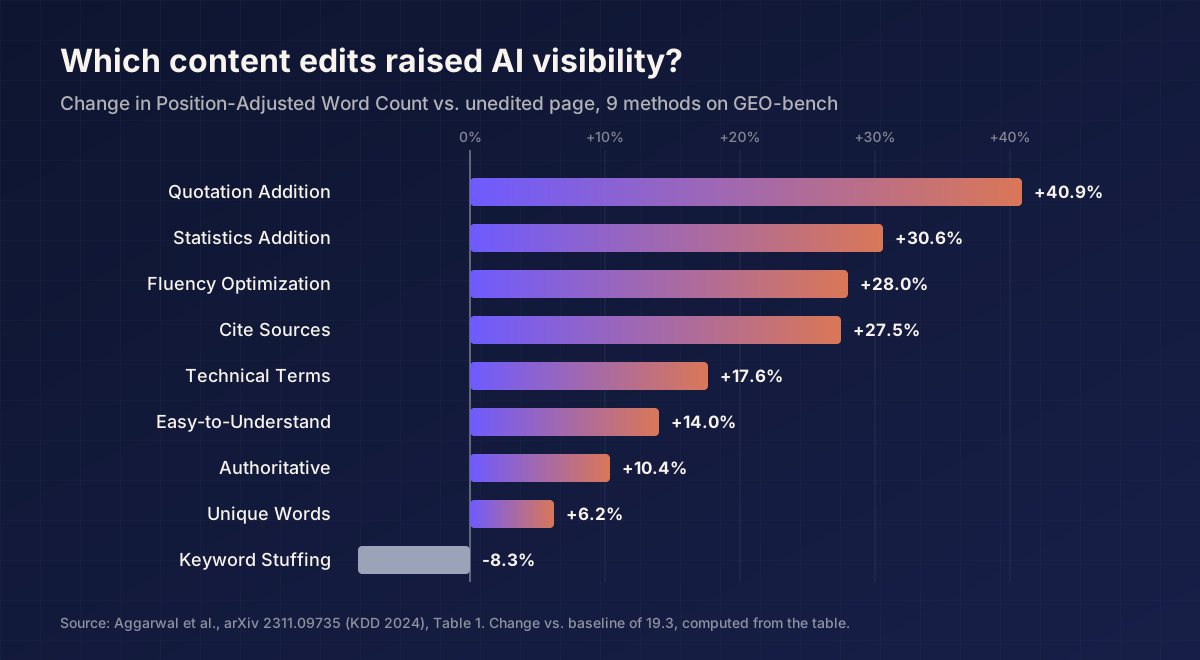
1. The GEO paper (November 2023, revised June 2024). On GEO-bench, Quotation Addition lifted Position-Adjusted Word Count from 19.3 to 27.2 (+41%), Statistics Addition to 25.2 (+31%) and Cite Sources to 24.6 (+27%). Keyword stuffing dropped it to 17.7. On Perplexity.ai, the best methods improved visibility by up to 22% and 37% on the paper’s two metrics. The limit: the main engine was GPT-3.5 reading the top 5 Google results, and today’s engines retrieve far more widely.
2. Ahrefs on AI Overview citations (2 March 2026). Across 863,000 keyword SERPs and 4 million AI Overview URLs, 37.9% of cited pages ranked in the top 10, 31.2% ranked 11 to 100, and 31.0% ranked beyond 100. In July 2025 the top-10 share was about 76%. Ahrefs links the drop to query fan-out, where Google runs related sub-queries behind the scenes, and says that link is its own inference. Practical reading: a page that answers the follow-up questions around a topic gets more chances to be cited.
3. Ahrefs on brand signals (26 May 2025). In a study of 75,000 brands, branded web mentions correlated with AI Overview visibility at 0.664, against 0.218 for backlinks and 0.326 for Domain Rating. That is correlation, which Ahrefs flags. It still matches what the GEO paper implies: engines quote what other sources say about you.
4. SE Ranking on traffic (June and November 2026). AI sends 0.32% of web traffic, mostly through ChatGPT, but 79.2% of sites now get some of it. Measured traffic is small. Influence on the buyers who never click is the part no tracker fully sees.
What the evidence does not support: special schema for AI, rewriting pages into tiny “chunks”, or keyword-stuffed FAQ blocks. Google’s AI features guide says no special schema.org markup is needed, and the GEO paper’s keyword-stuffing result points the same way.
How do you choose a GEO tool?
In 8 years of running Meta ads for 70+ brands, the rule that held up is to pay only for reports you will act on each week. GEO tools are the same. Decide by budget and by what you already pay for:
- Under $100 a month, still learning: set up GA4 and Bing Webmaster Tools first. Add Otterly Lite at $29 or Rankshift Starter at $82 annually once you have a prompt list.
- You need Claude and Copilot at the entry price: Rankshift, AthenaHQ Starter, or Otterly (Claude costs 3 credits per answer there).
- You already pay for Ahrefs or Semrush: use the prompts your plan includes before buying a separate tool. Ahrefs Lite includes 5 daily custom prompts; Semrush’s toolkit is $99/month.
- You want competitor benchmarks with no setup: Ahrefs Brand Radar’s $199 index.
- Agency with many clients: Rankshift (unlimited projects and seats) or Otterly Standard (unlimited workspaces).
- Enterprise with SSO and security review: Profound, Scrunch Enterprise or Peec AI Enterprise.
Whatever you buy, write the prompt list before the trial starts. Use real buyer questions, the kind people type into ChatGPT: “best [category] for [use case] under [price]”. Otterly’s guidance of 50 to 100 prompts per topic is a fair floor, because a 10-prompt sample swings for reasons that have nothing to do with your site.
For tools that cover the rest of search work, from audits to content briefs, see our best AI SEO tools comparison.
FAQ
What is generative engine optimization in simple terms?
Generative engine optimization (GEO) means making your pages and brand more likely to appear inside AI-written answers on ChatGPT, Gemini, Perplexity, Copilot, Claude and Google AI Overviews. The term comes from a 2023 paper by Aggarwal et al. (arXiv 2311.09735), which found quotations, statistics and cited sources raised visibility by up to 40%.
What is the cheapest GEO tool?
The cheapest paid GEO tool in this comparison is Otterly.ai Lite at $29/month for 20 prompts on 3 engines, verified November 2026. AthenaHQ has a free Essential plan with 300 credits, and Bing Webmaster Tools and GA4 report AI citations and AI visits for free.
How can I track brand mentions in ChatGPT and Gemini?
Use a prompt tracker that covers both: Otterly.ai, Rankshift, Peec AI, AthenaHQ, Writesonic, Ahrefs Brand Radar and Scrunch all do at their entry plans. For visits rather than mentions, GA4’s AI Assistant channel counts sessions from ChatGPT and Gemini.
How many prompts should a GEO tracker monitor?
Otterly.ai recommends 50 to 100 prompts per topic or market, because single AI answers vary from run to run. Below that, a change in your visibility score can be noise. Entry plans range from 20 prompts (Otterly Lite) to 350 custom prompts (Scrunch Starter).
Does llms.txt help with AI search?
There is no published evidence that llms.txt raises AI citations. It is an unofficial proposal from September 2024, and Google says no AI text files are needed for AI Overviews or AI Mode. It takes an hour to write, so most sites publish one anyway.
Should I block GPTBot?
Blocking GPTBot opts your content out of OpenAI model training and, per OpenAI’s documentation, does not affect inclusion in ChatGPT search. ChatGPT search uses OAI-SearchBot. Block OAI-SearchBot and your pages stop appearing in ChatGPT search answers.
Does Google Search Console show AI Overview traffic?
Yes, but not separately. Google says AI Overviews and AI Mode clicks and impressions are included in the Search Console Performance report under the “Web” search type, mixed with regular results. GA4 also counts them as Organic Search.
How is AI share of voice measured?
AI share of voice is the percentage of AI answers in a tracked prompt set that mention or cite your brand, compared with competitors. Ahrefs, Peec AI, Otterly.ai and Semrush all report it. The number depends entirely on which prompts you track.
Set up the free layer this week
Turn on the AI channel in GA4, verify your site in Bing Webmaster Tools, and check your robots.txt against the crawler table above. Give it 30 days. If AI sessions are turning into sign-ups, write 50 real buyer prompts and start a Rankshift or Otterly trial with them.
More on AI Marketing
All AI Marketing posts- Shopify SEO Services: What They Include, What They Cost and When to Hire Shopify SEO services cost $1,499 to $10,000 a month for one store on agency price pages read in November 2026. What Shopify does free, what to buy, how to vet.
- Best AI Ad Copy Generators in 2026: 11 Tools Compared on Price and Platform Fit The best AI ad copy generators for Meta, Google and TikTok in 2026: 11 tools compared, from free plans to Jasper at $59/seat. Prices verified November 2026.