
Disclosure: Shhots AI is our product. Agency and app prices were read on each provider's own pricing or service page on 17 November 2026. Shopify platform facts come from the Shopify Help Center and shopify.dev, read the same day. Shhots AI does not sell SEO services and has no business relationship with any agency named here.
Shopify SEO services cost $1,499 to $10,000 a month for a single store at the agencies that publish prices. Multi-market Shopify Plus programmes run to $15,000. On their own pages, read on 17 November 2026, 1Digital Agency starts at $1,499 a month for national SEO, Lead Marketing Strategies quotes $1,500 to $5,000, Conversion starts at $3,000, Netalico runs $3,700 to $10,000 and SeoProfy starts at $4,000. Ahrefs’ survey of 439 SEO providers found the most common retainer is cheaper: $501 to $1,000 a month (Ahrefs).
Before you pay anyone, know what Shopify already does for free. It generates your sitemap and robots.txt, adds canonical tags and ships product structured data in its themes (Shopify Help Center). A Shopify SEO service earns its fee on the work Shopify leaves to you: duplicate URLs from theme code, filter pages, app bloat, collection copy, links, migrations and, now, how your catalog shows up in ChatGPT, Gemini and Copilot.
This guide covers what the work includes, what nine named providers state about price, how to vet an agency, and a checklist of what you can fix yourself first.
What do Shopify SEO services include?
Agency pages list roughly the same areas. The useful question is which of them Shopify already covers.
| Area | What Shopify does by default | What a Shopify SEO service adds | Can a merchant do it alone? |
|---|---|---|---|
| Technical SEO | Sitemap, robots.txt, canonical tags, title and meta fields | Fixes theme links to duplicate URLs, controls filter and tag pages, edits robots.txt.liquid, plans redirects | Partly. Theme code edits need a developer |
| Site speed | Web performance dashboard with Core Web Vitals | App and script audits, image and theme fixes | Partly. Removing unused apps is easy |
| On-page | Editable titles, meta descriptions, URL handles, alt text | Keyword mapping to collections and products, collection copy, internal links | Yes, with time |
| Structured data | Product rich snippets in Theme Store themes | Review, breadcrumb, organization and FAQ markup, fixing app conflicts | Partly. An app can add most of it |
| Content | A built-in blog | Buying guides, comparison pages, size and care guides linked to collections | Yes, if someone can write |
| Links and PR | Nothing | Digital PR, outreach, backlink audits | Hard to do well alone |
| AI search | Agentic storefronts, on by default for eligible stores | Catalog data checks, AI citation tracking | Partly |
The rest of this guide goes through each area in the order an audit usually does.
What does Shopify already handle for SEO?
More than most agency pages admit. These are Shopify’s own statements, from its Help Center and developer docs:
- Sitemap. Shopify builds
sitemap.xmlat the root of your domain. It covers products, each product’s primary image, collections, pages and blog posts. On the Basic plan or higher, every international domain gets its own sitemap (Shopify). - robots.txt. Generated automatically. You can override it with a
robots.txt.liquidtheme template, which replaces Shopify’s output entirely (shopify.dev). - Canonical tags. “Auto-generated canonical tags are added to pages to prevent duplicate content from appearing in search results,” per Shopify’s SEO overview.
- Structured data. Themes in the Shopify Theme Store must include Google’s rich product snippets, plus a title, meta description and canonical URL (Theme Store requirements).
- Theme speed floor. Theme Store themes need an average Lighthouse performance score of at least 60 across the home, collection and product pages, on desktop and mobile. Shopify runs that test on a benchmark dataset, not on your store after you add apps.
- Editable search listings. Products, collections, pages and blog posts each have a title, meta description and URL handle you can edit. Shopify’s guidance is titles under 60 characters and meta descriptions under 160.
So the baseline is decent. Where stores lose ground is in what gets layered on top: theme customizations, apps, tags, filters and a catalog that keeps growing.
Which Shopify SEO problems need a specialist?
Seven problems show up on almost every Shopify SEO agency page. Some need a developer. Some only need someone to notice them.
Duplicate product URLs from collection links
One product on Shopify can load at several addresses. The Liquid within filter builds collection-scoped URLs such as /collections/sale-potions/products/draught-of-immortality, and Shopify’s own docs warn that these pages “have the same content on separate URLs” (shopify.dev).
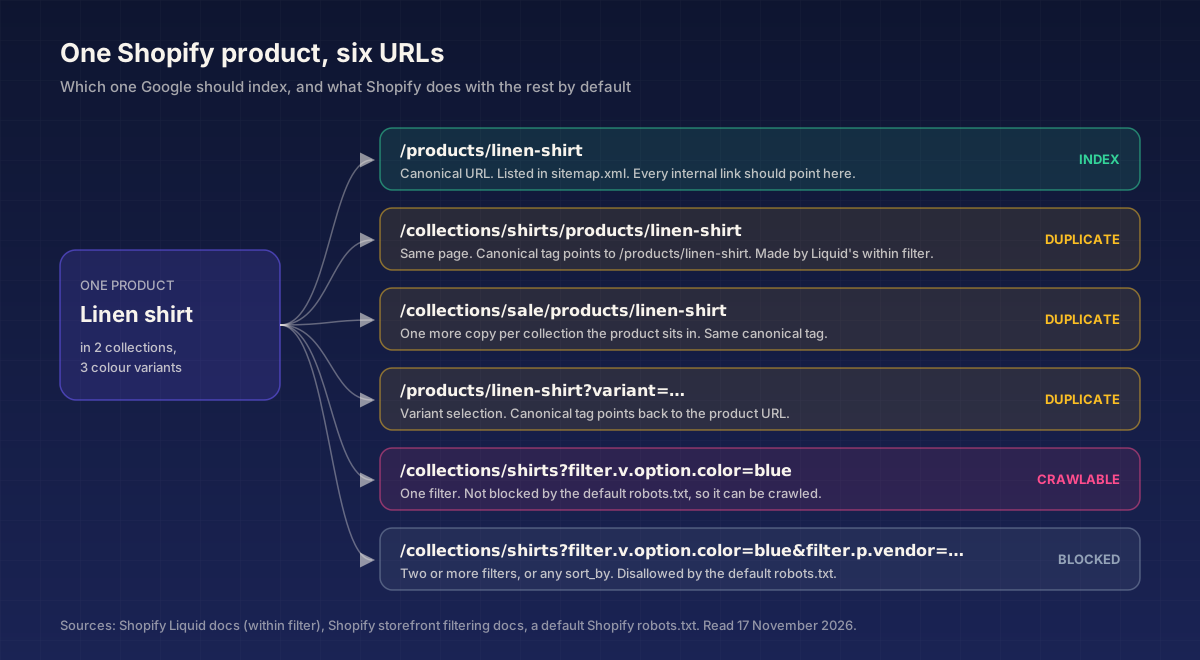
The canonical tag points every copy back to /products/<handle>, so the duplicates rarely get indexed. The waste is in crawling and internal links. Google treats a canonical as a signal it weighs, and Google’s own faceted navigation guide says canonical tags “may, over time, decrease the crawl volume” of non-canonical URLs (Google Search Central). If your theme’s collection grid links to the collection-scoped version, every product card sends crawlers to a duplicate first.
The fix is a theme edit: make the product card link to the plain product URL. It takes a developer minutes, and it is the first thing a competent Shopify audit checks.
Filter, sort and tag pages
Shopify’s Search & Discovery app supports up to 25 filters per store, and filter URLs use parameters such as filter.v.option.color=red (Shopify filters, shopify.dev). Every filter combination is a new URL.
Shopify’s default robots.txt already blocks part of this. A standard Shopify robots.txt (read on a live Shopify store on 17 November 2026) disallows:
/collections/*sort_by*, so sorted versions of a collection/collections/*+*, so combined tag pages/collections/*filter*&*filter*, so URLs with two or more filters
A single-filter URL is not blocked. Neither is a single tag page like /collections/shirts/blue. On a store with many filter values, that can mean thousands of crawlable near-duplicate collection pages. Google’s own recommendation for faceted navigation is to disallow those URLs in robots.txt when you don’t want them in search. Some single-filter pages deserve to rank (“blue linen shirts” may be a real search). Deciding which ones, and giving those their own collection with copy, is the judgement you are paying a specialist for.
Theme speed, apps and Core Web Vitals
Shopify’s web performance dashboard rates your store on real user data from the past 30 days:
| Metric | Good | Poor |
|---|---|---|
| Largest Contentful Paint (LCP) | 2,500 ms or less | Over 4,000 ms |
| Interaction to Next Paint (INP) | 200 ms or less | Over 500 ms |
| Cumulative Layout Shift (CLS) | 0.1 or less | 0.25 or more |
The dashboard’s over-time view marks events such as app installs, theme updates and new code, so you can see which change moved a score. Apps that inject scripts on every page are the usual suspect. Netalico and SeoProfy both list “app bloat” or app script cleanup as a named deliverable, which tells you how common it is.
Structured data conflicts
Theme Store themes ship product markup. Review apps, SEO apps and custom code often add their own. Two sets of Product markup on one page can disagree on price or availability. An audit should check that each page outputs one clean set, using Google’s Rich Results Test.
robots.txt.liquid edits
Shopify lets you add, remove or replace robots.txt rules, and its docs ask you to “save a copy of your current /robots.txt output” before publishing changes (shopify.dev). A wrong rule can block whole collections. This is one file worth leaving to someone who has edited it before.
Redirects and migrations
Shopify allows up to 100,000 URL redirects on standard plans, with a higher limit on Plus. Two limits catch people out: a redirect only fires when the old URL is broken, and you cannot redirect from Shopify’s fixed paths /products, /collections or /collections/all (Shopify redirects).
Migrations are where SEO help pays for itself fastest. Google’s own guide to hiring an SEO says “a great time to hire is when you’re considering a site redesign” or a new site launch (Google). A replatform from WooCommerce or Magento changes every URL. Missing the redirect map is how stores lose years of rankings in a week.
International stores and Shopify Plus
Shopify Markets adds language and country versions, and each international domain needs its own Search Console verification and sitemap submission. Shopify’s robots.txt docs say host-specific rules are only for stores using Markets with distinct domains. Agencies that sell “Shopify Plus SEO” mostly mean this layer: hreflang, multiple domains, B2B catalogs and headless Hydrogen storefronts. Conversion’s service page lists all four.
How much do Shopify SEO services cost?
Three sources give a usable range. None of them is perfect, so read them together.
The survey. Ahrefs polled 439 SEO providers. The page was last updated 15 August 2024, so treat the numbers as a 2024 snapshot (Ahrefs).
| Pricing model | Share of providers using it | Most common price | Average |
|---|---|---|---|
| Monthly retainer | 78.2% | $501 to $1,000 a month (20.4%) | Agencies $3,209, consultants $3,250, freelancers $1,349 a month |
| Hourly | 34.8% | $75 to $100 an hour (24%) | Agencies $98.90, consultants $171.18, freelancers $71.59 an hour |
| Per project | 48.9% | $2,501 to $5,000 (21.2%) | Agencies $9,508, freelancers $2,349 |
Shopify’s own estimate. Shopify’s SEO pricing guide (11 December 2025) puts ecommerce SEO at $2,000 to $10,000 a month, $150 to $500 an hour, or $5,000 to $30,000 as a one-off project. It lists a technical SEO audit at $2,500 to $15,000 one-off. The article does not say where these ranges come from.
Published agency prices. The table in the next section. They cluster between $1,500 and $5,000 a month for a single store, with Plus and multi-market work running to $10,000 to $15,000.
The gap between the survey’s most common $501 to $1,000 and the agencies’ $3,000 starting points is real. The survey covers every kind of SEO provider, including freelancers and local-business SEO. Agencies that specialise in Shopify and publish prices start higher.
Which Shopify SEO agencies publish their prices?
Most don’t. These are the named providers whose pricing or service pages I could read on 17 November 2026, in alphabetical order. Being listed is not an endorsement. Where a page gives no price, the table says so.
| Provider | Price stated on its own page | Terms stated | Shopify-specific work it names |
|---|---|---|---|
| 1Digital Agency | $1,499 to $5,999 a month (national); $899 to $4,499 (local) | 6-month initial term, then month-to-month. One-off onsite work from $1,699. Out-of-scope work $185/hour | Lists Shopify and Shopify Plus. Tiers are set by content volume: blogs, offsite articles, pages optimised |
| Conversion | From $3,000 a month for one storefront; multi-market Plus programmes up to $15,000 | Month-to-month after the first 90 days. Offers a pay-on-results option | Canonicals, faceted navigation, hreflang, Merchant Center feeds, agentic commerce data |
| Go Fish Digital | Not stated (custom proposal) | Not stated | Duplicate product pages, JavaScript rendering, Core Web Vitals, digital PR |
| Lead Marketing Strategies | $1,500 to $5,000 a month | ”No long-term contracts” | Duplicate URL and canonical fixes, product schema, collection copy, WebP images, Merchant Center sync |
| Netalico | $3,700 to $10,000 a month, average client about $4,500. Replatforms $25,000 to $250,000+ | Not stated. The page’s schema markup gives different figures ($2,000 to $10,000) | Canonicals, faceted navigation, app bloat removal, migration SEO |
| OuterBox | Not stated. “Depends on catalog size, competition, current rankings” | Not stated | Audit and roadmap, collection architecture, theme speed, migration SEO |
| SeoProfy | From $4,000 a month for small sites; $6,000 to $8,000 for mid-size. Technical audit $750 to $1,500 | Not stated | Canonical and duplicate URL control, app script cleanup, theme speed, variant alt text |
| Shopify Professional Services | Not stated (free discovery call) | Not stated | Audits, AI search visibility, migrations, technical fixes, link building, international SEO |
| SmartSites | From $2,600 a month (40 hours minimum at $65/hour) | No term stated; you can move between plans | Works on existing Shopify sites. General SEO page, not Shopify-only |
Prices read on each provider’s own page on 17 November 2026.
Two things to notice. First, the deliverables lists are close to identical across agencies; the price differences come from hours, content volume and seniority, which the tables don’t show. Second, several “best Shopify SEO agency” lists ranking in Google are written by agencies that rank themselves first, Netalico’s and Conversion’s among them. Read those as sales pages.
What is the minimum you commit to?
The monthly price matters less than the money you’re locked into before you can judge results.
| Provider | Lowest published plan | Minimum term | Minimum commitment |
|---|---|---|---|
| 1Digital Agency (local) | $899/month | 6 months | $5,394 |
| 1Digital Agency (national) | $1,499/month | 6 months | $8,994 |
| Conversion | $3,000/month | 90 days | $9,000 |
| Lead Marketing Strategies | $1,500/month | ”No Contracts”, per its page | $1,500 |
| SmartSites | $2,600/month | None stated | $2,600 |
Commitment is the plan price multiplied by the stated term. Netalico and SeoProfy don’t state a term.
Should you hire an agency, a freelancer, an app or do it yourself?
Pick by the problem you have.
- You’re migrating to Shopify or changing themes. Hire. A redirect map and a pre-launch crawl cost far less than a lost year of rankings. A one-off project is enough; a retainer isn’t required.
- You run Shopify Plus with several markets or domains. Hire a Shopify specialist. Hreflang and multi-domain sitemaps are where general SEO agencies go wrong.
- Rankings are flat and you’ve never had an audit. Buy a one-off technical audit first. SeoProfy publishes $750 to $1,500; Shopify’s guide quotes $2,500 to $15,000. Then decide whether you need ongoing help.
- You have under a few hundred products, one market and a Theme Store theme. Start with the checklist below and an SEO app. Most of the technical baseline is already there.
- You need content and links, not fixes. A freelance writer and a PR budget may beat an agency retainer that bundles both with work you don’t need.
SEO apps sit between DIY and hiring. Yoast SEO for Shopify costs $19 per 30 days, or $45 a month for the AI+ tier, with a 14-day trial. It writes titles and meta descriptions, adds product schema and generates an llms.txt file. Plug in SEO scans for missing tags and broken schema and bulk-edits alt text, with plans set by how many pages it scans, from 30 to unlimited. One warning from the App Store reviews of both: some merchants report theme problems after an app update or uninstall. Duplicate your theme before installing any SEO app.
How do you vet a Shopify SEO agency?
Google publishes its own list of questions to ask an SEO, including “Can you show me examples of your previous work” and “What kind of results do you expect to see, and in what timeframe?” (Google Search Central). Use those, then add the Shopify-specific ones below. A good agency answers them on the first call without needing to “look into it”.
Questions to ask
- Which duplicate URLs on our store would you fix first, and how? The answer should mention collection grid links, single-filter URLs and tag pages, not only “canonical tags”.
- Will you edit theme code, and what happens to those edits at the next theme update? Shopify carries code edits into a new theme version only when they don’t conflict with the update; otherwise someone has to copy them across by hand (Shopify). Ask who does that.
- Which of our apps slow the store down, and would you remove any? If they haven’t looked at your app list, they haven’t audited the store.
- How do you report results? Ask for organic revenue and orders from Shopify or GA4, alongside rankings and traffic.
- What access do you need? A staff account limited to the permissions the work needs is enough for most SEO work.
- What do we keep if we cancel? Content, theme edits, redirect maps and reports should all stay with you.
- What will you do in month one, and what in month six? Retainers that front-load an audit and then coast are common. Ask for the later months in writing.
- How will you handle AI search? Ask how they check your Shopify Catalog eligibility and agentic storefront settings, and how they measure citations in ChatGPT or Gemini.
Red flags
- Guaranteed rankings. Google’s own guidance: if they promise “first place in search results, find someone else.” The same page warns about anyone claiming a “special relationship” with Google.
- Backlink packages sold by count. “50 links a month” usually means low-quality placements. Google’s guide warns against link schemes and says you should never have to link to an SEO.
- Cold outreach. Google warns about firms that “email you out of the blue”.
- Secrecy. An agency that won’t list what it changed on your store, and why, is a risk to the store.
- Promises to remove
/products/or/collections/from URLs. Those paths are fixed on Shopify. Rebuilding around them usually means a headless storefront, which is a much bigger project than SEO. - Installing several SEO apps at once. Overlapping apps output duplicate meta tags and schema.
- A long lock-in with no audit first. You should see a written audit before committing to six or twelve months.
What can you fix yourself before hiring anyone?
Most of this list takes an afternoon. Do it before a sales call, and any agency proposal will have to justify itself against a cleaner store.
- Connect Google Search Console. Verify the domain and submit
sitemap.xmlunder Indexing > Sitemaps, as Shopify’s sitemap guide describes. Repeat for every international domain. - Turn off password protection. Google can’t read the sitemap of a store in private mode, and the web performance dashboard needs private mode off too.
- Rewrite your top 20 product titles. Name the product the way buyers search for it. Keep SEO titles under 60 characters.
- Write meta descriptions for every collection. Under 160 characters, with the product type and one concrete detail: price range, material, fit.
- Add copy to collection pages. Collections are often the pages that rank for category searches. A short paragraph on what is in the collection and who it’s for beats an empty grid.
- Write alt text for product images. Describe what is in the photo, such as “Men’s waterproof hiking boots”, Shopify’s own example. Each image gets a different description.
- Check product card links. Click a product in a collection. If the address bar shows
/collections/.../products/..., ask a developer to point cards at/products/.... - Delete apps you don’t use. Then check the web performance dashboard a week later.
- Compress large images. Hero images are the usual LCP problem.
- Set redirects for deleted products. Under Content > Menus > URL redirects, point each dead product URL to its closest live product or collection.
- Leave URL handles alone. Shopify warns that editing a handle too often can stop the product showing in search results. When you must change one, add a redirect from the old URL.
- Test one product page in the Rich Results Test. Look for one Product item with the right price and stock.
- Fill in your store policies. Terms of service, privacy policy and returns policy. Agentic storefronts require all three.
- Start one buying guide. Pick a question your support inbox gets every week and answer it on the blog, linking to the right collection.
If the product pages are short on images, Shhots AI (our product) has an AI product photography tool that makes extra studio and lifestyle shots from one product photo. Give each new image its own alt text.
How does AI search change Shopify SEO?
Your catalog now has a second audience: AI shopping assistants. Shopify’s agentic storefronts let customers find and buy your products in AI channels. The Help Center lists ChatGPT, Google AI Mode and Gemini, Microsoft Copilot and Meta, including Muse.
What Shopify’s Help Center states, as read on 17 November 2026:
- It is on by default for eligible stores. You manage channels in the admin under Sales channels > Agentic.
- Eligibility requires products eligible for Shopify Catalog, completed Terms of service, Privacy policy and Return and refund policy, and agreement to Shopify’s Agentic Storefronts supplemental terms.
- Checkout differs by channel. ChatGPT works as a discovery referrer, and customers check out on your own store. Google AI Mode and Gemini, Copilot and Meta can offer direct checkout inside the AI channel if it is turned on.
- Product data reaches Google’s AI channels through the Google & YouTube sales channel or Merchant Center. Other channels use Shopify Catalog.
- A knowledge base holds non-product answers such as return processes and shipping times.
The SEO work here is data quality. An assistant can only recommend what your catalog describes: product type, material, size, compatibility, price and policies. Thin product titles and missing attributes hurt you in AI channels the same way they hurt you in Google Shopping. The protocols behind these channels are explained in how agentic commerce protocols work, and tools that track AI citations are compared in the best GEO tools.
Ask any agency how it measures this. Several now list AI search as a deliverable: Conversion names agentic commerce and AI citation tracking, SeoProfy names AI citation tools, and Shopify Professional Services lists AI search visibility. Ask for a sample report before you pay for it.
FAQ
How much do Shopify SEO services cost?
Shopify SEO services cost $1,499 to $10,000 a month for a single store at agencies that publish prices, as read in November 2026. Lead Marketing Strategies quotes $1,500 to $5,000, Conversion starts at $3,000, Netalico runs $3,700 to $10,000 and SeoProfy starts at $4,000. Ahrefs’ provider survey found the most common SEO retainer is $501 to $1,000 a month.
Does Shopify do SEO automatically?
Shopify does the technical baseline automatically: it generates sitemap.xml and robots.txt, adds canonical tags, and Theme Store themes include product structured data. It does not write your titles, collection copy or alt text, control filter pages, or build links. That remaining work is what Shopify SEO services sell.
How much does a Shopify SEO audit cost?
A Shopify technical SEO audit costs $750 to $1,500 at SeoProfy, based on page count, as published in November 2026. Shopify’s own pricing guide gives a wider range of $2,500 to $15,000 for a one-off technical audit. An audit is the sensible first purchase if you have never had one.
Do I need an SEO app on Shopify?
You don’t need an SEO app, but one saves time on titles, meta descriptions, alt text and schema across a large catalog. Yoast SEO for Shopify costs $19 per 30 days, as of November 2026. Install one app at a time and duplicate your theme first, since overlapping apps can output duplicate tags.
How do I fix duplicate collection product URLs on Shopify?
Edit your theme so product cards in collection grids link to /products/handle instead of /collections/handle/products/handle. Shopify’s canonical tags already point duplicates to the product URL, but internal links to the duplicates waste crawling. The change is a small theme code edit for a developer.
Does Shopify offer its own SEO service?
Yes. Shopify Professional Services offers SEO audits, technical fixes, migrations, link building, international SEO and AI search visibility work. Its page does not state a price and offers a free discovery call, as of November 2026.
How long does Shopify SEO take to show results?
No one can promise a timeline, and Google’s own advice is to ask any SEO what results to expect and in what timeframe. Ask for that estimate in writing before you sign. Treat any guaranteed ranking date as a red flag.
What is different about Shopify Plus SEO?
Shopify Plus SEO mostly means international and scale problems: Shopify Markets with several domains, hreflang, host-specific robots.txt rules, B2B catalogs, headless Hydrogen storefronts and a higher redirect limit. A single-market Plus store has the same SEO needs as any other Shopify store.
Does Shopify SEO affect ChatGPT and Gemini?
Yes. Shopify’s agentic storefronts send eligible stores’ products to ChatGPT, Google AI Mode and Gemini, Microsoft Copilot and Meta. Eligibility needs Shopify Catalog-eligible products and completed store policies. Complete product data and policies are the levers you control.
Where to start this week
Connect Search Console, submit your sitemap and work through the 14-item checklist above. If rankings are still flat after a month, buy a one-off technical audit before signing any retainer, and take the vetting questions to the call. For the tools side of the job, the best AI SEO tools guide compares what each one costs.
More on AI Marketing
All AI Marketing posts- Best AI Ad Copy Generators in 2026: 11 Tools Compared on Price and Platform Fit The best AI ad copy generators for Meta, Google and TikTok in 2026: 11 tools compared, from free plans to Jasper at $59/seat. Prices verified November 2026.
- ChatGPT Ads: How They Work, What They Cost and How to Run Them ChatGPT ads show below answers for Free and Go users in 89 countries. Self-serve from $25 a day with CPM, CPC or conversion bidding. Specs, costs and setup.