
Disclosure: Shhots AI is our product. Every OpenAI fact here was read on OpenAI's own Help Center articles, developer docs, ad policies and announcements on 17 November 2026. Cost figures from third parties are labeled with their source and date. Shhots AI is our product and is mentioned once, in the creative section.
ChatGPT ads are labeled “Sponsored” units that appear below ChatGPT’s answer for logged-in adults on the Free and Go plans. OpenAI started testing them in the US on 9 February 2026, and by 21 October 2026 they ran in 89 countries, with more than 100,000 advertisers having used the platform (OpenAI). Businesses buy them in a self-serve Ads Manager at ads.openai.com from a $25 minimum daily budget, paying per 1,000 impressions or per click, or through agencies and technology partners. OpenAI says ads do not change ChatGPT’s answers and advertisers never see anyone’s chats.
This guide covers who sees the ads, how ChatGPT picks one, what they cost, the creative specs, the setup steps, what you are not allowed to advertise, and how ChatGPT ads compare with Google, Meta and Copilot ads. Every OpenAI fact was read on OpenAI’s own pages on 17 November 2026. Anything OpenAI has not published is marked “not stated by OpenAI”.
What are ChatGPT ads?
A ChatGPT ad is one paid unit shown below the end of a ChatGPT response. It carries a “Sponsored” label, a title, a description, one or more images and a link to the advertiser’s site. OpenAI’s Ads in ChatGPT help article says you see one ad unit at a time, and that ads “run on separate systems from our chat model”.
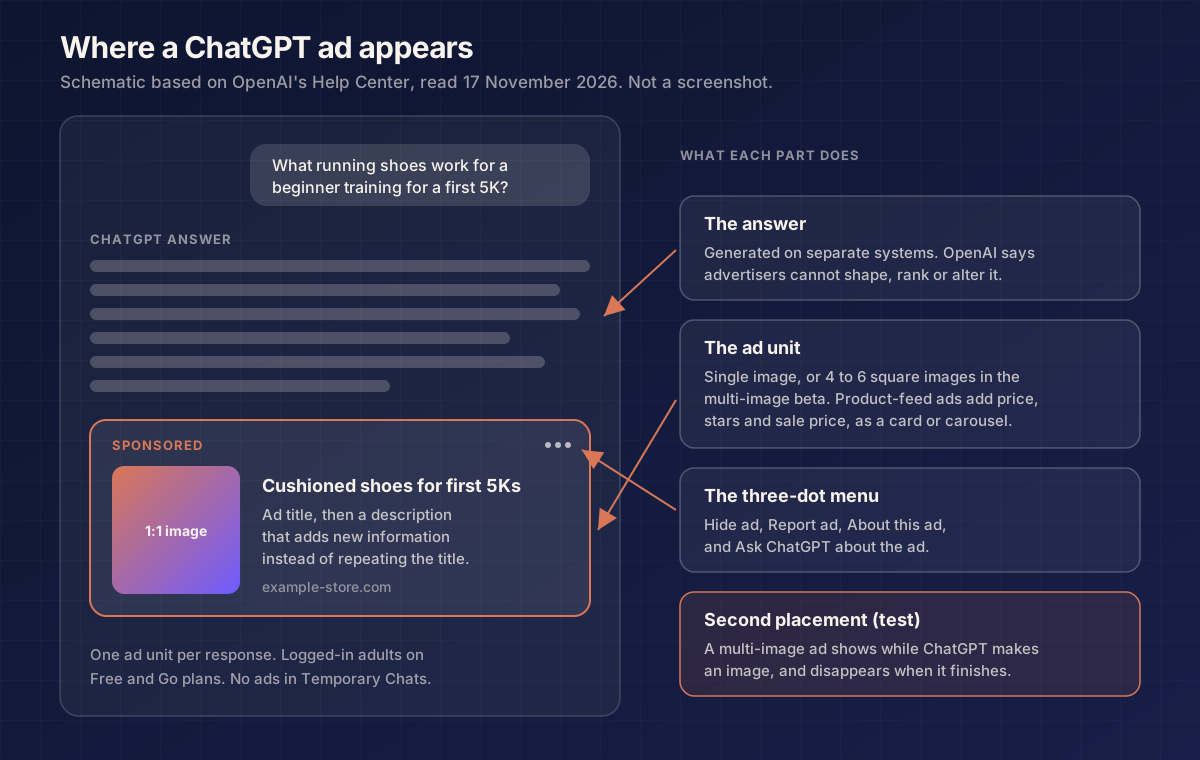
There are four ad experiences live or in testing as of November 2026:
| Format | Where it shows | Status (as of 17 Nov 2026) |
|---|---|---|
| Single-image ad | Below a ChatGPT response | Live in Ads Manager |
| Multi-image ad (4 to 6 square images) | Below a ChatGPT response | Open beta since 26 October 2026 |
| Product-feed ad (single product card or carousel with image, title, stars, price, sale price, brand) | Below a ChatGPT response | Live for retail advertisers with a feed |
| Visual ad during image generation | While ChatGPT creates an image; disappears when the image is done | Testing in the US since October 2026 with an initial group of advertisers |
Sources: Creating ads for ChatGPT Ads, Create Campaigns from Product Feeds, OpenAI, 5 October 2026.
OpenAI is also testing Sponsored Agents with select US advertisers. After clicking an ad, a user can start a separate, labeled chat with an agent the business sponsors, ask follow-up questions, then go to the website (OpenAI, 16 September 2026).
Every ad has a three-dot menu with Hide ad, Report ad, About this ad and Ask ChatGPT. ChatGPT cannot see the ad on screen unless the user picks Ask ChatGPT, and OpenAI says advertisers do not influence what ChatGPT says about an ad shared that way.
When did ChatGPT ads launch, and where are they available?
Ads went from a US-only test to 89 countries in eight months. The dates below come from OpenAI’s own posts and Help Center unless another source is named.
| Date | What happened |
|---|---|
| 16 Jan 2026 | OpenAI announces plans to test ads in ChatGPT (Axios) |
| 9 Feb 2026 | Test starts in the US for logged-in adults on Free and Go (OpenAI) |
| 26 Mar 2026 | Pilots announced for Canada, Australia and New Zealand |
| 5 May 2026 | Self-serve Ads Manager beta and CPC bidding launch; agency partners Dentsu, Omnicom, Publicis and WPP; tech partners Adobe, Criteo, Kargo, Pacvue and StackAdapt (OpenAI) |
| 11 Aug 2026 | Ads live in the UK, Mexico, Brazil, Japan and South Korea |
| 18 Aug 2026 | Expansion across Europe |
| 16 Sep 2026 | Sponsored Agents test, AI copy and image suggestions in Ads Manager, Shopify and HubSpot integrations |
| 23 Sep 2026 | Expansion to Southeast Asia and Taiwan |
| 5 Oct 2026 | Visual ads during image generation announced, plus new measurement partners |
| 21 Oct 2026 | 26 more countries, 89 in total; over 100,000 advertisers to date |
| 26 Oct 2026 | Multi-image format opens as a beta in Ads Manager |
| 30 Oct 2026 | Creative enhancements switched on by default for self-serve campaigns |
| Early Nov 2026 | Target CPA and Target CPC bidding released, per an OpenAI statement quoted by Search Engine Journal on 16 November 2026 |
Self-service access is listed by country on OpenAI’s Ads Manager Availability page. On 17 November 2026 it listed 89 countries as available, from Algeria to Vietnam, including the US, UK, Canada, Australia, India, Germany, France, Japan and Brazil. The legal entity that advertises and gets billed has to be based in a listed country.
One catch for new accounts: some self-serve accounts can at first advertise only in their home country, and OpenAI widens that as the account builds history. OpenAI Support will not say how much spend it takes to get other countries.
Who sees ChatGPT ads, and who doesn’t?
Ads show only on the Free and Go plans. Paying for Plus or anything above removes them.
| User | Sees ads? |
|---|---|
| Free plan, logged in, 18+ | Yes, in regions where ads run |
| Go plan | Yes |
| Free plan on the “Ads-Free” option | No, in exchange for fewer messages and no image generation or deep research |
| Plus, Pro, Business, Enterprise, Edu | No |
| Accounts identified or predicted as under 18 | No |
| Temporary Chats | No |
| Logged-out users | OpenAI’s help article says ads shown logged out are “appropriate for all audiences”; mature-content ads need an eligible logged-in user |
Source: Ads in ChatGPT, updated early November 2026.
Topic matters too. Ads are not eligible to appear near personal health, mental health or political conversations. OpenAI’s ad policies also block 19 brand-unsafe conversation categories, from child safety to weapons, plus emotionally reliant conversations.
How often do ads appear? OpenAI has not published a rate. SE Ranking ran 50,006 commercial prompts across 20 US niches on 23 July 2026 and found an ad on 25.94% of them, always a single sponsored offer below the answer (SE Ranking, 10 August 2026). The rate ranged from 12.76% in relationships to 37.68% in business prompts.
How does ChatGPT decide which ad to show?
ChatGPT matches ads to the conversation, then ranks eligible ads by relevance and bid. There are no keywords to buy.
OpenAI lists the signals its ads system uses (Ads in ChatGPT):
- The context and intent of the current conversation.
- The ad’s landing page, title and copy.
- The advertiser’s context hints and targeting settings.
- General location and language.
- With ad personalization on: past chats, memory, and how the user has interacted with earlier ads.
When several ads qualify, OpenAI says it weighs “a combination of factors, including relevance and advertiser bids”. The exact auction mechanics are not stated by OpenAI in its current help articles.
Context hints replace keywords. They are phrases you add at the ad group level that describe what you sell, who it helps and when it is useful. OpenAI’s own example: “cushioned everyday running shoes for beginners training for their first 5K” beats “running shoes”. The ad group help article is explicit that context hints “are not exact-match keywords or targeting rules” and do not guarantee delivery.
The targeting controls advertisers do get, per the campaign setup article:
| Control | Detail |
|---|---|
| Location | Countries, plus states, cities, markets and postal codes where available (country level only for product-feed campaigns) |
| Platforms | Android app, Android web, Desktop web, iOS app, iOS web |
| Custom audiences | Include or exclude; inclusion needs at least 25,000 matched users |
| Negative Phrases | Available to “qualifying advertisers” to keep ads away from specific contexts (OpenAI, 5 Oct 2026) |
| Age, gender, interests | Not offered. Not stated by OpenAI as a targeting option |
In the European Economic Area and Switzerland, personalized ads are not initially available, and OpenAI tells advertisers to avoid custom audiences there.
What data do advertisers get, and what stays private?
Advertisers get aggregated numbers and their own conversion data. They do not get chats.
OpenAI’s help article says advertisers never receive users’ chats, chat history, memories, name, email, precise location, IP address, or sensitive information. Reporting covers impressions, clicks, spend, CTR and, with tracking set up, attributed conversions. If a user deletes their ads data, OpenAI keeps it for up to 30 days before removing it.
For conversions, Ads Manager supports a JavaScript pixel and a Conversions API. OpenAI added Hightouch, Tealium and LiveRamp to pass conversion data, attribution partners including AppsFlyer, Triple Whale, Adjust, Northbeam, Branch and Singular, and geo-experiment partners Haus, Measured and WorkMagic for incrementality tests (OpenAI, 5 Oct 2026).
Reporting refresh times, from the product feed article: impressions, clicks and CTR update about every 15 minutes; spend is delayed about 7 to 8 hours.
How much do ChatGPT ads cost?
The minimum daily budget is $25 per campaign. There is no published minimum total spend for self-serve, and you never pay per conversion. Actual CPMs and CPCs are set by auction and OpenAI publishes no benchmarks; its advertiser FAQ says the platform “does not yet have performance benchmarks across advertisers, industries, or campaign types.”
What OpenAI states officially, verified November 2026:
| Item | Official answer |
|---|---|
| Minimum daily budget | $25 USD (also 15 EUR, 15 GBP, 25 CAD, 25 AUD, 725 INR, 2,500 JPY; 37 currencies listed) |
| Daily overspend cap | Up to 2x the daily budget on one day; no more than 7x over a Sunday to Saturday week |
| Views objective | Pay per 1,000 impressions (CPM) |
| Clicks objective | Pay per valid click (CPC) |
| Conversions objective | Optimizes for one standard conversion event; billed per click (oCPC) or per 1,000 impressions (oCPM) |
| Pay per conversion | No |
| Recommended bid | ”There is no recommended bid amount at this time” (Conversion-optimized Campaigns) |
| Default bid strategy | Maximize results for eligible new ad groups; manual max bid available |
What has been reported by third parties, with dates. Treat these as data points, not a rate card:
| Figure | What it is | Source |
|---|---|---|
| $60 CPM and about $200,000 minimum commitment | Pricing for the invite-only launch test, before self-serve | Adweek and The Information, via eMarketer, 2 Feb 2026 |
| $3 to $5 | OpenAI’s suggested starting maximum CPC bid, as cited by researchers | Search Engine Journal, 16 Nov 2026 |
| $1.72 CPC | One agency account (Opascope), about $60,000 over 15 days, published June 2026 | Same SEJ article |
| About $47 CPM | Our division of AdClarity’s estimated US August spend ($94 million) by its estimated impressions (about 2 billion) | Search Engine Land, 10 Nov 2026 |
| 1.30% CTR | SE Ranking’s own test: 97,000+ impressions, 1,263 clicks, 48 ads in the US, Canada, Australia and New Zealand | SE Ranking, 10 Aug 2026 |
The early performance evidence is mixed, and it is worth reading before you set a budget:
- Against: A working paper by Kaiser and Schulze pooled US traffic from 102 websites through 22 August 2026. A visit from a ChatGPT ad generated $0.89 in revenue against $2.45 for a paid search visit, and 84 of the 87 advertisers that ran both saw lower revenue per session on ChatGPT. OpenAI responded that the study covers “an earlier period” and a small sample (SEJ, 16 Nov 2026).
- For: OpenAI published partner results: WeightWatchers’ attributed CPA was 15.3% lower than its blended paid-search benchmark (DV Rockerbox), and 93% of Portland Leather’s ChatGPT ad visitors were new (Triple Whale) (OpenAI, 5 Oct 2026). These are vendor-selected examples.
- Retention: In AdClarity data, about one in three advertisers who tried ChatGPT ads were not running them in August 2026, and average spend per advertiser fell about 85% from May to August as advertiser numbers grew (Search Engine Land, 10 Nov 2026).
How do you run ads on ChatGPT?
There are four ways in: self-serve Ads Manager, an agency or technology partner, an app inside a tool you already use, or the API. Larger advertisers can also ask OpenAI’s sales team for managed support.
| Route | Who it fits |
|---|---|
| Ads Manager (self-serve) | Any business whose legal entity is in one of the 89 listed countries |
| Agencies: Dentsu, Omnicom, Publicis, WPP | Brands already buying through a holding company |
| Tech partners: Adobe, Criteo, Kargo, Pacvue, StackAdapt | Teams buying programmatically |
| ChatGPT Ads app for Shopify | US-based Shopify merchants; products come in through Shopify Catalog |
| ChatGPT Ads in HubSpot | Businesses that manage leads in HubSpot |
| Ads Manager plugin in ChatGPT | Create, edit and analyze campaigns with prompts inside ChatGPT |
| Advertiser API and Bulk API | Developers and agencies managing campaigns in code |
Most of the spend so far is direct: more than two-thirds of estimated US spend in AdClarity’s data went through OpenAI rather than programmatic partners.
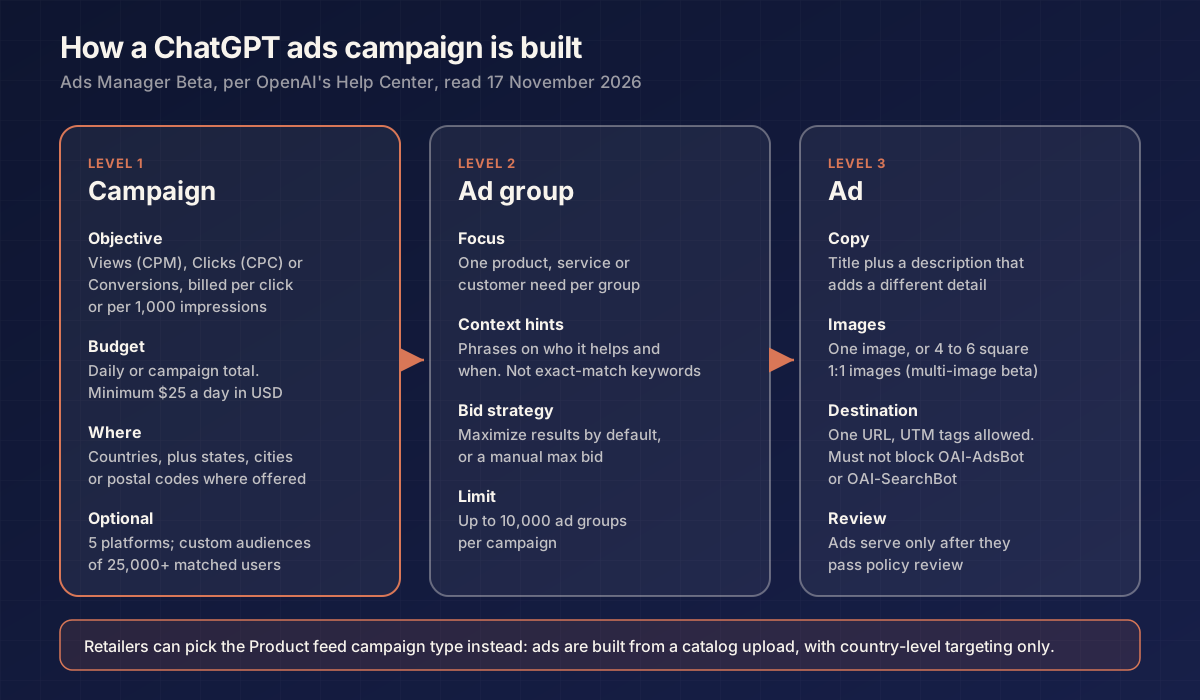
The self-serve setup takes six steps. A campaign is built in three levels.
1. Check that your country is supported
Open Ads Manager Availability. If your country is missing, you can still create an account, but it will not give you access until your country is added.
2. Create an account at ads.openai.com
Register the business, finish account verification and add a payment method. Ads do not serve while verification or billing is incomplete. Postpaid invoice accounts can also set a daily account spending limit.
3. Create a campaign
Pick the objective first, because it cannot be changed later; switching means a new campaign. Then set a daily or campaign-total budget, countries and optional platforms. To target only the US you have to include the US explicitly; excluding other countries is not enough.
On a first campaign, start and end dates may only appear after publishing. OpenAI warns against publishing just to reach those fields, because ads can go live as soon as they pass review.
4. Create ad groups with context hints
One ad group per product, service or customer need. OpenAI’s example is a plumber with separate groups for emergency repairs and preventive maintenance. Write context hints as full phrases about the buyer and the moment. Leave the bid strategy on Maximize results unless you need a hard cap, in which case use the manual max bid.
5. Create several ads per ad group
OpenAI’s guidance is “a high volume and diverse set of ads”, with each title and description variation taking a different angle. The specs are in the next section.
6. Set up conversion tracking and launch
Install the pixel or Conversions API before choosing the Conversions objective; it needs at least one standard conversion event, and custom events are not supported for optimization. Decide on creative enhancements (below), submit for review, then judge results on conversions, not spend pacing. OpenAI notes delivery and spend can fluctuate during the beta.
Retailers have a fourth campaign type to consider: product feeds. Upload a catalog as CSV or TXT, from a hosted URL or over SFTP, and Ads Manager builds product ads from it. Feed items expire after two weeks, so OpenAI recommends an automated hosted URL or SFTP upload. OpenAI says feed ads “have been among the strongest-performing ads in our program to date”. Feed products are used only for ads during the beta; they do not appear in organic ChatGPT answers.
What are the creative specs for ChatGPT ads?
OpenAI’s help articles describe formats and rules but publish no character limits or pixel sizes. Ads Manager shows the limits as you type.
| Spec | ChatGPT ads (verified 17 Nov 2026) |
|---|---|
| Ad parts | Title, description, image(s), destination URL |
| Title length | Not stated by OpenAI; it asks for “recommended character limits” shown in Ads Manager |
| Description length | Not stated by OpenAI |
| Single-image ad | 1 image |
| Multi-image ad | 4 to 6 square images, each 1:1 |
| Image pixel size and file type | Not stated by OpenAI |
| Call to action | ”Learn more” is the only CTA on multi-image ads |
| Destination | One URL per ad; every image in a multi-image ad links to it; UTM tags allowed |
| Landing page | Must be reachable and must not block the OAI-AdsBot or OAI-SearchBot user agents |
| Objectives supported | Reach, Clicks and Conversions for both image formats |
| Product-feed ads | Image, title, stars, price, sale price and brand pulled from the feed; card or carousel chosen by OpenAI |
| Video | Not one of Ads Manager’s ad formats (single or multiple images) as of November 2026 |
Third-party guides quote title limits anywhere from 24 to 50 characters. Those numbers do not appear in OpenAI’s help articles, so check the counter in Ads Manager before you brief anyone.
Creative enhancements are on by default. Since 30 October 2026, OpenAI can rewrite your headlines and descriptions to fit the conversation, translate them, resize images and change the destination URL to another page on your site. Variations run without your approval and there is no preview of each one (Creative enhancements for ChatGPT Ads). It applies to self-serve and BPO campaigns, not sales-managed accounts. You can switch it off per account or per campaign under Manage settings. Regulated advertisers, and anyone whose legal team signs off on every claim, should turn it off before launch.
How should you prepare creative for ChatGPT ads?
Write the ad as the useful next step after the answer above it. The person has just read a paragraph that answered their question, and your ad lands directly under it.
After 8 years of running Meta ads across 70+ brands, my instinct is to lead with a hook that stops the scroll. That instinct works against you here. Nobody is scrolling. They asked a question and got an answer. OpenAI’s own guidance points the same way: “benefit-focused copy” that says what the product does, who it is for and when it helps, “rather than relying on a catchy line”.
A worked example for a skincare brand selling a fragrance-free moisturizer:
| Part | Weak | Better |
|---|---|---|
| Context hint | moisturizer | fragrance-free daily moisturizer for adults with sensitive skin who react to scented products |
| Title | Glow like never before | Fragrance-free moisturizer for sensitive skin |
| Description | Shop our best-seller today | Ceramides and no added scent. Ships in 2 days, 30-day returns. |
| Landing page | Homepage | The product page the title describes |
The shipping and returns details above are placeholders. Use only what is true on your landing page: creative enhancements read that page, and OpenAI’s policies require ads to be consistent with their destination.
Five rules, built on OpenAI’s help articles:
- Write several variations per ad group, each with a different angle. Price, a use case, an ingredient, a comparison, a delivery promise. OpenAI says a diverse set of ads gives the system more conversations to match. I would start with five.
- Make the title informative. Name the product type and the buyer. Slogans give the matching system nothing to work with.
- Make the description add a fact the title lacks. Repeating the title wastes the line.
- Use plain product images. OpenAI asks for “clear visuals” that match the copy and warns against abstract or cluttered images. A clean product shot or the product in use beats a busy lifestyle collage.
- Never imitate ChatGPT. The ad policies ban creative that copies the look, function or voice of ChatGPT’s interface.
For the multi-image format you need 4 to 6 square images of one offer. If you sell physical products, Shhots AI’s image ad generator makes image ad variations from a product photo and exports them at 1:1; the Starter plan is $19 a month for 2,000 credits, up to 175 image generations. For writing the title and description variations, our comparison of AI ad copy generators covers the tools.
What can’t you advertise on ChatGPT?
OpenAI’s ad policies, last updated 10 September 2026, limit the early program mostly to consumer categories: household and consumer goods, local services, travel and entertainment, and digital products and education.
| Category | Status (policy v1.6, Sept 2026) |
|---|---|
| Household goods, local services, travel, digital products, education | Allowed |
| Financial services | US only, approved advertisers, case by case (credit cards, mortgages, insurance, brokerages and more); credit repair, debt settlement and bullion banned |
| Health services | US only, approved advertisers, case by case (dental, vision, supplements, urgent care and more) |
| Legal services | US only, licensed in the jurisdiction where the ad shows |
| Dating and adult content | Banned (lingerie and swimwear allowed in a standard retail context) |
| Alcohol over 0.5% ABV, tobacco, vaping | Banned |
| Gambling | Banned (casino hotel stays allowed when gambling is not the focus) |
| Cannabis, THC, psychedelics | Banned (THC-free CBD topicals may be allowed) |
| Political and social-issue ads | Banned |
| Individual job or housing listings | Banned |
Two more points for AI and software companies. Version 1.6 of the policy reserves OpenAI’s right to decline ads that conflict with its “business interests, or competitive position”. And on 12 September 2026, exchange4media, citing The Information, reported that OpenAI stopped approving ads for competing image- and audio-generation tools, with Adobe confirming the notice. Video-generation tools were still allowed at the time of that report. OpenAI has not published this rule by name.
Every ad and landing page is reviewed, mostly by automated systems with human escalation, and ads or pages the systems cannot evaluate are not eligible to run.
How do ChatGPT ads compare with Google, Meta and Copilot ads?
ChatGPT ads sit between search and social. The buyer asked a question, like search, but you cannot buy the question, and the ad shows after an answer has already been given.
| ChatGPT ads | Google Search ads | Meta ads | Microsoft Copilot ads | Perplexity | |
|---|---|---|---|---|---|
| Where the ad shows | One unit below a ChatGPT answer; test placement during image generation | Search results; Google also runs ads in AI Overviews and AI Mode | Facebook and Instagram feeds, Stories, Reels and other placements | Below Copilot’s answer | No ads |
| What triggers it | Conversation context plus context hints; personalization if on | Keywords you bid on | Audience targeting and Meta’s delivery system | The whole conversation in a session, per Microsoft | n/a |
| How you buy | Ads Manager (self-serve), agencies, tech partners, Shopify and HubSpot apps | Google Ads | Meta Ads Manager | Microsoft Advertising | n/a |
| Pricing | CPM, CPC, conversion-optimized (billed per click or impression), set by auction | Auction, mostly per click | Auction; the billing event depends on the objective | Microsoft Advertising auction | n/a |
| Minimum spend | $25 a day per campaign | No fixed minimum published; daily spend can reach 2x your average daily budget | Varies by objective, currency and bid strategy; Ads Manager shows the floor | Not stated for Copilot specifically | n/a |
| Creative | Title, description, 1 image or 4 to 6 square images; product feed cards | Text ads, Shopping, Performance Max assets | Image, video, carousel | Responsive search, product, multimedia and vertical ads | n/a |
| Audience data advertisers get | Aggregated reporting; no chats | Keyword and search term reports | Aggregated reporting by audience segment | Microsoft Advertising reporting | n/a |
| Status | Beta, 89 countries | Mature | Mature | Live since Oct 2024 rollout | Ads phased out |
Sources and dates: ChatGPT from OpenAI’s Help Center (17 Nov 2026). Google AI Overviews and AI Mode ads and Perplexity’s exit from Search Engine Land, 18 Feb 2026, which reports the Financial Times’ finding that Perplexity phased out its ads and has no plans to bring them back. Google budget cap from Google Ads Help. Meta budget floor from Meta Business Help Centre. Copilot ad types and conversation-level matching from Microsoft Advertising, 2 Oct 2024. Anthropic has said Claude will stay ad-free, per the same Search Engine Land report.
Which to use for what:
- Demand that already searches by keyword (emergency plumber, a product name): Google Search still gives you the query itself. ChatGPT gives you context hints.
- Products people discover by seeing them, like apparel, beauty or home goods: Meta is still where the creative volume and video live. ChatGPT’s Ads Manager has no video ad format.
- Considered purchases people research by asking questions, like software, travel, courses and higher-priced goods: ChatGPT is the new test. In AdClarity’s data, software and services for work made up 57 of the top 100 US advertisers and more than 69% of their spend.
If you run Meta at the same time, our guides to Meta ad sizes and safe zones and creative fatigue cover that side.
How are ChatGPT ads different from showing up in ChatGPT’s answers?
Paying for an ad does not get you into the answer. They are two separate systems.
The answer is organic. ChatGPT decides which brands and sources to mention or cite, and OpenAI says advertisers “have no ability to shape, rank, or alter” it. SE Ranking’s study shows how separate the two are: the advertiser’s own domain was cited in the answer above its ad in only 3.63% of placements, and the brand was mentioned in 4.44% (SE Ranking, 10 Aug 2026).
| ChatGPT ads | Organic visibility in ChatGPT | |
|---|---|---|
| Where | Below the answer, labeled Sponsored | Inside the answer, as mentions, citations and links |
| How you get it | Bid in Ads Manager | Be the source ChatGPT finds and trusts: crawlable pages, clear facts, third-party mentions |
| Cost | $25 a day minimum, auction prices | No media cost |
| Speed | Live after ad review | Weeks to months |
| Users reached | Free and Go only | Every plan, including Plus, Pro and Enterprise |
| Measurement | Ads Manager, pixel, Conversions API | AI referral traffic in analytics plus prompt tracking tools |
Two practical overlaps. Ads require your landing page to allow both OAI-AdsBot, which checks pages submitted as ads, and OAI-SearchBot, which OpenAI’s crawler docs say surfaces websites in ChatGPT search. Blocking OAI-SearchBot costs you both channels. And product feeds uploaded for ads stay out of organic answers during the beta, which is a separate route from OpenAI’s Agentic Commerce Protocol for checkout inside ChatGPT.
The other half of the plan is organic: our comparison of GEO tools covers how to track whether ChatGPT mentions your brand at all.
Should you test ChatGPT ads now?
Test if all three are true:
- Your product is in an allowed category and your company is in one of the 89 countries.
- People research it by asking questions before they buy.
- You can track conversions with a pixel or Conversions API, so you can compare cost per acquisition against search.
Wait if your category is restricted, if you have no conversion tracking, or if your monthly paid budget is too small to hold back $750 (30 days at the $25 minimum) for a test you will judge on conversions.
A sensible first test: one campaign, the Clicks objective, two or three ad groups for distinct use cases, five ads per group, creative enhancements off for the first two weeks so you can see which of your own variations work. OpenAI says delivery fluctuates during the beta, so give it enough budget to reach a few dozen conversions before you decide.
FAQ
Does ChatGPT have ads?
Yes. ChatGPT shows labeled sponsored ads below answers for logged-in adults on the Free and Go plans. Testing began in the US on 9 February 2026, and as of 21 October 2026 ads run in 89 countries. Plus, Pro, Business, Enterprise and Edu accounts do not see ads.
How much do ChatGPT ads cost?
ChatGPT ads have a $25 minimum daily budget per campaign in Ads Manager, verified November 2026. You pay per 1,000 impressions or per click, set by auction; there is no pay-per-conversion option. OpenAI publishes no CPM or CPC benchmarks. The invite-only launch test in February 2026 reportedly priced ads at a $60 CPM with about $200,000 minimum commitments.
How do I advertise on ChatGPT?
Sign up at ads.openai.com, check that your legal entity is in one of the 89 supported countries, verify the account, add billing, then create a campaign, ad groups with context hints, and ads. You can also buy through agencies such as Dentsu, Omnicom, Publicis and WPP, tech partners such as StackAdapt and Criteo, or the ChatGPT Ads app for Shopify in the US.
What do ChatGPT ads look like?
A ChatGPT ad is one unit below the answer with a “Sponsored” label, a title, a description, an image or 4 to 6 square images, and the advertiser’s link. Product-feed ads add price, sale price, stars and brand, as a single card or a carousel. A separate test shows multi-image ads while ChatGPT generates an image.
Do ChatGPT ads use my conversations?
Yes, to pick the ad, but not to share with advertisers. The current conversation always informs which ad you see. With ad personalization on, past chats and memory can too. OpenAI says advertisers never receive chats, memories, names, emails or precise location. You can turn off personalization in Settings > Ad Controls.
Can I turn off ads in ChatGPT?
Yes. Upgrade to Plus or Pro, or switch the Free plan to the Ads-Free option in Settings > Ads controls, which removes ads but lowers message limits and removes tools like image generation and deep research.
Is there a ChatGPT ads API?
Yes. OpenAI’s ads developer docs cover an Advertiser API for campaigns, ad groups, ads and reporting, a Bulk API, the Conversions API and measurement pixel, and product feeds, including delta feeds that update prices and availability without a full upload. Authentication uses bearer tokens. Hotel feeds are in limited beta.
Do ChatGPT ads affect ChatGPT’s answers?
No, according to OpenAI. Ads run on separate systems from the chat model, and advertisers cannot shape, rank or alter answers. In SE Ranking’s July 2026 study, the advertiser’s domain was cited in the answer above its own ad in only 3.63% of placements.
Can AI companies advertise on ChatGPT?
Some can. OpenAI’s policy reserves the right to decline ads that conflict with its competitive position, and in September 2026 trade press reported that OpenAI stopped approving ads for rival image- and audio-generation tools. Video-generation tools were still allowed at the time of that report.
Start with one ad group
Write five context hints for the single product your customers ask the most questions about, then five title and description pairs that each answer a different one of those questions. Put them in one Clicks campaign at the $25 daily minimum, with creative enhancements off, and read the conversions after two weeks.
More on AI Ads
All AI Ads posts- How to Use the Meta Ad Library to Research Competitor Ads The Meta Ad Library shows every active Facebook and Instagram ad, free. How to search it, read run dates and variants, use the API, and what 6 spy tools cost.
- Canva Alternatives for Ads 2026: 7 Tools, Verified Prices Canva alternatives for making ads in 2026: what Canva does for ads, where it stops, and 7 tools with prices read from each vendor page in October 2026, including free options.
- Topview AI Alternatives 2026: 8 Tools, Verified Prices Topview AI alternatives compared for 2026 with prices read from each vendor page in October 2026, plus what Topview itself costs and what reviewers say.