
Disclosure: Shhots AI is our product. Every price below was read on the vendor's own pricing page or help center on 17 November 2026. Character limits come from Google Ads Help, the Meta Ads Guide and TikTok Ads Manager help, read the same day. We did not run paid tests of the third-party tools; this is a researched comparison.
Most advertisers in 2026 need two AI ad copy generators: the one already inside the ad platform, and a general assistant for the thinking. Meta’s text generation and Google’s text customization write extra ad variants with no separate fee. ChatGPT Plus and Claude Pro cost $20 a month each and handle angles, hooks and rewrites. Pay for a dedicated tool only for something those can’t do: Anyword (from $39 a month billed yearly) for predicted performance scores, Jasper ($59 per seat a month billed yearly) for shared brand voices, AdCreative.ai (from $39 a month) for copy and image in one place.
Below: a comparison of 11 tools on price, free option, ad templates, platform limits, brand voice and languages; what Meta’s and Google’s own copy tools actually do; a reusable prompt for any LLM; the character limits for Meta, Google and TikTok; and the policy mistakes AI copy makes most often. All prices were read on 17 November 2026.
Which AI ad copy generator should you pick?
Start from where the ad runs and who writes it.
| If you need | Use | Price (verified November 2026) |
|---|---|---|
| More text variants on Meta ads you already run | Meta text generation in Ads Manager | No separate fee |
| More headlines and descriptions on Google Search ads | Google Ads text customization (AI Max for Search) | No separate fee |
| One assistant for angles, hooks, scripts and rewrites | Claude Pro or ChatGPT Plus | $20/month each; Claude Pro is $17/month billed yearly |
| A predicted score for each variant before you spend | Anyword | $49/month, or $39/month billed yearly |
| Shared brand voices and audiences for a team | Jasper Pro | $69/seat/month, or $59/seat billed yearly |
| Copy and a static ad image from the same tool | AdCreative.ai | From $39/month |
| Five seats on a small budget | Copy.ai Chat | $29/month, or $24/month billed yearly |
| To spend nothing | Rytr Free, ChatGPT Free, Claude Free | $0, with usage limits |
My default after 8 years of running Meta ads across 70+ brands: write the angles and hooks in a general LLM, where you control the brief, and let the platform’s own tool spin the extra variants it wants to test. A dedicated copy tool earns its fee when a team needs shared voice rules or a score to settle arguments.
How do the 11 AI ad copy tools compare?
| Tool | Entry price | Free option | Ad-specific features | Knows platform limits | Brand voice | Languages |
|---|---|---|---|---|---|---|
| Anyword | $39/month yearly, $49 monthly | 7-day trial, 2,500 words | Performance predictions on ad copy | Not stated | 1 voice on Starter | 30+ |
| Jasper | $59/seat/month yearly, $69 monthly | 7-day trial | ”Search Ad” template, social campaign templates | Not stated | 2 voices on Pro | 30+ |
| Copy.ai | $24/month yearly, $29 monthly, 5 seats | Ad copy and hook generator tools on its site | Headlines, body copy and CTA from the free tool | Not stated | Not stated | Not stated |
| AdCreative.ai | From $39/month | ”Try it free” trial | Ad text and headline generator next to image ads | Not stated | Brand limit per plan | Not stated |
| Hypotenuse AI | Custom pricing | Trial, length not stated | Facebook captions, Instagram captions, Google ads | Not stated | Ecommerce Enterprise plan only | 40+ |
| Rytr | $9/month Lite | Free: 10,000 characters a month | ”Ads” among 40+ use cases | Not stated | Writes in your voice | 30+ |
| ChatGPT | $20/month Plus | Free plan | None built in; you prompt it | Only if you put them in the prompt | Projects and custom GPTs on Plus | Multilingual |
| Claude | $20/month Pro, $17 billed yearly | Free plan (Sonnet and Haiku) | None built in; you prompt it | Only if you put them in the prompt | Projects (up to 5 on Free) | Multilingual |
| Gemini | Not verified in USD | Free plan | None built in; you prompt it | Only if you put them in the prompt | Not stated | Not stated |
| Meta text generation | No separate fee | Part of Ads Manager | Primary text variants from your own copy, past ads and Page | Writes into Meta’s own fields | Draws on your past ads and Page | Not stated |
| Google text customization | No separate fee | Part of AI Max for Search | Extra responsive search ad headlines and descriptions | Fills Google’s own fields | Draws on your site, ads and keywords | All Google Ads languages |
“Not stated” means the vendor’s pricing or product page did not say. None of the dedicated tools claimed on those pages to enforce Meta, Google or TikTok character limits for you, so check the counts yourself before you paste.
The dedicated ad copy tools, one by one
Anyword: the one that scores variants before you spend
Anyword’s draw is performance predictions: it scores copy against marketing data before the ad goes live, and its homepage says you can “predict performance of ads before you go live.” That is the feature a general LLM can’t copy, because ChatGPT has never seen your results.
Starter costs $49 a month, or $39 billed yearly, for 1 seat, 1 brand voice and unlimited words. Predictions are capped: the pricing table shows 50 a month on Starter with monthly billing and 100 with yearly. Data-Driven is $99 a month, or $79 billed yearly, with 3 seats. The 7-day trial stops at 2,500 words. Anyword lists 30+ languages.
Pick it when you produce enough variants that choosing between them is the bottleneck. Treat the score as a tiebreaker, and let real spend make the final call.
Jasper: brand voices for a team
Jasper Pro costs $69 per seat a month, or $59 billed yearly, with a 7-day trial. Pro includes 2 brand voices, 5 knowledge assets and 3 audiences. Business is custom priced with unlimited voices. Its template library includes a “Search Ad” template for search ad copy and social campaign templates, and the pricing page lists 30+ languages.
The value is consistency. When four people write ads for one brand, a stored voice and audience profile stop the copy drifting. For a solo founder, $59 a month buys little that a Claude project with your brand notes can’t do.
Copy.ai: cheap seats, and a pricing page now aimed at sales teams
For ad copy specifically, the useful Copy.ai page is its free ad copy generator, which writes headlines, body text and CTA lines, and a separate hook generator. Those are the closest thing to a no-cost dedicated ad tool in this list.
The paid side has moved. The Chat plan is $29 a month, or $24 billed yearly, and includes 5 seats with unlimited chat words and access to OpenAI, Anthropic and Gemini models. Every plan above it is a go-to-market platform starting at $1,000 a month (Growth, 75 seats). There are no ad templates on the pricing page.
For ad copy, the Chat plan is a cheap way to give a small team several models under one login.
AdCreative.ai: copy and creative from one place
AdCreative.ai makes static ad images, and its text generator writes “ad texts and headlines” for them using a range of copywriting frameworks. The pricing section on its homepage (the old /pricing URL returns a 404) lists Starter at $39 a month, Professional at $249 and Ultimate at $999. On 17 November 2026 it was also showing a Black Friday offer of 50% off quarterly and yearly plans. It lists a Compliance Checker AI feature among its plan features.
Pick it when the copy and the image need to come out together. For the full breakdown of its credits, see our AdCreative.ai pricing analysis.
Hypotenuse AI: ecommerce catalogs first
Hypotenuse prices both plans as custom. The Basic plan includes Facebook captions, Instagram captions and Google ads; brand voice training is only on Ecommerce Enterprise. It supports 40+ languages. It suits a store that already uses Hypotenuse for product descriptions and wants ad copy from the same product data.
Rytr: the cheapest paid plan
Rytr’s free plan gives 10,000 characters a month, and Lite at $9 a month removes the character cap. Ads are one of its 40+ writing use cases, with 30+ languages. Rytr now sells itself mainly as a relationship manager and follow-up assistant, so ad copy is a side feature. Fine for a one-off batch of headlines.
Which tools dropped out of AI ad copy?
Two names still appear in most “best ad copy tool” lists, and both have moved on:
- Writesonic now presents itself as an AI search visibility platform. Its pricing page lists AI search tracking, site audits and an AI article writer from $79 a month billed yearly, and does not list ad copy generation.
- Copysmith is now an umbrella for three products: Frase, Describely and Rytr. Describely writes product titles and descriptions at $0.75 per product for up to 500 products, and its pricing page does not mention ad copy.
If a comparison still ranks either as an ad copy generator, its research is out of date.
What do Meta’s and Google’s built-in AI copy tools do?
Both platforms now write ad copy inside the ad builder. They know their own fields, cost nothing extra, and learn from delivery data you can’t see. They also write from what you give them, so a weak original produces weak variants.
Meta text generation in Advantage+ creative
Meta’s text generation creates primary text variations “inspired by your original primary text, your previous ads, or content from your business Page,” per Meta’s Marketing API documentation. Its sample response shows five variations. Jon Loomer reports that AI-generated options now sit separately from the five primary texts you can enter by hand, so one ad can carry up to ten primary text options.
Two lines from Meta’s documentation matter more than the feature list. Advertisers “are responsible for previewing ad creative featuring AI-generated creatives before publishing,” and Meta “does not make any warranties regarding the completeness, reliability, and accuracy” of the suggested text. Read every variant before it runs.
Google Ads text customization (formerly automatically created assets)
Google renamed automatically created assets to text customization. It is a campaign-level setting available through AI Max for Search, and you must opt in to AI Max to use it, per Google Ads Help. It generates extra headlines and descriptions for responsive search ads from your domain, landing page, existing ads and ad group keywords.
The details worth knowing:
- Generated assets serve only when Google predicts they will beat the ones you wrote.
- Assets are reviewed and refreshed at least every 48 hours.
- It supports every language Google Ads supports.
- From September 2026, campaigns using text customization were automatically upgraded to AI Max.
Check the ad-level asset report for wording you would not have approved, especially prices and claims pulled from old landing page copy.
Can ChatGPT, Claude or Gemini write ad copy as well as a dedicated tool?
Yes, if you brief them properly. The dedicated tools mostly wrap the same kind of model in templates. Copy.ai’s Chat plan itself runs on OpenAI, Anthropic and Gemini models. What you lose with a general LLM is the template, the stored voice and any performance scoring. What you gain is full control of the brief and a lower price.
| Assistant | Free plan | Paid entry (verified November 2026) |
|---|---|---|
| ChatGPT | Yes, unlimited text chats subject to abuse guardrails | Plus at $20/month |
| Claude | Yes, Sonnet and Haiku with usage limits | Pro at $20/month, or $17/month billed yearly ($200 upfront); Max from $100/month |
| Gemini | Yes | Paid Google AI plans are priced by country; the USD price did not display when we checked, so it is left out |
Which Claude model is best for copywriting?
Anthropic doesn’t publish a copywriting benchmark, so go by what each model is built for. In Anthropic’s models overview, Claude Sonnet 5.5 is described as “the best combination of speed and intelligence,” and Claude Opus 5.5 is the suggested starting point for most work.
In practice:
- Short ad variants, hooks and rewrites: Sonnet. It is fast, and it is on the Claude Free plan.
- Angle research, full video scripts, a month of campaign copy from one brief: Opus, which needs the $20 Pro plan.
- Haiku is built for high-volume classification and extraction. Use it through the API to check thousands of lines against your rules, not to write them.
ChatGPT’s paid tiers follow the same pattern. Use the faster model for volume and the reasoning model for the strategy step.
A reusable ad copy prompt that works in any LLM
Most generic AI ad copy comes from a one-line prompt. This brief fixes that. Fill it in once per product, save it in a ChatGPT project or Claude project, and change only the platform block per request.
You are a direct-response copywriter writing paid social and search ads.

PRODUCT: [name, what it is, price, the one thing it does better than alternatives]
CUSTOMER: [who buys it, in their words, and the problem they are trying to solve]
PROOF I CAN USE: [only claims I can back: reviews, ratings, specs, guarantees with terms]
CLAIMS NOT ALLOWED: [anything legal or the ad platform would reject]
VOICE: [3 example sentences in our brand voice; 3 phrases we never use]
OFFER: [discount, bundle, free shipping threshold, deadline]

PLATFORM: Google responsive search ad
LIMITS: 15 headlines, max 30 characters each. 4 descriptions, max 90 characters each.
TASK: Write 15 headlines and 4 descriptions. At least 3 headlines name the product,
3 state the offer, 3 state a benefit, 3 answer an objection. Count characters
including spaces and show the count after each line. Rewrite any line over the limit.
Do not address the reader by a personal attribute (age, health, finances, religion,
ethnicity). Do not promise outcomes I haven't listed under PROOF.
Swap the platform block for Meta:
PLATFORM: Meta, Facebook Feed and Instagram Reels
LIMITS: Primary text 125 characters or less, with the hook inside the first 44.
Headline 27 characters or less.
TASK: Write 5 primary texts, each on a different angle (problem, outcome, objection,
social proof, offer), and 5 headlines. Show character counts.
Then use follow-ups instead of new chats, so the model keeps the brief:
- “Give me 10 more opening lines for angle 3, each under 44 characters.”
- “Rewrite the strongest two for a reader who has never heard of us.”
- “Which of these makes a claim that isn’t in PROOF? List them.”
- “Translate the top three into Spanish and German, keeping the character limits.”
Models miscount characters often. Paste the finals into the ad platform’s own field, which shows the count, or a spreadsheet with =LEN(). For 20 more prompts tied to image and video ads, see the AI ad prompt library.
What are the character limits for Meta, Google and TikTok ad copy?
Google’s limits are hard: the field rejects longer text. Meta’s and TikTok’s numbers are recommendations or display caps, and longer text runs but gets cut off behind “See more”. OpenAI publishes no character limits for ChatGPT ads, and its guidance asks for benefit-focused copy rather than a catchy hook.
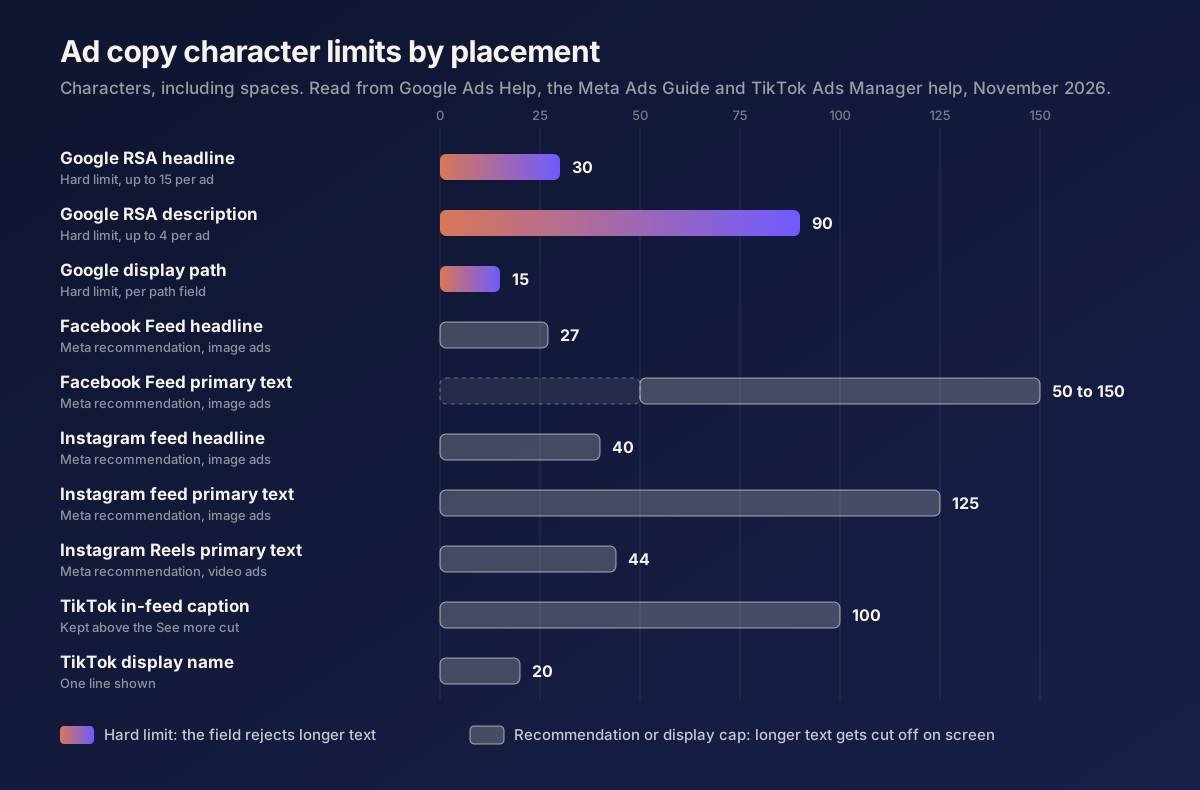
| Placement | Field | Limit | Type | Source |
|---|---|---|---|---|
| Google responsive search ad | Headline | 30 characters, 3 to 15 per ad | Hard limit | Google Ads Help |
| Google responsive search ad | Description | 90 characters, 2 to 4 per ad | Hard limit | Google Ads Help |
| Google responsive search ad | Display path | 15 characters per field | Hard limit | Google Ads Help |
| Facebook Feed, image ad | Primary text | 50 to 150 characters | Recommendation | Meta Ads Guide |
| Facebook Feed, image ad | Headline | 27 characters | Recommendation | Meta Ads Guide |
| Instagram feed, image ad | Primary text | 125 characters, up to 30 hashtags | Recommendation | Meta Ads Guide |
| Instagram feed, image ad | Headline | 40 characters | Recommendation | Meta Ads Guide |
| Instagram Reels, video ad | Primary text | 44 characters | Recommendation | Meta Ads Guide |
| TikTok in-feed | Ad caption | Within 100 characters (50 for Chinese, Japanese, Korean) to avoid “See more” | Display guidance | TikTok Ads Manager help |
| TikTok in-feed | Display name | One line, 20 characters (10 for Chinese, Japanese, Korean) | Display cap | TikTok Ads Manager help |
Three details that trip up AI-written copy:
- Double-width characters count twice. In Korean, Japanese and Chinese, every character counts as 2 in Google Ads, and TikTok counts them as 2 as well. A translated headline that fits in English can fail in Japanese.
- Pinning costs reach. Google says pinning a headline cuts the combinations it can test and “isn’t recommended for most advertisers.” Pin only what legal requires.
- Non-Spark TikTok captions can’t carry links, @ mentions or hashtags, per TikTok’s in-feed ad specs. Spark Ads use the organic post’s caption instead.
For image and video dimensions per placement, see Meta ad sizes and safe zones.
What makes Facebook ad copy convert in 2026?
Copy that converts on Meta now has to work in a 44-character Reels line and a 125-character feed preview at the same time. So the first line does the selling, and everything after it is for the people already interested.
The structure I keep coming back to:
- Hook in the first line. A specific problem or result the buyer recognizes, inside 44 characters.
- One claim you can prove. A rating with its source, a spec, a guarantee with its terms.
- The offer, with the price. Hiding the price wastes clicks from people who were never going to pay it.
- One call to action that matches the button.
A human Facebook ad copywriter still does the part AI can’t: reading reviews and support tickets for the customer’s exact words, and deciding which claims the brand can stand behind. Feed that research into the prompt above and the LLM writes the volume. Before you write, read what competitors are already running in the Meta Ad Library. When a winning ad’s results start dropping, the fix is usually new creative rather than new copy; see Meta ad creative fatigue.
Which ad policy mistakes does AI-generated ad copy make?
AI models write the way the internet writes ads, and a lot of that copy breaks platform policy. Check every batch against this list before it goes live.
- Naming the reader’s personal attributes (Meta). Meta prohibits ads that assert or imply personal attributes, including age, physical or mental health, vulnerable financial status, religion, ethnicity and sexual orientation. Its own policy examples: “Meet other seniors” is rejected, “Meet seniors” is allowed. A line like “Struggling with your weight?” implies a health attribute. Rewrite it to describe the product.
- Improbable results (Google). Google’s misrepresentation policy bans claims that entice users with “an improbable result (even if this result is possible).” Delete “in 7 days” promises unless you can document them.
- Hidden costs (Google). The same policy requires you to “clearly and conspicuously disclose the payment model or full expense that a user will bear.” Watch for “Try it free” on a trial that bills automatically.
- Gimmicky formatting (Google). The editorial policy rejects incorrect capitalization, gimmicky punctuation or spacing, unnecessary repetition and phone numbers in ad text. “FREE SHIPPING!!!” is the kind of line it catches.
- Health and weight loss (Meta). Under Meta’s health and wellness policy, weight loss and cosmetic ads must target people 18 or older, and ads can’t claim to cure, heal or eliminate incurable diseases.
- Claims from the wrong source. Both platforms’ AI tools pull text from your landing page and old ads. An expired discount on the page can turn up in a generated headline.
Where does ad copy meet the creative?
In my experience on Meta and TikTok, the words that carry the most weight are often spoken inside the video. The hook a creator says in the first two seconds is copy, and it needs the same testing as a headline.
Shhots AI is our product, so weigh this accordingly. In the AI UGC ad generator, you upload a product photo, pick a creator and a hook style, and Shhots writes the script, and you can edit the hook, the scene-by-scene script and the closing message before it renders a 10, 15 or 30-second video with voiceover and captions. It writes in 12 languages. The $19 Starter plan covers up to 3 UGC ads a month and the $49 Pro plan up to 10. If you only want the words, the UGC prompt generator turns a product into a UGC script, five hook options and a text-to-video prompt.
A cheap way to run this: write 10 hooks with the prompt above, then turn the best three into short UGC videos and let spend pick the winner. For the full cost picture of human and AI UGC, see how much a UGC video costs. For tools that make the image and video ads themselves, see the best AI ad generators.
FAQ
What is the best AI ad copy generator in 2026?
For most advertisers, the best AI ad copy generator is the platform’s own tool (Meta text generation or Google text customization, no separate fee) plus Claude Pro or ChatGPT Plus at $20 a month for briefs and hooks. Anyword, from $39 a month billed yearly, is the pick when you want a predicted performance score for each variant.
Is there a free AI ad copy generator?
Yes. Copy.ai has a free ad copy generator and hook generator on its site, Rytr’s free plan gives 10,000 characters a month, and ChatGPT and Claude both have free plans. Meta’s and Google’s built-in copy tools carry no separate fee beyond your ad spend.
Can Copy.ai write ad copy?
Yes. Copy.ai’s free ad copy generator writes headlines, body text and calls to action, and its Chat plan ($29 a month, or $24 billed yearly, for 5 seats) gives access to OpenAI, Anthropic and Gemini models for longer ad briefs. Its higher plans are go-to-market platforms starting at $1,000 a month.
Which Claude model is best for copywriting?
Use Claude Sonnet 5.5 for short ad copy, hooks and rewrites; Anthropic describes it as the best combination of speed and intelligence, and it is on the free plan. Use Claude Opus 5.5 on the $20 Pro plan for longer work like angle research and full video scripts.
Does Google Ads have an AI ad copy generator?
Yes. Google Ads text customization, formerly called automatically created assets, generates extra headlines and descriptions for responsive search ads from your landing page, existing ads and keywords. It runs through AI Max for Search, which you must opt in to, and supports every Google Ads language.
Does Meta write ad copy for you?
Yes. Meta’s text generation in Ads Manager creates primary text variations from your original text, your previous ads and your Page. Meta says advertisers are responsible for previewing AI-generated text before ads publish and does not guarantee its accuracy.
What are the character limits for Google responsive search ads?
Google responsive search ad headlines are limited to 30 characters and descriptions to 90 characters, with 3 to 15 headlines and 2 to 4 descriptions per ad. Each display path field allows 15 characters, and Korean, Japanese and Chinese characters count as 2.
Is AI-generated ad copy allowed on Facebook and Google?
Yes. Both platforms review AI-written ad copy under the same policies as human-written copy, and both offer their own AI text tools. The common rejections come from content, such as naming a personal attribute on Meta or promising an improbable result on Google.
Write your next 10 hooks
Copy the prompt above into Claude or ChatGPT, fill in your product, proof and limits, and ask for 10 hooks under 44 characters. Then take the best three into the AI UGC ad generator and test them as 10-second videos.
More on AI Ads
All AI Ads posts- Zeely Review 2026: Pricing, Complaints and 7 Alternatives An independent Zeely review for 2026: current pricing, refund and cancellation terms, what Trustpilot and app store reviewers say, and 7 alternatives with prices read in October 2026.
- Canva Alternatives for Ads 2026: 7 Tools, Verified Prices Canva alternatives for making ads in 2026: what Canva does for ads, where it stops, and 7 tools with prices read from each vendor page in October 2026, including free options.
- Topview AI Alternatives 2026: 8 Tools, Verified Prices Topview AI alternatives compared for 2026 with prices read from each vendor page in October 2026, plus what Topview itself costs and what reviewers say.